

Onion ABA
The year is approximately 2036. BreakingNewsABA is reporting on the current status of the field of behavior analysis, including the latest in research, practice, and policy. Please do not take this seriously. This piece is SATIRE.
Research
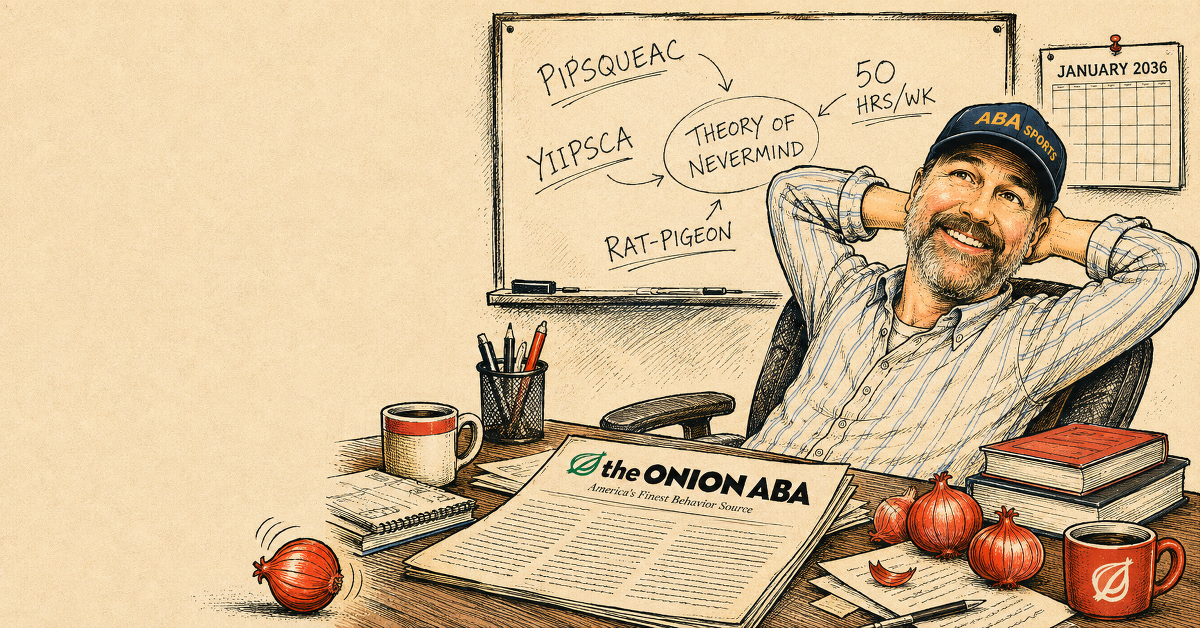
Over a decade after publishing “A Verbal Behavior Analysis of Theory of Mind”, Francesca degli Espinosa published a new paper in Perspectives on Behavior Science titled “A Theory of Nevermind”, which contradicts her earlier research. Timothy Hackenberg (Espinosa’s sidekick) promised a subsequent experimental analysis using his new rat-pigeon hybrid. Hackenberg insists, “The rat-pigeons are excellent at Nevermind. We’ve recorded very long durations where they don’t mind me, and I don’t mind them. We ignore each other and the rat-pigeons get it!” The rat-pigeons have no comment. When asked why the reversal on her theory, Espinosa states, “I changed my mind.” Espinosa is building off her recent successful children’s book Do You Mind? and her memoir Out of My Mind, available on Amazon.
Derek Reed, David Cox, and Jacob Sosine have announced an upcoming publication in the Journal of Applied Behavioral Analysis of Artificial Intelligence (JABAAI; Dan Hutt, ed.) titled Artificial Intelligence and the Matching Law, Part 11. Promising to be the last matching law and AI article, Reed, Cox, and Sosine found that AI matching law uses were undermatched when AI used matching law on another AI’s matching law data. The research crew confirms only one parameter from generalized matching law applies to AI. “It’s all sensitivity, no bias”, says Cox. Meanwhile, Reed and Sosine have publicly clashed over whether to call it the “ungeneralized matching law” or the “discriminated matching law” since the AI version now has fewer variables. While Reed insists “ungeneralized and discriminated are the same thing”, Sosine is adamant that he can tell the difference.
Gregory Hanley announced a new functional assessment after teaming up with Scott O’Donnell to help athletes with performance problems. Building on the success of the IISCA (Interview Informed Synthesized Contingency Analysis), the YIIPSCA (Yip Informed Interview Probe Survey for Competing Athletes) is gaining popularity. Critics report challenges when replicating it and question its generality because the intervention only works with the omnibus mand approach, “my way or the highway.” Hanley’s most recent functional assessment is the PIPSQUEAC (People Interviewing People Questioning Until Everyone Acts Crazy) that identifies the function of problem behaviors related to being small in stature. Hanley commented, “The real beauty of these functional assessments comes out when the client doesn’t have a behavior problem – it creates one!” Hanley predicts the new functional assessments will keep behavior analysts working well into the next millennium.
The Society for the Expansion of Behavior Analysis (SEBA) is celebrating its 10th anniversary. All members will receive free access to all three Continuing Education (CE) seminars on SEBA’s website (sebaimpact.org), a sticker that reads “I like Ike”, and a lollipop (pineapple flavor only). SEBA also announced they have reached triple digits in downloads of their podcast, The Evolving Behavior Analyst, now in its 10th season with almost 7 episodes. SEBA is also announcing a conference with keynote speaker Suzanne Bell’s presentation, “Behavior Science in Outer Space” about the use of behavior analysis on the Mars missions, Ben Fisher’s presentation, “Behavior Science in Inner Space” about the use of mindfulness in behavior analysis, and Taylor Swift’s presentation “Behavior Science in Blank Space” which was an experimental analysis measuring typing speed after the removal of the space bar on the keyboard. Those early adopters, AKA “Swifties”, claim no space is faster.
Brian Mentelisome published a new article in Neuroscience with the latest breakthrough in measuring brain and behavior. Mentelisome reports that fMRI indicates increased activity in the parts of the brain involved in speaking and memory when someone is telling a story. When asked why he needed the fMRI to tell him someone was telling a story, Mentelisome stated, “The brain is a mysterious black box with a completely different set of rules. Using fMRI is the only way we’ll be able to understand why people do what they do. The results are obvious: we behave because our brains tell us to!”
Practice
Kristyn Peterson, Mariah Padilla, and Mary Lewis are collaborating on a new effort to bring Organizational Behavior Management (OBM) professionals into the Autism Industry after the three had individually been successful in transitioning BCBAs from autism into OBM. Their new program uses AI to lie on your resume and make all your consulting gigs look as though you were doing in-home and clinic work with autistic children. Peterson has released a statement on behalf of their new company, OWW2G (OOPS! We Were Too Good), “We never thought we would get here. We just tried to be as effective as possible in helping BCBA’s working in Autism find new roles in OBM. We did not expect or predict that there would be no more BCBA’s to work with Autistics. We were too good.”
The Behavior Analyst Certification Board (BACB) announces a new ethics code, task lists, pathways, and license requirements. The requirements are lower than they were previously, and Jim Carr commented, “We are using our science to help clinicians through the certification process by instituting variable ratios and variable intervals for earning hours”. This is the 39th time the BACB has changed its pathways to certification. Carr also reports that all elementary schools will now be required to teach the 40-hour RBT training course. Carr states, “this way, we’ll be able to hire RBT’s before they reach high school!” When asked if he is concerned about staffing with inexperienced teenage therapists, the BACB has long stood by their claim, repeated by Carr, “this is the only way to have enough practitioners to serve the autistic population”.
Policy
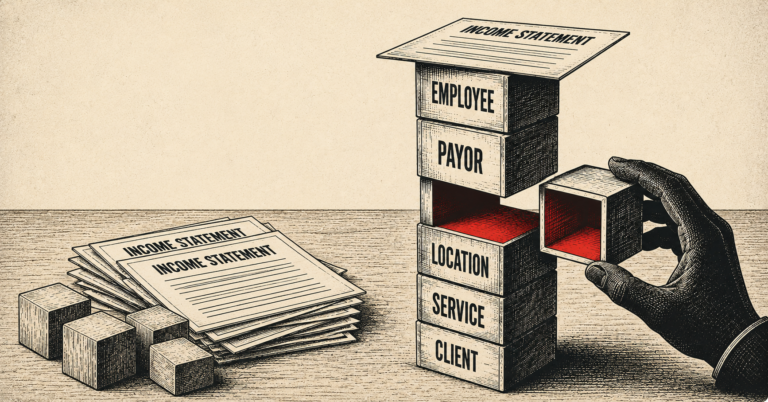
XYZ Autism Treatment Centers has a new 168-hour-per-week mandate. Their CEO, millionaire Chuck Barnes, states, “Due to the current economic climate, we cannot take any clients unless they are willing to do 168 hours.” When Barnes was asked about the content of the programming and the clinical rationalization, he stated: “Clients will not only be enrolled in ABA therapy, but also earning hours towards BCBA certification.” Barnes reports their ‘client-to-clinician-to-client’ model works because clients are paid the money it costs them to be in the program, creating a never-ending loop of funding. Barnes claims, “I’ve created perpetual funding! It never runs out!” Relatedly, XYZ Autism Treatment Centers is currently in Chapter 11 bankruptcy and under investigation for insurance fraud.
Pennsylvania is the newest state to pass ABA4All, a new bill that limits the number of behavior analysts working in the autism industry. “We all need ABA. But there’s not enough practitioners to spread around. We can’t have them all serving a small portion of the population when the rest of us need them too”, said Governor Cherrelle Parker (D-Pennsylvania). One group (Autism Moms) opposes the bill while another group (Advocates with Autism) supports it. Parker promises the bill will free up behavior analysts to deal with society’s pressing problems, such as crime, overpopulation, war, education, pollution, waste, and over-consumption. Parker promised, “we’ll finally start making progress on these problems now that we have the right people solving them.”