


Should Leaders Hold Their People Accountable? Yes. Absolutely.
Now that we’ve gotten that out of the way for some of you who came in here ready to lambaste me, let’s get to the true crux of the matter.
The question isn’t whether leaders should hold people accountable. Of course they should. Organizations cannot function without expectations, feedback, follow-through, and consequences. The better question is whether leaders have created the conditions necessary for people to succeed and whether they’re willing to examine their own behavior when performance falls short.
The world has been littered with people who held positional authority and were perfectly willing to hold others accountable while divorcing themselves from any accountability for the performance of those they led. When people struggled, their answer was to push harder, repeat the directive, increase the pressure, or threaten a consequence. If performance still didn’t improve, they blamed the performer for lacking motivation, commitment, professionalism, resilience, or whatever other label kept the focus safely away from the leader. History has also given us dictators who produced order and compliance through coercion, intimidation, and fear. They controlled behavior, sometimes on a massive scale. But we wouldn’t confuse that control with leadership simply because people complied or certain outcomes were achieved. Getting people to do what they’re told when the cost of refusal is high proves that coercion can work. It doesn’t prove that leadership occurred.
That may be an extreme example, but the behavioral process exists on a continuum. A leader doesn’t have to be a dictator to create an environment in which people perform primarily to avoid criticism, embarrassment, a bad evaluation, lost opportunities, or becoming the next target. Positional authority can produce compliance. It just doesn’t necessarily produce commitment, trust, learning, creativity, or discretionary effort. People working under fear may do what is required while the leader is watching. They may also hide mistakes, avoid difficult conversations, manipulate data, blame coworkers, stop offering ideas, and do the minimum necessary to stay out of trouble. Some leave. Others remain physically present while mentally and emotionally checking out. They adapt, all right. They adapt to surviving the leader.
Adaptive Intelligence
Adaptive Intelligence (Gavoni & Ventura, 2026) is grounded in evolutionary and behavior science. Living organisms survive and thrive by adapting to the environments in which they operate. Human behavior is influenced by our biology, our learning history, and the current environment surrounding us. As leaders, we cannot change someone’s DNA, and we cannot go back and rewrite everything they’ve previously experienced. But we can influence the current environment, and leaders are often among the most important variables within that environment.
Leaders don’t merely exist in the environment of others. They help arrange it. They influence what gets noticed, ignored, reinforced, corrected, measured, and discussed. Their behavior can make asking for help easier or more dangerous. It can make initiative worthwhile or risky. It can make honest feedback useful or career-limiting. That gives leaders tremendous influence, but it also gives them responsibility.
Adaptive Intelligence is an evolution of emotional intelligence. Emotional intelligence helps us recognize emotions, regulate our reactions, understand what other people may be experiencing, and navigate relationships. Adaptive Intelligence requires us to take the next step by examining the relationship between behavior and environment, recognizing the impact we’re having, and adapting our behavior so others can adapt more effectively. Values are central to that process. Adaptively intelligent leaders understand their own values. They know the kind of leader they want to be and the qualities they want their behavior to represent, especially when things become difficult. It is easy to say you value respect, honesty, growth, service, or accountability when everyone is performing well. The real test comes when you’re frustrated, under pressure, or disappointed.
Those thoughts, emotions, memories, and urges are what behavior scientists refer to as private events. Other people may not be able to observe them directly, but they still influence what we do. A leader may feel angry, threatened, embarrassed, or defensive. They may have the thought, ‘These people don’t care,’ or, ‘I shouldn’t have to keep explaining this.’ Adaptive Intelligence doesn’t require leaders to pretend those private events aren’t happening. It requires them to notice what is happening internally without automatically allowing it to drive their next move. The leader can pause, reconnect with their values, examine the available evidence, and choose behavior that is more likely to produce the impact they want.
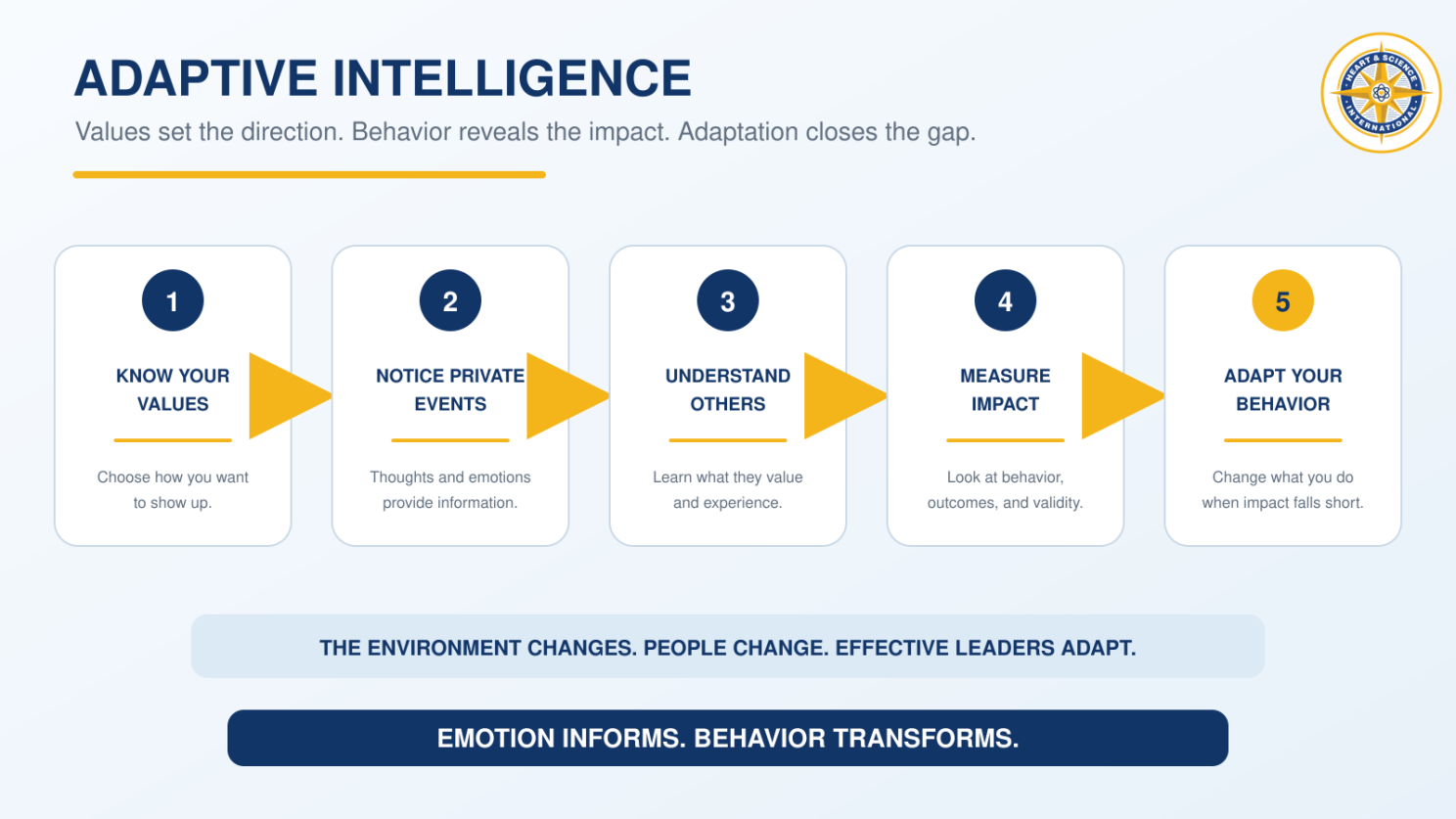
Values are ongoing directions, not destinations we complete and check off a list. A leader may value respect, courage, service, growth, or honesty. Valued outcomes are the measurable results that matter to people and the organization. Values help determine how we travel; valued outcomes help clarify where the effort is supposed to lead. The best leaders don’t simply know their values. They define behaviors and use measures that help them determine whether they’re moving toward them. If I say I value honesty, but people are afraid to bring me bad news, my intentions don’t settle the question. If I say I value growth but embarrass people when they make mistakes, the environment I’ve created is teaching something very different. It isn’t about intent. It’s about impact.
Adaptively intelligent leaders also work to understand what other people value. That doesn’t mean manipulating people or pretending everyone values the same things. It means learning what makes the work meaningful to them and helping them connect their behavior to outcomes that matter. People are more likely to allocate time, attention, energy, and effort toward outcomes they value.
Ultimately, people want to feel valued and produce valued outcomes.
That is where leadership and system design should begin. What are the valued outcomes we’re trying to produce? What valued behaviors will move us toward those outcomes? How will we know whether those behaviors are occurring? And how will we know whether the people doing the work actually feel valued throughout the process? Those questions belong at the front end of system development, not as an afterthought once morale or retention falls apart.
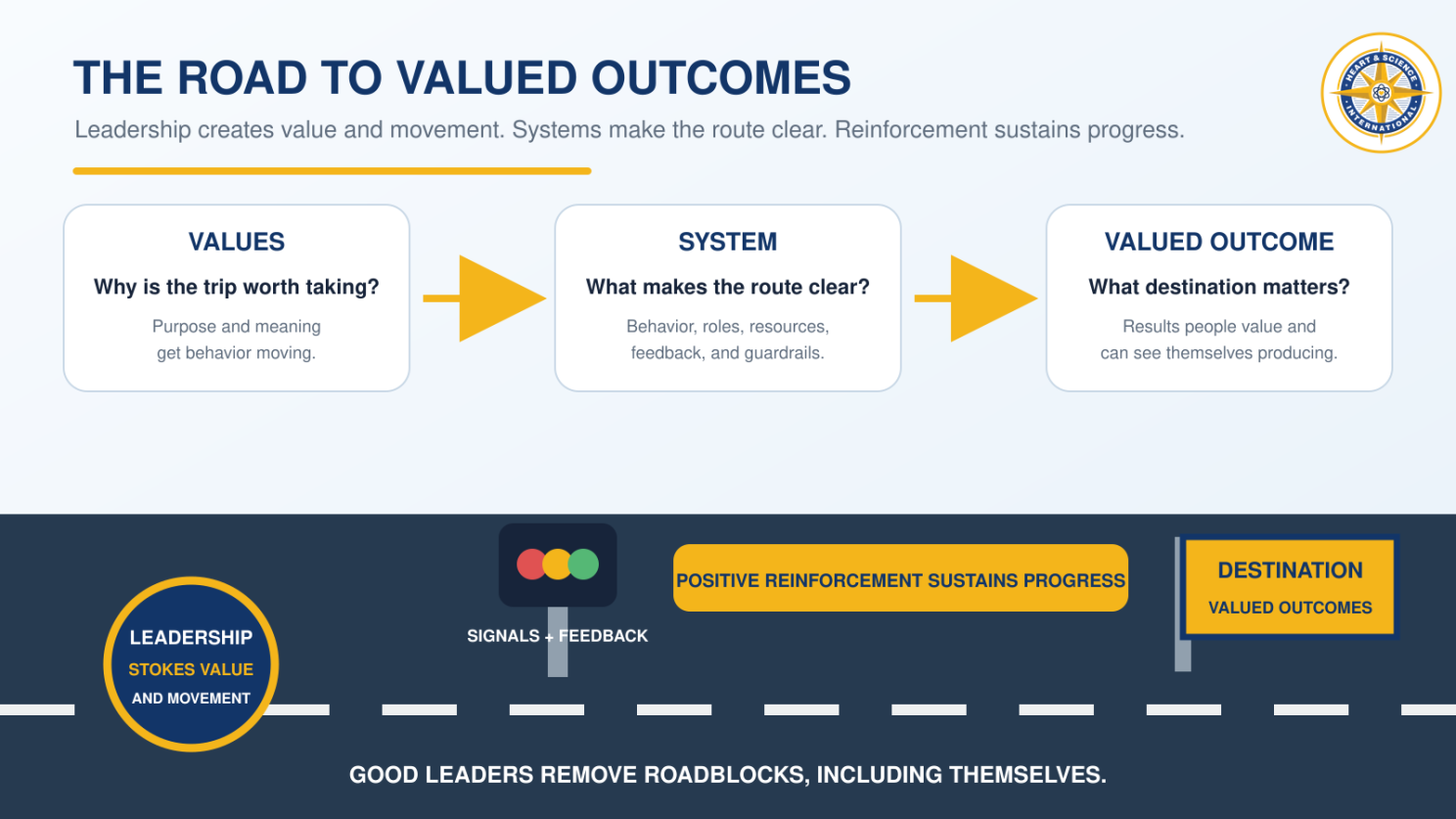
This is where the Performance Alignment Map comes in. I often explain it using the example of driving somewhere. Before you get into an automobile, you need a destination and a reason to go there. Why would you allocate your behavioral resources toward reaching a place that has no value to you? The more value the destination holds, the more likely you are to begin moving toward it and persist when the trip becomes inconvenient. That’s part of the Leading Hat. Good leaders help stoke that fire. They connect the destination to something people value and help them understand why the outcome deserves their effort. A slogan on the wall isn’t going to do that by itself.
But purpose and motivation are not enough. You can care deeply about reaching a destination and still get lost if there’s no map, the road signs contradict one another, the lane markings have disappeared, and every person you ask gives you different directions. That’s where the system guides behavior.
The rules of the road, lane markings, speed limits, directional signs, red lights, yellow lights, green lights, guardrails, mile markers, and GPS feedback all make it more likely that we’ll reach the destination effectively, efficiently, and safely. A red light signals us to stop. A green light signals that movement can continue. Lane markings clarify where our behavior should occur. Road signs prompt us before a decision needs to be made. Guardrails reduce the likelihood that one mistake becomes catastrophic. GPS feedback tells us whether we’re still on course and gives us a chance to adjust before we end up fifty miles in the wrong direction.
That is what a good performance system does. It clarifies the destination, defines the behaviors required to reach it, identifies who is responsible for each part of the journey, provides feedback about progress, and establishes the supports and consequences needed to keep performance moving in the right direction.
The Performance Alignment Map helps leaders build that route. We begin with valued outcomes and work backward to identify the behaviors required to produce them. Then we examine how those behaviors connect across roles and levels of the organization. We identify what people need in the way of resources, training, coaching, feedback, measurement, and reinforcement so the entire chain of performance leads toward the intended destination.
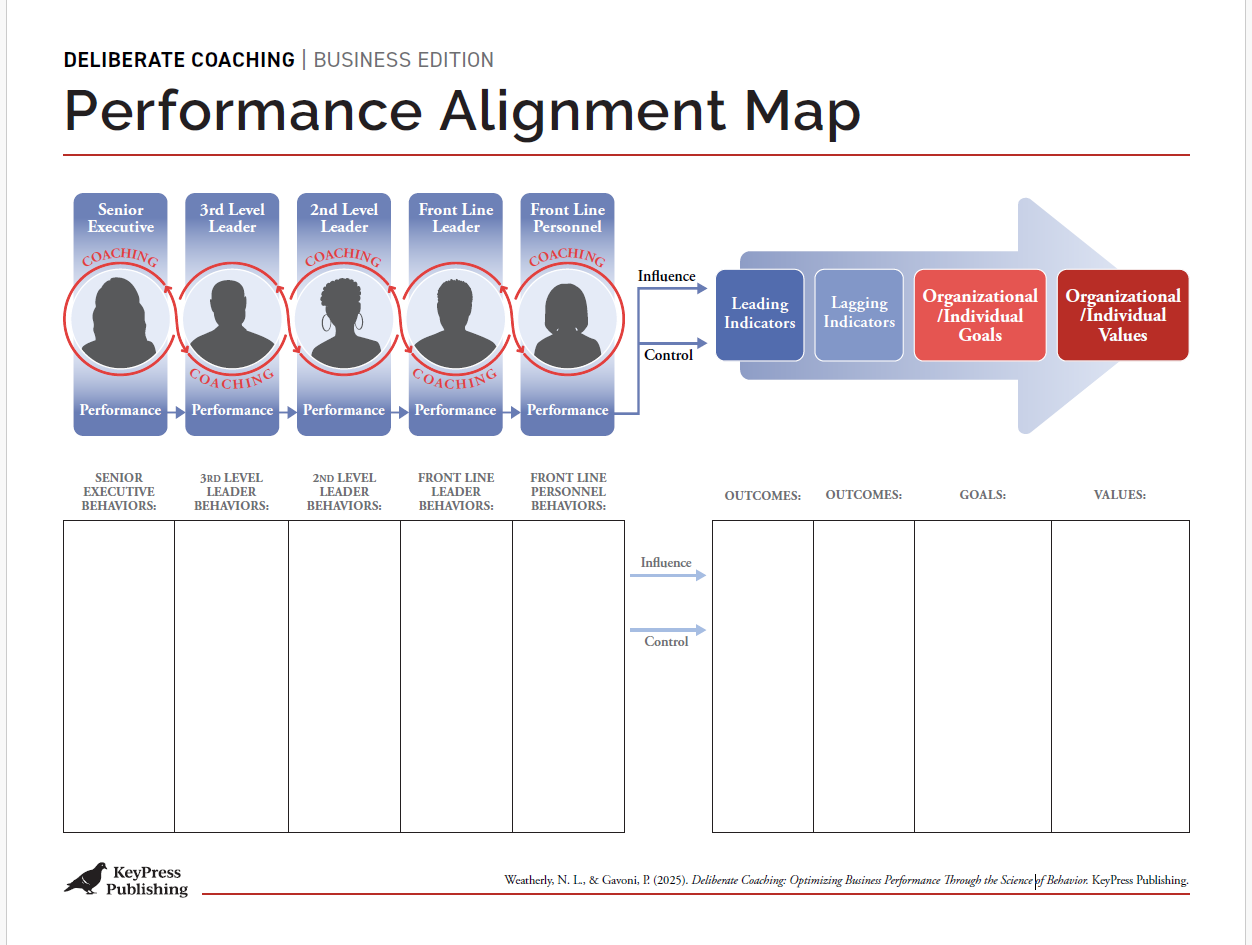
All results require behavior. If we cannot identify and connect the behaviors required to reach a valued outcome, we aren’t ready to hold someone accountable for producing it.
Leaders also need to remove obstacles from the road. Sometimes the obstacle is a lack of resources. Sometimes it is conflicting priorities, unclear authority, unnecessary paperwork, inadequate training, or a process that makes the right behavior harder than the wrong behavior. Sometimes the leader is the obstacle.
A leader may say they value initiative and then punish anyone who acts without approval. They may say they value honesty and then become defensive when someone brings them bad news. They may say they value people while making decisions without asking how those decisions affect the people responsible for carrying them out. An adaptively intelligent leader is willing to recognize when they’ve become a roadblock and change their own behavior. They become a guide rather than another hazard people have to navigate around.
This is where systems and leadership work together but serve somewhat different purposes. Good systems guide and maintain behavior. Good leadership helps get behavior up and running, connects it to values, and helps people come into contact with positive reinforcement.
Positive reinforcement is another concept that gets mangled in leadership conversations. It doesn’t simply mean praise, pizza parties, gift cards, or being nice to people. Positive reinforcement occurs when something follows a behavior and makes that behavior more likely to happen again. The effect on future behavior tells us whether something was actually reinforcing.
Something intended as a reward may not function as reinforcement at all. A leader may praise someone every day, but if the behavior doesn’t increase or maintain, the praise wasn’t reinforcing that behavior. Meanwhile, seeing students improve, solving a difficult problem, gaining competence, earning greater autonomy, receiving credible recognition, having an obstacle removed, or getting feedback that shows meaningful progress may all reinforce performance.
Feeling valued may also be reinforcing, but leaders can’t assume that it is because they told people they were appreciated. We have to look at impact. Are people more willing to contribute? Are they speaking honestly? Are they taking initiative? Are they remaining with the organization? Are they continuing to engage when the leader isn’t standing over them? A strong system should measure performance and impact: Are we producing valued outcomes, are the behaviors required to produce them occurring, and are we creating an environment in which people feel valued and want to continue contributing?
That is why social validity should be built into the system. We shouldn’t only measure whether the organization reached its goals. We should also measure whether people value those goals, whether they find the procedures acceptable, whether the outcomes are meaningful, and whether they feel valued while doing the work. A yearly climate survey may tell us how people felt after the damage was already done. That is more of an autopsy than a feedback system. Brief pulse checks, reciprocal feedback, direct conversations, retention patterns, requests for assistance, and observable discretionary effort can help leaders adapt while change is still possible.
Good outcomes alone don’t prove that good leadership is occurring. A leader may inherit or build a strong system with clear routines, established measures, and consistent follow-through. That system may produce impressive results even while the leader relies heavily on positional authority, pressure, and fear. If the numbers look good but people are exhausted, silent, afraid, or trying to escape, the system may be producing outcomes while leadership is failing.
Happy-Crappy Organizations
The opposite can happen too. I’ve seen people with positional authority who were excellent at wearing the Leading Hat. They built relationships, people liked them, staff felt safe, and everybody felt heard. But the organization was what I sometimes call happy-crappy. People felt good, but expectations were unclear, feedback was inconsistent, performance wasn’t measured, and outcomes were falling short.
Good relationships without adequate systems can produce comfort without performance. Strong systems without good leadership can produce compliance without commitment. We need both.
This is why I use the Four Hats of Leadership. Leaders need to know when to lead, train, coach, and manage. The Leading Hat establishes direction, trust, value, and the motivation to engage. The Training Hat develops behavior that isn’t yet in someone’s repertoire. The Coaching Hat strengthens, refines, and helps generalize behavior in the actual performance environment. The Managing Hat clarifies expectations, monitors performance, provides feedback, and helps maintain behavior over time.
Accountability largely belongs under the Managing Hat, but not every performance problem is a management problem. If someone doesn’t know how to perform the behavior, accountability won’t teach it. If they can demonstrate the skill during training but struggle to use it in the natural environment, they may need coaching. If the expected behavior is difficult, punishing, or rarely reinforced, the environment may need to change. If people don’t understand or value the destination, the leader may need to put on the Leading Hat.
Adaptive Intelligence helps the leader diagnose what the situation requires and change hats when the current approach isn’t working. A leader who only knows how to manage will treat every performance gap as an accountability problem. A leader who only knows how to lead may create a positive climate without enough structure to produce reliable outcomes. When strong systems, Adaptive Intelligence, and all Four Hats (Gavoni, 2024) come together, leaders can build trust, develop skills, coach application, maintain performance, connect work to values, and help people contact positive reinforcement.
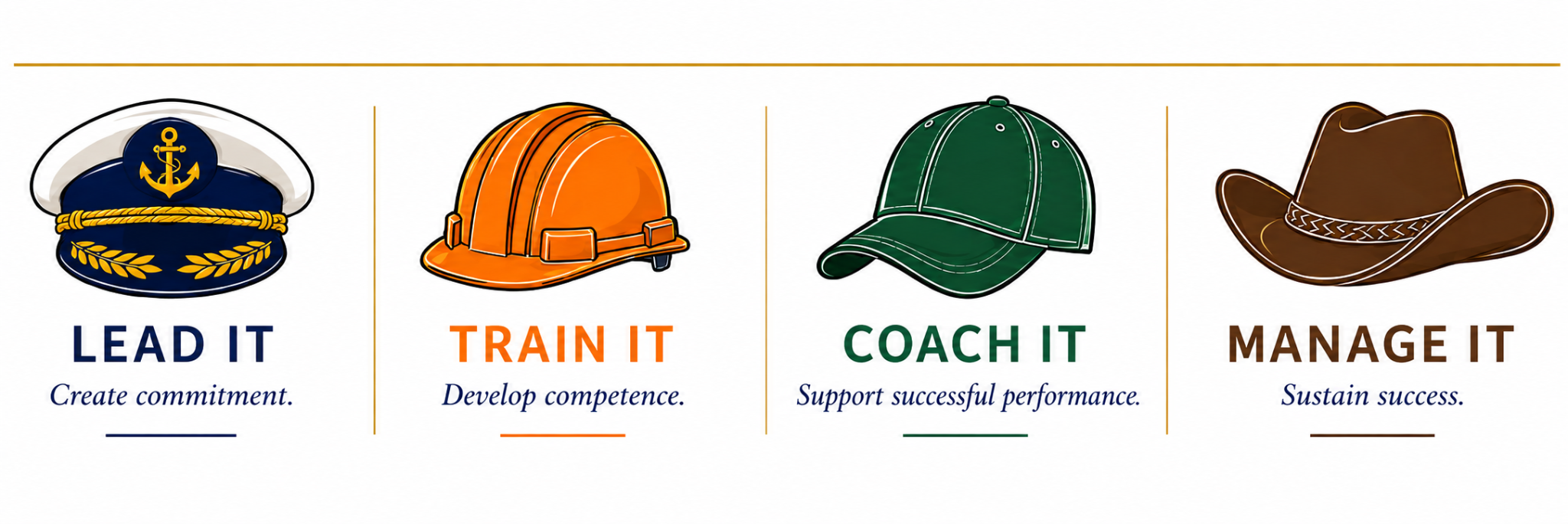
The Four Hats of Leadership
When performance falls short, the next step isn’t automatically accountability. The next step is diagnosis. The Performance Alignment Map helps design the route. Performance diagnostics help determine why movement has stalled. Is the behavior clearly defined and trained? Can the person perform it under actual working conditions? Are the necessary tools available? Is there useful feedback? Does good performance produce anything the person values? Is competing behavior easier, faster, safer, or more reinforcing? Has the leader unintentionally become part of the problem?
Those questions don’t excuse poor performance. They make accountability more accurate. If the destination is clear, the route is workable, the person has the necessary skills and resources, meaningful obstacles have been addressed, feedback has been provided, reinforcement is available, and the person still chooses not to follow through, then yes, hold them accountable. But when those conditions are missing, holding the performer accountable may simply allow the leader to avoid accountability for a poorly arranged environment.
The performer owns their behavior. The leader owns a significant part of the environment in which that behavior occurs. This applies whether we’re talking about a teacher leading students, a principal leading teachers, a district leader supporting principals, or an executive leading an organization. The higher someone moves up the organizational chart, the more their behavior influences the conditions experienced by people below them.
Who Should Be Held Accountable First?
So, should leaders hold their people accountable? Sure. But the first person you need to hold accountable as a leader is yourself. You need to be accountable for knowing your values, noticing when your private events begin pulling your behavior away from those values, and adapting based on your actual impact. You need to be accountable for understanding what others value, clarifying the destination, designing the system, removing obstacles, measuring whether people feel valued, and wearing the leadership hat the situation requires.
Because the measure of your leadership can ultimately be found in the behavior of your followers. Not simply in whether they comply while you’re watching, but in whether they continue performing, solving problems, speaking honestly, supporting others, and going beyond the minimum after you leave the room.
It’s about impact, not intent. And that impact begins with you.





Join the discussion ▾