Fundraising Built on an Alternative to ABA
MCLEAN, VIRGINIA — Positive Development, a company that treats autistic children without applied behavior analysis, raised $51.5 million in Series C funding in 2025 and told investors its model runs at roughly half the cost of a typical ABA program. In January 2026 it added a $45 million growth facility. This is not a fringe experiment. Positive Development says it is already the largest provider of its kind, operating in 23 service areas across eight states as of mid-2025, and it is spending the money to chase the contracts incumbent ABA providers depend on: commercial and state Medicaid payers.
The company’s clinical model, which it calls developmental relationship-based intervention, or DRBI, blends speech, occupational and mental health therapy and runs at far lower weekly hours than the 30- to 40-hour ABA plans that dominate the market. The pitch to payers is direct: comparable outcomes at lower intensity, for less money.
The Series C was co-led by aMoon, a new backer, with existing investors B Capital and Flare Capital Partners and additional participation from Digitalis Ventures and Healthworx. Positive Development says it has now raised more than $100 million in total.
A New Class of Competitor, Funded to Scale
Positive Development is the best-capitalized name in a widening field. In January 2026, virtual provider AnswersNow closed a $40 million Series B led by HealthQuest Capital to scale what it markets as “ABA 2.0,” care delivered online by master’s- and doctoral-level BCBAs. AnswersNow says it reaches clinical outcomes in about one-sixth the hours of traditional therapy, roughly five hours a week against the usual 30-plus, and that it can cut payer costs by as much as 75%.
The challengers come in two forms. One, like Positive Development, abandons ABA outright for a developmental model. The other, like AnswersNow, keeps ABA but strips out the hours and the real estate, shifting care onto screens and into homes and tying its appeal to lower utilization. Both aim at the same vulnerability: an incumbent model built on high weekly hours delivered largely by registered behavior technicians in brick-and-mortar centers.
Increasingly, the argument that the old model is broken comes from the people raising money to replace it. A widely circulated May 2026 MedCity News column, “Autism Therapy Is in Dire Need of a New Business Model,” was written by Jeff Beck, founder and CEO of AnswersNow, who argues, “A new breed of outcomes-based providers practicing ABA 2.0 is how we as an industry find our way back to the moral and clinical high ground.” The framing doubles as a sales pitch.
Why Payers Are Suddenly Listening
The pitch is landing because of what is happening on the payers’ books. Medicaid spending on core ABA services rose exponentially from 2019 to 2024. A Trilliant Health analysis found ABA visits up 267% over the same period.
Payers have begun to say so in public. On Centene’s second-quarter 2025 earnings call, CEO Sarah London identified behavioral health as the single largest driver of a spike in the insurer’s Medicaid health benefits ratio, which climbed to what she called an “unacceptable” 94.9%, and pointed to ABA as the most significant contributor.
States are moving too. New York phased in a 25% cut to its Medicaid rate for technician-delivered ABA, with the second reduction taking effect in April 2026. An industry survey found that 74% of the state’s Medicaid ABA providers said they would exit the program if it did. North Carolina, where ABA payments are projected to climb from $122 million in fiscal 2022 to $639 million in fiscal 2026, has moved to contain costs, and Nebraska and Indiana have imposed rate cuts or hour caps.
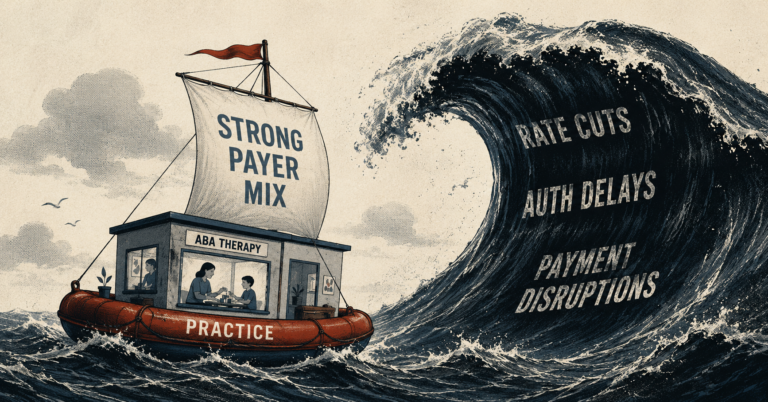
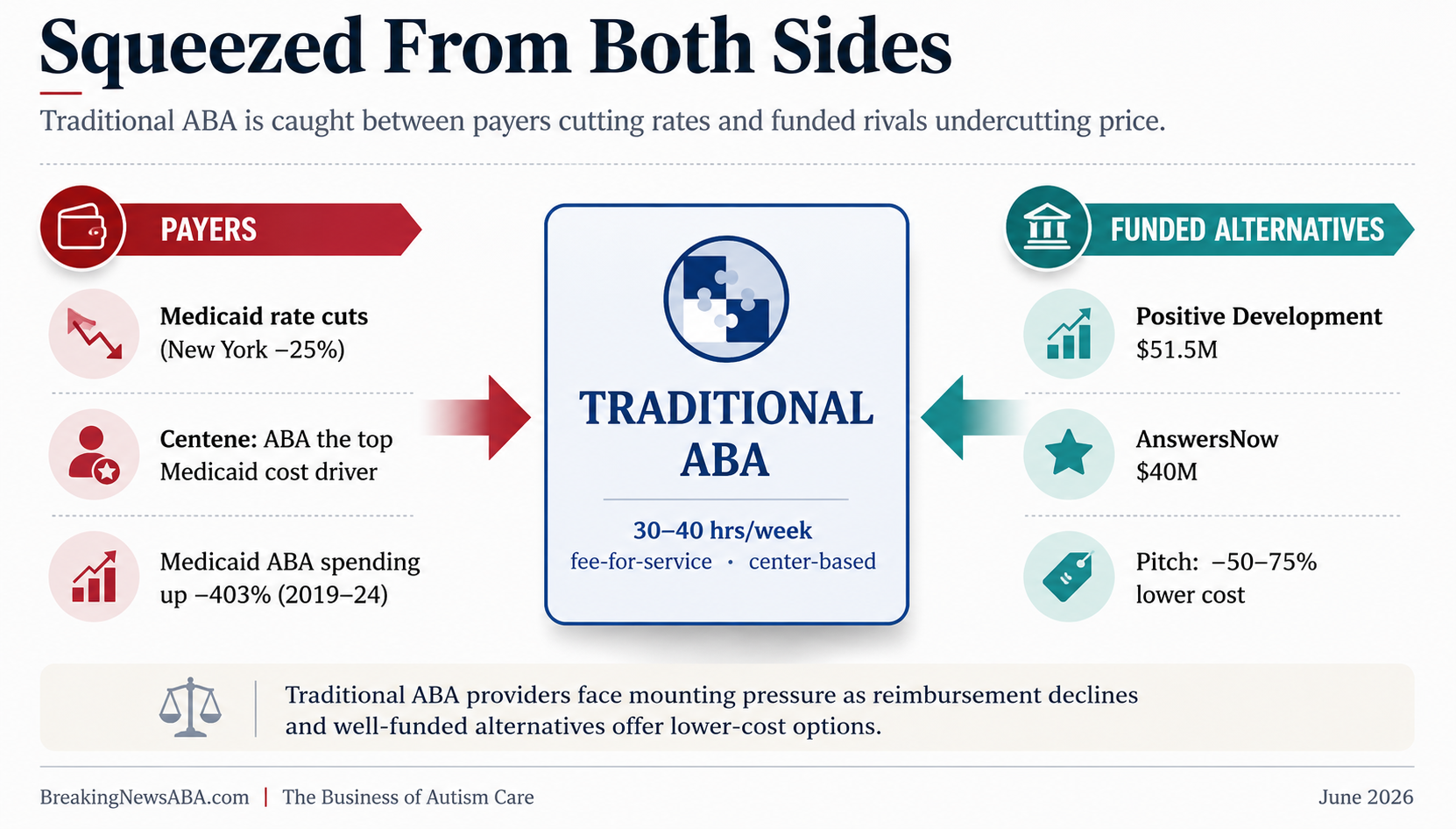
Incumbent ABA providers now face pressure from both directions at once: payers cutting the rates that fund the high-hour model, and venture-backed rivals offering to deliver autism care for a fraction of the cost.
The Pitch: Half the Cost, Paid for Outcomes
The alternatives are not only selling fewer hours; they are selling a different way to pay. Positive Development says it delivers outcomes at more than 50% below the cost of traditional ABA and is pursuing payment arrangements with commercial and Medicaid plans that reimburse for results rather than billed hours. It has signed commercial and state Medicaid health-plan partnerships, and in late 2025 it promoted a recommendation from the American Academy of Child and Adolescent Psychiatry that payers broaden coverage to include developmental models.
Those savings figures are largely self-reported, and independent outcome data on the newer models is still thin. For cost-pressured payers, that may not weigh heavily. The incumbents’ own numbers have become the alternatives’ strongest argument: if traditional ABA is billed at 30 or 40 hours a week and a competitor promises similar results at a fraction of the utilization, the burden of proof shifts onto the high-hour model.
The Capital Has Burned Before
There is reason for caution. The last venture darling in this space, Sprout Therapy, rebranded as Elemy and reached a $1.15 billion valuation on a $219 million round led by SoftBank in 2021, with backers that included Chelsea Clinton’s Metrodora Ventures and Ashton Kutcher’s Sound Ventures. Within roughly a year it wound down direct care, laid off clinicians and abruptly cut off therapy to families before pivoting to selling software.
That collapse has not cooled investor appetite. If anything, the cost crisis has sharpened it. Capital is again flowing to autism-care companies whose central promise is that they can do it for less, and this time they are arriving just as payers go looking for somewhere else to send their members.
What It Means for Incumbents
For the private equity-backed operators that consolidated the industry, the exposure is direct. PE firms acquired more than 500 autism centers over the past decade and built their model on 30-40 weekly hours billed fee-for-service, the exact structure payers are now trying to shrink and rivals are pricing against. Providers counting on ABA’s standing as the evidence-based standard to protect their contracts may be misreading the moment. Payers are not debating the science. They are looking at the bill, and for the first time they have well-funded alternatives to call.
AT A GLANCE
| Positive Development — Series C (2025): | $51.5M, co-led by aMoon with B Capital and Flare Capital Partners (Behavioral Health Business, Aug. 2025) |
| Positive Development — growth facility: | $45M debt facility for national expansion and acquisitions (BusinessWire, Jan. 2026) |
| The model: | Developmental relationship-based intervention (DRBI), non-ABA; speech, OT and mental health at lower weekly hours |
| Cost claim: | More than 50% below traditional ABA (company-reported) |
| AnswersNow — Series B (Jan. 2026): | $40M led by HealthQuest Capital; virtual “ABA 2.0,” ~5 hrs/week, up to 75% payer cost cut (company-reported) |
| Cautionary precedent: | Sprout/Elemy hit a $1.15B valuation on $219M (SoftBank, 2021), then wound down direct care in 2022–23 |
| Medicaid ABA spending: | Core services up ~403%, 2019–2024, per federal claims data (BHB, June 2026) |
| ABA utilization: | Visits up 267% (Medicaid +298%) 2019–2024 vs. ~74% prevalence rise (Trilliant Health; CDC) |
| Payer signal: | Centene CEO called a 94.9% Medicaid HBR “unacceptable,” named ABA top driver (Q2 2025) |
| Rate cuts: | New York phasing in a 25% ABA cut; NC ABA spend projected $122M (FY22) to $639M (FY26) |
| PE consolidation: | 574 PE-owned autism centers across 42 states as of 2024 (Brown University, Jan. 2026) |
| Bottom line: | Incumbents squeezed from both sides: falling rates and funded, lower-cost rivals courting their payers |
SOURCES & REFERENCES
| 1. | Larson, Chris. “Positive Development Hauls in Monster $51.5M Round on Promised Cost-Savings and an Alternative to ABA.” Behavioral Health Business. Aug. 6, 2025. bhbusiness.com |
| 2. | Positive Development. “Positive Development Raises $51.5M to Expand Nation’s Leading Developmental Therapy Model for Autism.” Press release via BusinessWire. July 22, 2025. businesswire.com |
| 3. | Positive Development. “Positive Development Secures $45 Million Growth Facility to Expand Access to Developmental Therapy and Autism Diagnostics Nationwide.” Press release via BusinessWire. Jan. 13, 2026. businesswire.com |
| 4. | Positive Development. “Positive Development Applauds AACAP’s Call to Expand Autism Care Access and Recommendation That Payers Broaden Coverage to Include DRBI.” Press release via BusinessWire. Nov. 10, 2025. businesswire.com |
| 5. | AnswersNow. “AnswersNow Completes $40M Series B to Expand BCBA-Driven, AI-Enabled Autism Therapy.” Press release via GlobeNewswire. Jan. 21, 2026. globenewswire.com |
| 6. | Larson, Chris. “AnswersNow Raises $40M, Plans to Double Clinician Headcount.” Behavioral Health Business. Jan. 21, 2026. bhbusiness.com |
| 7. | Beck, Jeff. “Autism Therapy is in Dire Need of a New Business Model.” MedCity News (MedCity Influencers, opinion). May 11, 2026. medcitynews.com |
| 8. | Larson, Chris. “ABA Volume Skyrocketed by 267% from 2019 to 2024.” Behavioral Health Business (Trilliant Health analysis). Dec. 22, 2025. bhbusiness.com |
| 9. | Larson, Chris. “Federal Data Reveal Top Earners in Medicaid’s 403% ABA Spending Surge.” Behavioral Health Business. June 5, 2026. bhbusiness.com |
| 10. | Behavioral Health Business. “Centene Flags Surging ABA Costs as Medicaid Pressures Mount.” July 25, 2025. bhbusiness.com |
| 11. | Acuity. “New York Medicaid ABA Reimbursement Rate Reduction 2026: 25% Cut and Centers of Excellence.” 2025–26. acuity.news |
| 12. | North Carolina Health News. “NC moves to rein in soaring autism therapy costs.” Apr. 27, 2026. northcarolinahealthnews.org |
| 13. | Behavioral Health Business. “ABA Providers Facing a Reckoning Amid Negative Headlines, Payer Cuts.” Apr. 9, 2026. bhbusiness.com |
| 14. | Brown University. “Private equity firms acquired more than 500 autism centers in past decade, study shows.” Jan. 7, 2026. brown.edu |
| 15. | Landi, Heather. “Elemy reaches unicorn status boosted by $219M investment from SoftBank, Chelsea Clinton and Ashton Kutcher.” Fierce Healthcare. Oct. 6, 2021. fiercehealthcare.com |
| 16. | Larson, Chris. “Elemy Lays Off Staff As it Winds Down Direct Care for Platform Business.” Behavioral Health Business. Dec. 5, 2022. bhbusiness.com |
| 17. | U.S. Centers for Disease Control and Prevention. Autism Data and Statistics (ADDM Network prevalence, 2016–2022). cdc.gov/autism/data-research |