A Payer Outside the Claims System
Florida put about $1 billion into family-directed scholarship accounts for students with disabilities this school year, an average of roughly $10,000 across more than 140,000 children, according to Step Up For Students, the nonprofit that administers most of the program. By statute, those accounts can pay for ABA delivered by or under the supervision of a BCBA.
Arizona’s program, the country’s first, runs at an annualized pace of about $900 million, and just over half of its students with a disability carry an autism diagnosis. Texas opens a $1 billion program for the 2026-27 school year. EdChoice, the school-choice research and advocacy group, counts 21 education savings account (ESA) programs across 18 states, and the Council of Parent Attorneys and Advocates (COPAA) tallied 135,025 students in the 12 programs built specifically for students with disabilities in 2024-25.
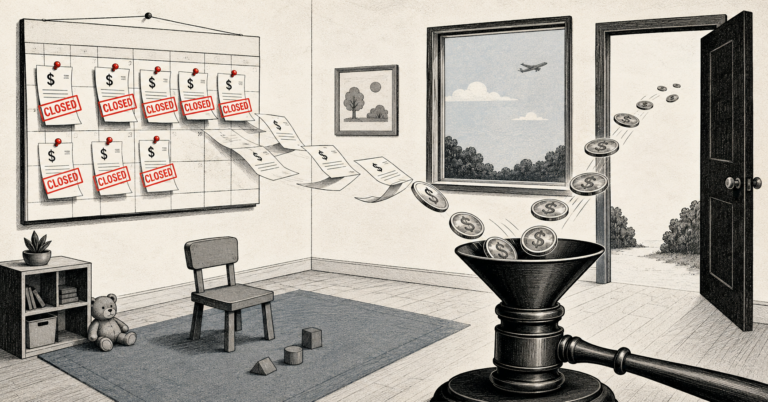
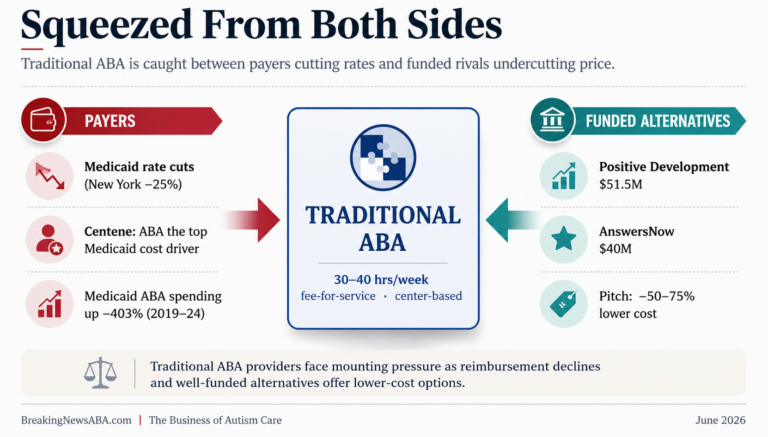
For ABA operators squeezed between Medicaid rate pressure and commercial utilization review, the education channel behaves differently from anything else in the payer mix. Funds arrive on a posted quarterly schedule. Spending follows the parent rather than a plan contract, and nothing in the chain requires a medical-necessity finding, a physician-prescribed treatment plan, or a CPT claim.
Parity law does not reach this money either. The federal Mental Health Parity and Addiction Equity Act binds health plans and insurers; state education funds sit outside it.
How Florida Pays for ABA
Florida created its program in 2014, the second state to do so after Arizona, and served 1,491 students in the first year. The Family Empowerment Scholarship for Students with Unique Abilities (FES-UA) now reports 140,147 funded students for 2025-26, which Step Up For Students calls the largest school-choice program for students with special needs in the country. Awards average about $10,000; students at matrix levels 254 and 255, the state’s two highest support tiers, average between $22,000 and $34,000.
The FES-UA purchasing guide lists ABA first among approved specialized services. Providers must be licensed by the Florida Department of Health, approved by the state’s Agency for Persons with Disabilities, or approved as specialized instructional services providers, and ABA qualifies when delivered by or under the supervision of a BCBA, including hours furnished by an RBT (registered behavior technician). Program entry still requires a qualifying diagnosis from a licensed physician or Florida psychologist, and autism spectrum disorder is first on the eligibility list.
Money lands in four equal installments, no later than September 1, November 1, February 1, and April 1, according to the AAA Scholarship Foundation’s program handbook, and parents direct payments to providers from there. The contrast with Florida’s insurance route is sharp. The state’s autism mandate, s. 627.6686, caps ABA benefits at $36,000 a year and $200,000 per lifetime and pays only for treatment prescribed by the insured’s treating physician under a treatment plan. The scholarship account has no clinical gate: its standard is educational benefit, its reviewer is a scholarship funding organization, and its ceiling is the account balance.
One payer rule does carry over. Families may not bill an insurer, Medicaid, or any other agency for services the account already paid for; doing so forfeits the scholarship.
The accounts pay for ABA under education rules, provider credentialing and expense categories, rather than payer rules built on medical necessity, parity, and utilization review.
Arizona Shows Who Signs Up
Arizona’s Empowerment Scholarship Account program reports quarterly to the legislature, and its numbers show who signs up. In the third quarter of fiscal 2025, 8,623 of the 16,553 ESA students with a disability, 52 percent, had an autism diagnosis, the Arizona Department of Education told legislators in its May 2025 report. Autism accounts for roughly 13 percent of students served nationwide under IDEA, the federal special education law, per the National Center for Education Statistics.
Students with a disability were 19 percent of the program’s 87,602 students that quarter, against about 14 percent in Arizona’s district schools. Most awards fall between $7,000 and $8,000, and disability weights push individual accounts past $30,000. The department’s 2025-26 parent handbook names “Applied Behavior Analysis (ABA) and Verbal Behavior Analysis” among approved educational therapies, requires the provider’s license or accreditation on file before purchases are approved, and reserves therapy spending for students with a disability.
Therapy spending is still a sliver of the program. Purchases categorized as educational therapies and services for students with a disability totaled roughly $4.7 million in the third quarter across the program’s tracked payment channels, a figure that blends ABA with speech, occupational, and other therapies.
Texas Brings a $1 Billion Test
Texas opens the next market this fall. Senate Bill 2, signed by Gov. Greg Abbott in May 2025, put $1 billion behind the Texas Education Freedom Accounts program for its first two years; Abbott called it “the largest day-one school choice program in the United States.” Most students will draw about $10,900, set at 85 percent of average per-student public school funding, according to figures reported at the signing.
The design tilts toward the families ABA serves. A child with a disability enrolled in a participating private school can receive up to $30,000 a year, provided an individualized education program (IEP) is on file with the Texas Education Agency by the close of the application window, under agency guidance issued for the launch. The comptroller’s approved-expense categories include therapies purchased through the state’s payment platform.
Demand outran the money immediately. More than 274,000 students applied between February 4 and March 17, about 248,000 were deemed eligible, and state officials expect the first awards to go to students with disabilities, their siblings, and children from low-income families, Community Impact reported from comptroller documents.
Where the Insurance Rules End
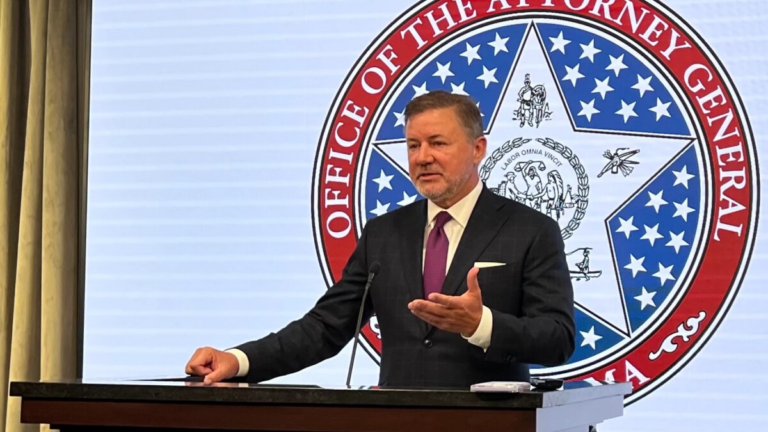
What the channel lacks is the machinery payers spent more than a decade building around ABA. No clinician reviews dosage or goals before money moves. Oversight is categorical and retrospective: Arizona auto-approves purchase requests under $2,000 and vets them afterward, an arrangement that has let nonqualifying purchases through, AZPM reported in February. Superintendent of Public Instruction Tom Horne says his office has recovered $1.2 million in misspent ESA funds.
“I’m doing everything conceivable to keep it accountable.” – Tom Horne, Arizona Superintendent of Public Instruction (2026)
Disability advocates aim their sharpest warning at the family side of the trade. Florida’s own compliance paperwork spells it out: when a student takes the scholarship, “the district school board is not obligated to provide the student with a free appropriate public education,” and the student keeps only the rights of a unilaterally parentally placed private school student under IDEA. Disability Rights Arizona and the Texas Council for Developmental Disabilities publish similar cautions for their states’ programs, and COPAA’s January report found that families often are not informed of what they give up.
COPAA’s participation data also temper the market-size math. Across eight of the nine states with disability-specific programs, about 2 percent of eligible students participate; Florida reaches 29 percent. “COPAA is concerned that students with disabilities, who have historically experienced barriers to participating in these programs, will be even less likely to be able to access the benefits of these programs in the future,” Chris Roe, the group’s director of state policy and the report’s author, said in a statement.
Texas Education Freedom Account payments begin with the 2026-27 school year, and Florida’s 2026-27 application cycle opened February 1. Arizona’s program faces a ballot test: organizers of the Protect Education, Accountability Now Act have until July to qualify a measure for the November midterm that would impose accreditation requirements and a $150,000 household income cap on the nation’s oldest ESA.
AT A GLANCE
| ESA programs nationwide: | 21 programs in 18 states (EdChoice, 2026) |
| Disability-specific choice programs: | 12 programs in 9 states; 135,025 students in 2024-25 (COPAA, January 2026) |
| Florida FES-UA, 2025-26: | 140,147 funded students; about $1 billion in scholarships; average award about $10,000 (Step Up For Students) |
| FES-UA top matrix awards: | $22,000 to $34,000 average at levels 254 and 255 (Step Up For Students) |
| FES-UA ABA rule: | Approved specialized service when provided by or under the supervision of a BCBA, including RBT hours (FES-UA Purchasing Guide, 2024-25) |
| FES-UA deposit schedule: | Four equal installments: Sept. 1, Nov. 1, Feb. 1, April 1 (AAA Scholarship Foundation handbook, 2025) |
| Florida insurance contrast: | ABA benefits capped at $36,000/year and $200,000 lifetime; physician-prescribed treatment plan required (s. 627.6686, F.S.) |
| Arizona ESA, Q3 FY2025: | 87,602 students; $901,174,756 in annualized scholarship awards (Arizona Department of Education, May 2025) |
| Arizona autism concentration: | 8,623 of 16,553 ESA students with a disability (52%) vs. about 13% of IDEA students nationally (ADE; NCES) |
| Texas program (SB 2): | $1 billion over two years; up to $30,000/year for students with disabilities; launches 2026-27 (TEA) |
| Texas demand: | 274,000+ applications Feb. 4 to March 17, 2026; about 248,000 eligible (Community Impact) |
| IDEA trade-off: | Scholarship students hold only the rights of parentally placed private school students (s. 1002.394, F.S.) |
SOURCES & REFERENCES
| 1. | Step Up For Students. Family Empowerment Scholarship for Students with Unique Abilities: 2025-26 Fast Facts. stepupforstudents.org/research-and-reports/unique-abilities/. Accessed June 2026. |
| 2. | EdChoice. Education savings account program tally, 2026: 21 programs in 18 states. edchoice.org. Accessed June 2026. |
| 3. | Council of Parent Attorneys and Advocates. Private School Choice Programs and Students with Disabilities. January 2026. copaa.org. |
| 4. | Step Up For Students. FES-UA Purchasing Guide 2024-25. July 19, 2024. go.stepupforstudents.org. |
| 5. | Step Up For Students. FAQ: FES-UA scholarship amounts (matrix levels 254-255 average $22,000 to $34,000). stepupforstudents.org. Accessed June 2026. |
| 6. | AAA Scholarship Foundation. Florida FES-UA Parent/School Handbook. Revised January 29, 2025. aaascholarships.org. |
| 7. | Section 627.6686, Florida Statutes. Coverage for individuals with autism spectrum disorder required; exception. flsenate.gov. |
| 8. | Section 1002.394, Florida Statutes (2025). The Family Empowerment Scholarship Program. leg.state.fl.us. |
| 9. | Arizona Department of Education. Empowerment Scholarship Account Program: Fiscal Year 2025 Quarter 3 Executive and Legislative Report. May 30, 2025. azed.gov. |
| 10. | Arizona Department of Education. ESA Parent Handbook, School Year 2025-2026. azed.gov. |
| 11. | National Center for Education Statistics. Students With Disabilities (Condition of Education; 2022-23 data). nces.ed.gov. |
| 12. | Office of the Texas Governor. “Governor Abbott Signs Landmark School Choice Legislation Into Law.” May 3, 2025. gov.texas.gov. |
| 13. | KUT News. “Amid cheers and protests, Gov. Abbott signs $1 billion Texas school voucher bill into law.” May 2025. kut.org. |
| 14. | Texas Education Agency. TAA correspondence: “Senate Bill 2: Education Savings Accounts and Children with Disabilities” and “Updated Guidance: ESAs and IEPs.” 2025-2026. tea.texas.gov. |
| 15. | Community Impact. “Over 270k Texans applied for education savings accounts.” April 6, 2026. communityimpact.com. |
| 16. | Haghighi, Noor. “As use of state voucher program skyrockets, public school advocates seek reform.” AZPM News. February 16, 2026. news.azpm.org. |
| 17. | Arundel, Kara. “Private school choice could ‘undermine’ special education gains, COPAA says.” K-12 Dive. January 27, 2026. k12dive.com. |
| 18. | Disability Rights Arizona. Arizona’s Empowerment Scholarship Account (ESA) Program (rights guidance). 2024. disabilityrightsaz.org. |
| 19. | Texas Council for Developmental Disabilities. Private School Vouchers and Students with Disabilities. 2025. tcdd.texas.gov. |