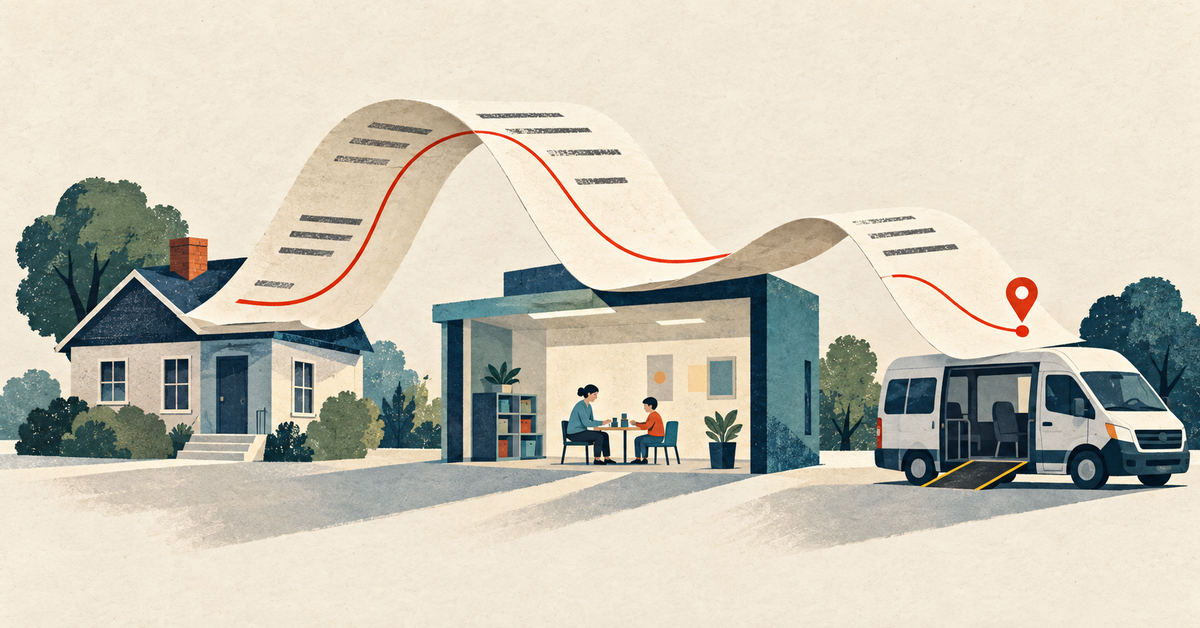
WASHINGTON – A House Republican bill would extend electronic verification to Medicaid-funded applied behavior analysis (ABA) in clinics as well as homes, with a proposed Jan. 1, 2027, start date and an exemption for states with existing systems. Records would identify who delivered each session, who received it, where it took place, and when it started and ended.
Rep. Gabe Evans (R-Colo.) introduced the bill, H.R. 10618, on Sept. 28, and Energy and Commerce Committee Republicans included it in a 14-bill anti-fraud package the next day. In an Oct. 2 analysis, the law firm Alston & Bird wrote that the package’s bills are “unlikely to advance before the end of the current Congress,” which ends Jan. 3, 2027.
The bill pairs ABA with non-emergency medical transportation (NEMT), the rides Medicaid covers to and from medical appointments, and would put both under electronic visit verification (EVV). Federal law now requires EVV for personal care and home health services that require an in-home visit. The bill’s text has no such setting limit.
Sept. 28 was also the day Evans hosted CMS Administrator Mehmet Oz in his district to discuss Medicaid fraud. In the committee’s announcement, Evans said, “Blue states like Colorado have allowed scammers and criminals to exploit millions of dollars in taxpayer-funded Medicaid programs like non-emergency transport and autism therapy.”
Alongside the package, the committee’s Republican staff released a report that lists ABA among Medicaid programs “experiencing high rates of fraud,” along with medical transportation, home- and community-based services, adult day care, and substance use treatment. It says Medicaid spending on ABA rose 421% from 2021 to 2025, “from $2 billion to over $10 billion per year nationally.”
What Verification Would Look Like
Each session record would have to show the type of service, the person served, the provider, the date, the location, and the start and end times. Those are the six items federal law sets for home care visits. The bill also borrows that law’s implementation rules: states would have to consult providers to keep their systems “minimally burdensome,” take input from families, and offer training.
“NEMT and ABA services can present vulnerabilities when Medicaid lacks reliable electronic confirmation that a service was actually provided.” – House Energy and Commerce Committee Republicans, Sept. 29, 2026
CMS’s Aug. 4 toolkit for state Medicaid ABA programs recommends that states consider extending EVV to ABA, particularly home-based services. The toolkit itself creates no new federal requirement.
Colorado’s 2025 guidance requires EVV for fee-for-service pediatric behavioral therapy delivered in homes or community settings. Its FAQ says the state activated a claims check on Feb. 1, 2022, making claims without a matching record subject to denial. It describes a state system available to providers at no cost, with location captured only at the start and end of a visit.

The bill would exempt states that require electronic verification of ABA and NEMT when it becomes law, provided they keep those systems. It does not establish whether Colorado’s requirements would qualify. HHS would notify a state found out of compliance; the state would then have 90 days after receiving the notice to submit a plan showing how it would comply within one year of receipt. The bill specifies no funding penalty, unlike the existing home care EVV law, which can reduce federal Medicaid matching funds.
What the $10 Billion Counts
CMS’s data book puts Medicaid and Children’s Health Insurance Program (CHIP) ABA payments at about $1.94 billion in 2021 and $10.1 billion in 2025, up 421%. It includes beneficiaries without autism and combines fee-for-service claims with managed care encounters. The 2025 figures are preliminary. Payment growth alone does not establish fraud.
The Republican staff report says spending “grew six times faster than the number of children receiving the service.” The data book shows a 200% increase in ABA recipients, making the percentage increase in payments about 2.1 times the increase in recipients. Its counts include adults.
The sixfold comparison matches a broader measure: 67% growth in beneficiaries with an autism diagnosis who used any Medicaid or CHIP service. CMS paired that figure with 421% in its Aug. 4 announcement, but the staff report does not show its calculation. Among ABA recipients with an autism diagnosis, the data book shows 189% beneficiary growth and 363% payment growth.
Backers and Timing
The committee’s Oct. 5 list of supporters includes The Transportation Alliance, a trade association whose members include NEMT companies. Its president, Bill Rouse, thanked Evans and the committee for the transportation measure. No ABA, autism, or behavioral health organization appears in that published list.
As of Oct. 6, the official bill record listed referral to the Energy and Commerce Committee as its latest action. The proposed Jan. 1, 2027, start date was less than three months away.
AT A GLANCE
| The bill: | H.R. 10618, STOP Medicaid Fraud Act of 2026; Rep. Gabe Evans (R-Colo.); introduced Sept. 28, 2026 |
| Services covered: | Medicaid ABA and non-emergency medical transportation; no setting limit in the bill text |
| Proposed start date: | Jan. 1, 2027; a noncompliant state has 90 days after receiving HHS’s notice to file a plan and one year after receipt to comply |
| Each session record: | Type of service, recipient, individual providing it, date, location, and start and end times |
| Exempt: | States requiring electronic verification of ABA and NEMT at enactment, if they retain those systems; Colorado’s eligibility is unconfirmed |
| Medicaid and CHIP ABA payments: | About $1.94 billion (2021) to $10.1 billion (2025), up 421%; 2025 figures are preliminary |
| ABA recipients: | Up 200%, 2021–2025; recipients with an autism diagnosis rose 189%. The counts are not limited to children. |
| Outlook: | Alston & Bird said Oct. 2 that the package’s bills are “unlikely to advance before the end of the current Congress” |
SOURCES & REFERENCES
| 1. | Office of Rep. Gabe Evans. “CMS Administrator Oz Joins Rep. Gabe Evans in Colorado’s 8th District to Discuss State Medicaid Fraud and to Tour UNC’s New College of Osteopathic Medicine.” Press release. Sept. 28, 2026. https://gabeevans.house.gov/media/press-releases/cms-administrator-oz-joins-rep-gabe-evans-colorados-8th-district-discuss-state |
| 2. | U.S. House of Representatives. H.R. 10618, Strengthening Tools for Oversight to Prevent Medicaid Fraud Act of 2026 (introduced). 119th Congress. Sept. 28, 2026. https://www.govinfo.gov/content/pkg/BILLS-119hr10618ih/html/BILLS-119hr10618ih.htm |
| 3. | Social Security Administration. Social Security Act § 1903(l), electronic visit verification requirements (42 U.S.C. § 1396b(l)). Accessed Oct. 6, 2026. https://www.ssa.gov/OP_Home/ssact/title19/1903.htm |
| 4. | House Committee on Energy and Commerce. “E&C Republicans Introduce Critical Fraud-Fighting Package to Protect Vulnerable Americans and Safeguard Taxpayer Dollars.” Press release. Sept. 29, 2026. https://energycommerce.house.gov/posts/e-and-c-republicans-introduce-critical-fraud-fighting-package-to-protect-vulnerable-americans-and-safeguard-taxpayer-dollars |
| 5. | Alston & Bird. “Health Care Week in Review | E&C Republicans Introduce Anti-Fraud Bill Package; CMS Finalizes the GLOBE Model.” Oct. 2, 2026. https://www.alston.com/en/insights/publications/2026/10/health-care-week-in-review-october-2-2026 |
| 6. | U.S. Constitution, Amendment XX, Section 1. National Archives. https://www.archives.gov/founding-docs/amendments-11-27 |
| 7. | House Committee on Energy and Commerce, Majority Staff. The Real Costs of Fraud: Examining Program Integrity Requirements and Exposing Fraud in Medicare and Medicaid. Sept. 29, 2026, pp. 9 and 24. https://d1dth6e84htgma.cloudfront.net/EC_Fraud_Staff_Report_9_29_26_468cdcbe40.pdf |
| 8. | The MITRE Corporation, prepared for the Center for Medicaid and CHIP Services. Autism Spectrum Disorder and Applied Behavior Analysis Data Book. August 2026. Methods, pp. 1–3; Tables 1, 3, and 10. CMS ZIP containing PDF and Excel files. https://www.medicaid.gov/media/file/asd-aba-data-bookaugust-2026.zip |
| 9. | Centers for Medicare & Medicaid Services. State Medicaid & Children’s Health Insurance Program Applied Behavior Analysis Toolkit. August 2026, pp. 6–7, 14–18, and 123–124. https://www.medicaid.gov/medicaid/downloads/autism-services-aba-toolkit.pdf |
| 10. | Colorado Department of Health Care Policy and Financing. “Electronic Visit Verification Program Manual.” Updated March 26, 2025. Official test-site copy; accessed Oct. 6, 2026. https://hcpf.test.colorado.gov/electronic-visit-verification-program-manual |
| 11. | Colorado Department of Health Care Policy and Financing. “Pediatric Behavioral Therapies Billing Manual.” “Allowed Place of Service Codes.” Official test-site copy; accessed Oct. 6, 2026. https://hcpf.test.colorado.gov/pbt-manual |
| 12. | Colorado Department of Health Care Policy and Financing. “Electronic Visit Verification Frequently Asked Questions.” Updated April 10, 2025. Official test-site copy; accessed Oct. 6, 2026. https://hcpf.test.colorado.gov/electronic-visit-verification-frequently-asked-questions |
| 13. | Centers for Medicare & Medicaid Services. “CMS Launches New State Toolkit to Protect Children with Autism, Strengthen Oversight of Applied Behavior Analysis Services.” Press release. Aug. 4, 2026. https://www.cms.gov/newsroom/press-releases/cms-launches-new-state-toolkit-protect-children-autism-strengthen-oversight-applied-behavior |
| 14. | House Committee on Energy and Commerce. “WTAS: E&C Republicans’ Agenda ‘Continuing the Fight Against Fraud.’” Press release. Oct. 5, 2026. https://energycommerce.house.gov/posts/wtas-e-and-c-republicans-agenda-continuing-the-fight-against-fraud |
| 15. | The Transportation Alliance. “About Us.” Accessed Oct. 6, 2026. https://www.ttamobility.org/about-us |
| 16. | Library of Congress / Congressional Research Service. H.R. 10618, bill-status record, 119th Congress. GovInfo. Updated Oct. 6, 2026, 08:05 UTC; accessed Oct. 6, 2026. https://www.govinfo.gov/bulkdata/BILLSTATUS/119/hr/BILLSTATUS-119hr10618.xml |






Join the discussion ▾