
Where the Idea Started
Dr. Scott O’Donnell treats behavior analysis as a science of everyone’s behavior, including his own, and for years he has pointed it at his golf game and his pool table. The idea took shape in his car. After working in a behavioral psychology lab, O’Donnell said, he would drive home listening to frustrated Philadelphia sports talk radio hosts and wonder whether the science could do something about it.
“I wonder if behavior analysis could help here. And that would be a real test for that science,” he recalled thinking in an interview with BreakingNewsABA. If it could make him or an athlete better at a sport, he reasoned, that would prove the science to him. He has not helped a team win a championship yet, he said, but he has used the approach to get better himself, and he can show the data.
Start With Four Steps
O’Donnell’s method is the same one behavior analysts use on any target, turned on yourself. In the interview, he laid it out as four steps. First, operationally define the behavior you want to change, so it is specific and countable. Second, select the measurement. Third, record the data and then assess it. Fourth, make one change at a time and determine the effect.
That last step is the discipline most people skip. Change one thing, see what the data does, keep it if it helps, and drop it if it does not. “It’s not just a guessing game,” O’Donnell said, referring to adjusting his own routine. He keeps what the numbers show is working and cuts what they show is not, even when a change feels helpful but the data disagrees.
Pool, One Shot at a Time
Start with something concrete, O’Donnell said, and pool is his example. He records data during practice, such as how long it takes him to run a rack, and compares that across time. When he wants to build a specific skill, he will watch a video of a particular shot, attempt it, and count how many times he makes it.
The logic is simple, and it is why he practices the way he does. “The more I make that shot in practice, the more I’m going to make it when I’m playing a game,” he said. His own notes describe the sequence the same way: track your data, compare it across time, intervene with a resource such as a how-to video, count how many times you can execute the skill, and practice.
Golf and the Pre-Shot Routine
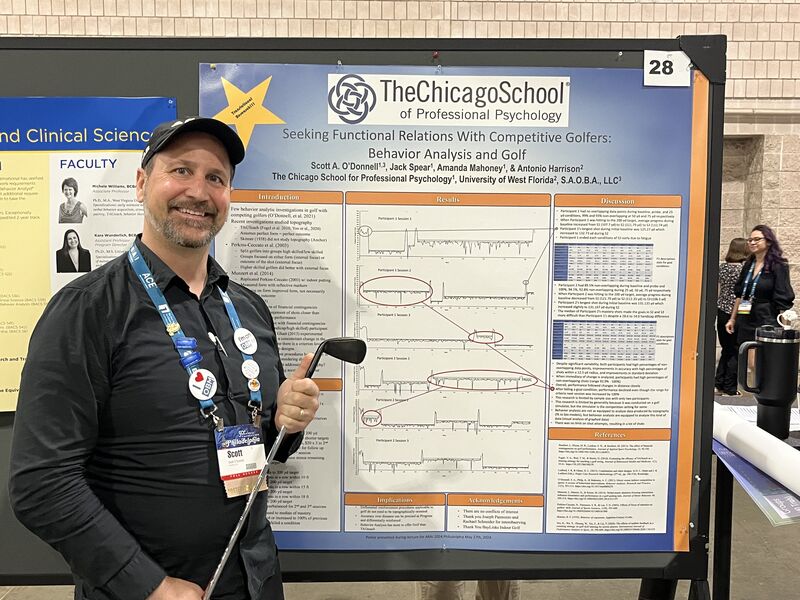
For golf, O’Donnell leans on precision teaching, a data system for counting how often a behavior happens, and charts his practice on a standard celeration chart. At the driving range, he counts how many shots he makes. On the course, he shifts to a different set of tools: mindfulness, diaphragmatic breathing, and a fixed pre-shot routine.
That routine is what he calls a behavioral chain, a sequence of small actions that makes the good shot more likely. He focuses on the stimuli that actually matter- the ball, the alignment, the target- and works through the steps the same way every time. What he does not do is hype himself up. A pep talk, he said, is not the key. When people tell him he plays slowly, he answers that the routine is the work.
“I’m actually going as fast as I can. I just have a lot of different things I got to do before I take a shot.” – Scott O’Donnell, PhD (2026)
He treats the chain as something to test, not a fixed ritual. He can add a link or remove one and watch whether his numbers improve or slip, so the routine keeps getting tuned by the data rather than by feel. Earlier in his training, he also applied acceptance and commitment therapy (ACT) and a mindfulness sport-performance approach to himself, recording how each affected his play.
For Beginners: Get a Guide, and Get Over the Data
For readers with no background in the science, O’Donnell’s first piece of advice is to get some guidance. Anyone can say they are using behavior analysis on themselves, he said, but without knowing what they are doing, it probably will not work. Talking with a behavior analyst, sometimes through therapy, can point a beginner in the right direction.
The bigger hurdle is the data itself. Most people do not want to record it, and O’Donnell says getting over that is the first real step. There is nothing to hide from, in his view, and no reason to feel bad about what the numbers show. He finds the practice freeing, and even a little addictive. “I get excited when I get to put… that dot on that piece of paper,” he said, describing the small reward of logging another session.
He is careful about one boundary. O’Donnell does not record data on his own children, and he says practitioners should not treat their own kids as clients, even though the same behavioral philosophy he uses at home guides him. The self-management method is for your own behavior, or for a client who has agreed to it, not a tool to quietly run on the people around you.
The Payoff
What separates him from most players, O’Donnell said, is not talent but information. He knows exactly how good he is at a given skill because he has the data, and he knows exactly how to get better because he has tested the changes one at a time. For anyone who wants to try it, the instruction is the same one he gives himself: define the behavior, measure it, record and read the data, and change one thing at a time until the game improves.
AT A GLANCE
| Source: | Dr. Scott O’Donnell, PhD, interview with BreakingNewsABA (2026) |
| Core method: | 1) Operationally define the behavior; 2) select the measurement; 3) record and assess data; 4) change one thing at a time and check the effect |
| Pool approach: | Time how long it takes to run a rack; watch a video of a shot; count makes in practice |
| Golf approach: | Precision teaching and standard celeration charts to count range shots; mindfulness, diaphragmatic breathing, and a pre-shot routine on the course |
| Pre-shot routine: | A behavioral chain focused on relevant stimuli (ball, alignment, target); not a pep talk |
| Beginner advice: | Consult a behavior analyst; get comfortable recording your own data |
| Key boundary: | Do not run data on your own kids; self-management is for your own behavior or a consenting client |
| O’Donnell’s edge: | Knowing exactly how good he is and what to change, because he has the data |
SOURCES & REFERENCES
| 1. | O’Donnell, Scott. Interview with Lucy Thomas, BreakingNewsABA. 2026. Interview transcript and background notes. |