
A Slowdown in Exits Reaches Pediatric Therapy
The Wall Street Journal reported that U.S. private equity assets held in funds more than ten years old reached a record $348.5 billion at the end of 2025, while another $512.7 billion was held in funds aged seven to nine years, reflecting an industry-wide slowdown in exits. Higher interest rates, lower leverage availability, and lower valuation expectations have extended holding periods across many sectors despite the increasing use of continuation funds and secondary transactions.
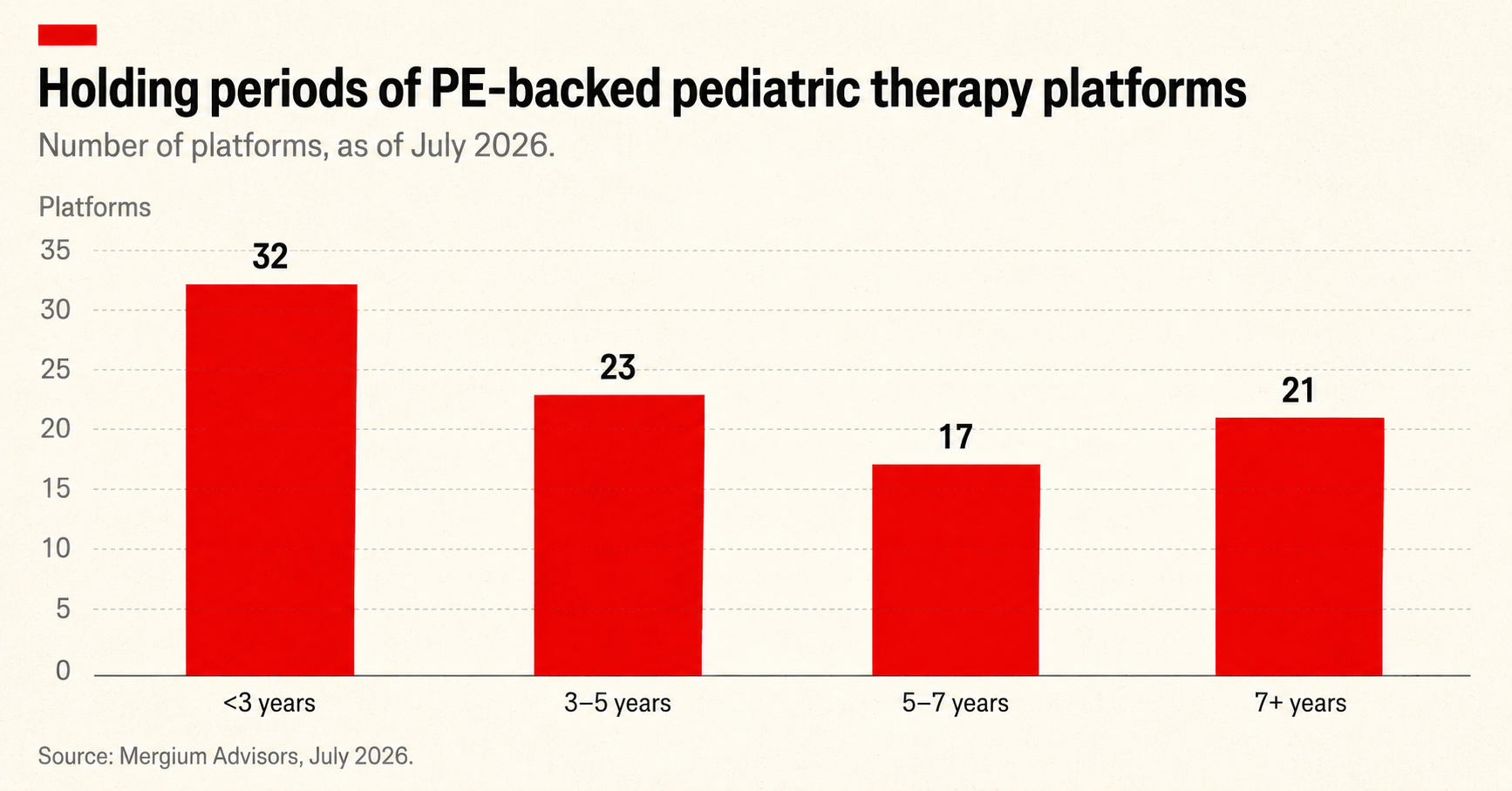
Research conducted by Mergium Advisors indicates that pediatric therapy has not been immune to this broader trend. Of the 93 private equity-backed pediatric therapy platforms included in the analysis, approximately 38, or 41%, have been held by their current sponsors for more than five years. Of those, 21 have been held for at least seven years.
Historically, many private equity sponsors have targeted investment horizons of approximately four to seven years. The growing number of pediatric therapy platforms approaching or exceeding that range suggests that exit timing is increasingly being driven by market conditions rather than fund timelines alone. While longer holding periods have become more common across private equity, the concentration of mature investments suggests that a substantial number of pediatric therapy platforms could enter the market over the next several years if exit conditions improve.
Why Holding Periods Are Extending
Several factors may be contributing to these extended holding periods. Higher interest rates have reduced debt capacity for leveraged buyouts, making acquisitions more difficult to finance. Valuation multiples have also moderated from their 2021–2022 highs, making many sponsors reluctant to sell at valuations below their original expectations. At the operating level, persistent clinician shortages, wage inflation, reimbursement pressure, and increased Medicaid scrutiny in several states have weighed on profitability. At the same time, long-term demand for autism and multidisciplinary pediatric therapy services remains favorable, encouraging some sponsors to continue creating value while waiting for more favorable exit conditions.
Not Necessarily a Sign of Weakness
Longer holding periods should not necessarily be interpreted as a sign of weak platform performance. Across private equity, many sponsors are delaying exits simply because current market valuations do not fully reflect the value they believe has been created. In pediatric therapy, where long-term demand fundamentals remain attractive, sponsors may prefer to continue growing their platforms rather than exit into a less favorable transaction market.
In pediatric therapy, where long-term demand fundamentals remain attractive, sponsors may prefer to continue growing their platforms rather than exit into a less favorable transaction market.
The outlook for pediatric therapy platforms that have been held for more than five years remains uncertain. Some sponsors may already be preparing their platforms for an eventual sale, although the timing will likely depend on financing conditions, buyer demand, and operating performance.
A Concentrated Buyer Universe
The buyer universe for larger platform exits is likely to be relatively concentrated. If larger platforms begin coming to market, the most likely acquirers include other private equity sponsors and large strategic healthcare organizations. In some cases, continuation vehicles may also provide liquidity while allowing sponsors to retain ownership of attractive assets. Although an IPO remains a theoretical exit path, current public market conditions make that outcome considerably less likely.
The Next Wave of Deals
If financing markets continue to improve, these mature investments could represent the next wave of significant transactions in pediatric therapy. According to Mergium Advisors’ research, pediatric therapy M&A activity has remained remarkably consistent at approximately ten announced transactions per quarter, and an increase in sponsor exits could provide an additional catalyst for deal activity over the next several years.
AT A GLANCE
| PE assets, funds 10+ years old: | $348.5 billion at year-end 2025, a record (The Wall Street Journal) |
| PE assets, funds 7–9 years old: | $512.7 billion (The Wall Street Journal) |
| Pediatric therapy platforms analyzed: | 93 private equity-backed platforms (Mergium Advisors) |
| Held more than 5 years: | ~38 platforms, or 41% (Mergium Advisors) |
| Held at least 7 years: | 21 platforms (Mergium Advisors) |
| Typical target horizon: | Approximately 4 to 7 years |
| Pediatric therapy M&A pace: | ~10 announced transactions per quarter (Mergium Advisors) |
| Most likely acquirers: | Other PE sponsors, large strategic healthcare organizations, continuation vehicles |
| Least likely exit path: | IPO, given current public market conditions |
SOURCES & REFERENCES
| 1. | The Wall Street Journal. Reporting on U.S. private equity assets held in funds more than ten years old ($348.5 billion) and in funds aged seven to nine years ($512.7 billion) at year-end 2025. 2026. |
| 2. | Mergium Advisors. Analysis of 93 private equity-backed pediatric therapy platforms, holding-period distribution, and pediatric therapy M&A activity. 2026. |