
The price a founder sold for and the money they actually received are often very different, and that gap has grown. From 2018 to 2022, private equity firms bought up hundreds of ABA practices. Many clinicians who sold got much of their payment as equity in the new platform or as earnouts based on future results. Only part of the price was paid in cash at closing. The rest depended on how the platform performed afterward. Three years later, with ABA deal multiples down and some platforms pulling back, much of that paper is now worth less than the original deal suggested.
Anatomy of an ABA Add-On
When a platform buys a smaller ABA agency as an add-on, the acquisition is a sponsor bolted onto its anchor company. The purchase price is rarely a single amount paid in a single form. Most of it is cash at closing, so the founder’s immediate proceeds are clear. A slice is usually rollover equity, the portion of the seller’s proceeds reinvested into the buyer’s larger company, making the founder a minority owner of the platform. Less often now, part of the purchase price is an earnout, a conditional payment tied to meeting performance targets after the sale. Advisers who broker these deals describe a typical structure as most of the price in cash, with roughly 10 to 20 percent taken as rollover equity and, when an earnout is present, another 10 to 20 percent of deal value left contingent. The exact split depends on the buyer, the agency, and the seller’s negotiating position.
The most important number is not the headline multiple, but which dollars are guaranteed and which are not. “Separate guaranteed money from conditional money, including rollover equity, seller notes, and earnouts,” Kevin Taggart, managing partner at healthcare M&A firm Mertz Taggart, advised behavioral health owners in a June 2026 note on weighing offers. Cash at closing is the only guaranteed amount. Rollover equity and earnouts are really bets on the buyer’s future performance.
The Multiples Have Reset
Those bets were made when the market was at its peak. From 2018 to 2021, mid-sized ABA agencies often sold for 8 to 10 times EBITDA (earnings before interest, taxes, depreciation, and amortization). Top-quality agencies sometimes sold for even more, according to Hendon Partners, a healthcare M&A advisory firm. Easy access to capital, low interest rates, and strong competition drove prices higher.
The market changed in 2022 and 2023. Higher interest rates, greater scrutiny of ABA use by payers, Medicaid audits, and slower growth all pushed deal multiples down. Hendon reported that several platform deals were repriced or restructured. As of May 2026, quality ABA agencies now sell for about 5 to 8 times EBITDA, down from before. FOCUS Investment Banking reported in December 2025 that current add-on deals are going for 5-9 times EBITDA.
The main exception is size. Top autism platforms with locations in several states, accreditation, and strong clinical oversight still sell for 12 to 15 times EBITDA, according to FOCUS. For example, Behavioral Innovations, with about 80 locations, sold in 2024 for a reported $300 million, at a price close to 15 times EBITDA. But for founders who sold a single-state agency and rolled their equity into a platform, the value of their paper depends on the platform’s multiple, which has dropped for most platforms.
Why the Rollover Paper Is Worth Less
Rollover equity is often described as a second chance to profit: you take some cash now, keep a stake, and hope to cash out again when the platform sells for a higher price. That stake could end up being worth more than the cash you gave up, but it could also be worth less or even nothing. Rolled equity is usually a minority stake and is often not sellable, either practically or legally, until the entire company is sold. Its value depends on factors such as debt, dilution from new add-ons, the exit multiple, and the sponsor’s decisions. Founders who rolled equity at peak valuations now face more debt, more co-investors, and lower exit multiples than they expected. That is why the paper often falls short of its promise.
Its value depends on how the buyer performs.
“If the buyer is well-run and continues to grow, the rollover may become worth significantly more than the cash you reinvested. If the buyer struggles, that equity may be worth far less.” – Kevin Taggart, Managing Partner, Mertz Taggart (2026)
The sharpest illustration of the downside is the Center for Autism and Related Disorders. CARD, which grew to 265 locations at its peak, was the largest autism services provider in the country when Blackstone bought it in 2018. The company carried no debt before the buyout and about $160 million when it filed for Chapter 11 bankruptcy in 2023, after shuttering more than 100 facilities, according to NBC News. Its founder, Doreen Granpeesheh, repurchased most of the operations out of bankruptcy. In a Chapter 11, equity holders stand last in line, behind lenders and creditors, and a seller who had taken CARD platform stock as rollover would have held exactly that spot. CARD is the most prominent private-equity-backed ABA provider to file for bankruptcy, but others pulled back: Invo Healthcare exited home- and center-based ABA in 2023, and the venture-backed in-home provider Elemy withdrew from most of its states in 2022.
The Earnout That Mostly Does Not Pay
The other slice of paper, the earnout, has grown rarer and less friendly to sellers. Use of earnouts has fallen across private-company dealmaking. The American Bar Association’s 2025 Private Target Mergers and Acquisitions Deal Points Study, which tracks private deals across industries, found earnouts in 18 percent of deals, down from 26 percent in its 2023 study. ABA therapy sits within that broader private market, where advisers say earnouts are typically tied to EBITDA, revenue, or operational milestones such as BCBA retention and client census over 12 to 36 months.
When earnouts do appear, the terms increasingly favor the buyer. The buyer agrees to run the business in a manner consistent with past practice during the earnout period in only 14 percent of deals. They agree to operate it to maximize the earnout in just 5 percent, the American Bar Association study found. Once the deal closes, the buyer controls the business the earnout depends on.
For a founder who took paper in the boom, the headline multiple was a ceiling, not a check.
Earnouts rarely pay out as expected. In deals outside of life sciences, SRS Acquiom found in its 2024 data that earnouts paid out only about 21 cents per dollar promised. Only 59 percent of deals paid anything at all, and earnouts were disputed in at least 28 percent of cases. For a founder who agreed to a headline price with 15 percent tied to an earnout, the most likely outcome is that most of that money never comes.
What the Headline Multiple Hid
Looking back, boom-era sales look different now. A founder who sold in 2021 at a high multiple got most of the price in cash, rolled 20 percent into the platform, and left 15 percent on an earnout. They kept the cash but held onto two claims that have since lost value: a minority stake in a platform with a lower multiple or more debt, and an earnout that usually pays only a small part of what was promised. The announced sale price was real, but what the seller actually received was less. That is the key point.
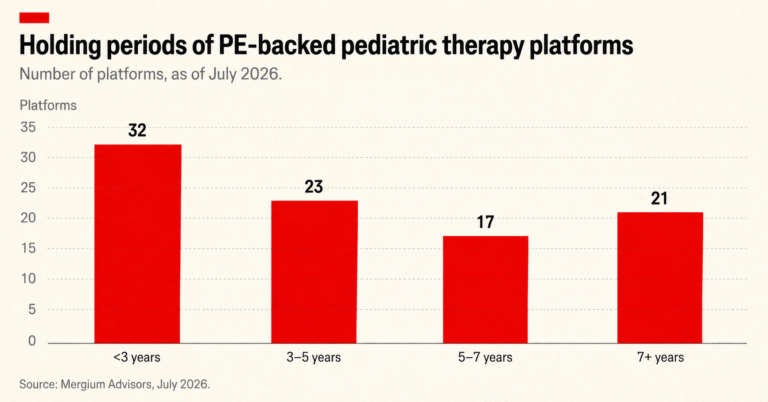
Timing makes this even clearer. Nearly 80 percent of private equity autism deals closed between 2018 and 2022, according to a January 2026 JAMA Pediatrics study that found 574 private-equity-owned autism centers in 42 states by the end of 2024. Now, these platforms are reaching the point where sponsors want to sell, recapitalize, or refinance. These events will finally determine what the rollover equity from the last cycle is really worth. Each exit will show, on a case-by-case basis, whether the second payout is greater than the first.
AT A GLANCE
| Typical ABA add-on structure: | Majority cash at closing; ~10–20% rollover equity; earnout, when used, ~10–20% of deal value (ABA M&A advisers, 2026) |
| ABA multiples, 2020–2021 peak: | Mid-market agencies 8–10x EBITDA; platform-quality 10x+ (Hendon Partners, 2026) |
| ABA multiples, 2026: | Quality agencies ~5–8x; add-ons 5–9x (Hendon Partners; FOCUS Investment Banking) |
| Scaled best-in-class platforms: | 12–15x EBITDA (FOCUS Investment Banking, December 2025) |
| Behavioral Innovations sale, 2024: | ~$300M at ~15x EBITDA, ~80 locations (FOCUS Investment Banking) |
| Earnout use, private-company M&A: | 18% of deals in 2025, down from 26% in 2023 (American Bar Association Deal Points Study) |
| Earnout payout: | ~21 cents on the dollar; 59% of deals pay anything; contested at least 28% of the time (SRS Acquiom, 2024 claims data) |
| Buyer discretion in earnouts: | Buyer runs business per past practice in 14% of deals; agrees to maximize earnout in 5% (American Bar Association, 2025) |
| PE-owned autism centers: | 574 across 42 states as of Dec 31, 2024; ~80% acquired 2018–2022 (JAMA Pediatrics, January 2026) |
| CARD: | 265 locations at peak; no debt before 2018 Blackstone buyout, ~$160M at 2023 Chapter 11 filing (NBC News, 2024) |
| Bottom line: | Headline sale multiples overstated realized proceeds for founders who took rollover equity and earnouts |
SOURCES & REFERENCES
| 1. | Mertz Taggart (Kevin Taggart). “What Behavioral Health Owners Should Understand Before Comparing Offers.” June 23, 2026. mertztaggart.com |
| 2. | American Bar Association, Business Law Section, M&A Committee, Market Trends Subcommittee. “2025 Private Target Mergers & Acquisitions Deal Points Study.” December 2025. |
| 3. | SRS Acquiom (Casey McTigue). “M&A Earnout Provisions – What You Need to Know,” drawing on the 2024 SRS Acquiom M&A Deal Terms Study and M&A Claims Insights Report. srsacquiom.com |
| 4. | FOCUS Investment Banking (Eric Yetter). “Behavioral Health EBITDA Multiples (2025 Update).” December 17, 2025. focusbankers.com |
| 5. | Hendon Partners (Neli Gertner). “ABA Therapy and Autism Services M&A Multiples in 2026.” May 4, 2026. hendonpartners.com |
| 6. | Arnold DR, Singh Y, et al. “Private Equity in Autism Services.” JAMA Pediatrics. Published online January 5, 2026; 2026;180(3):341–343. Brown University School of Public Health. |
| 7. | Morgenson G. “Her son was doing well at a clinic serving kids with autism. Then private equity took over.” NBC News. March 14, 2024. nbcnews.com |
| 8. | Bloomberg Law. “Blackstone-Backed Autism Treatment Center Files for Bankruptcy.” 2023. |
| 9. | Behavioral Health Business. “PE-Backed Invo Healthcare Closes Autism Home Support Services, Abandons Home- and Center-Based ABA.” June 22, 2023. bhbusiness.com |
| 10. | Corporate Finance Institute. “Equity Rollover: Definition, How It Works, Benefits and Risks.” 2025. |
| 11. | Auxo Capital Advisors; DealFlow OS. ABA therapy M&A deal-structure guides. 2026. |