
The Signal
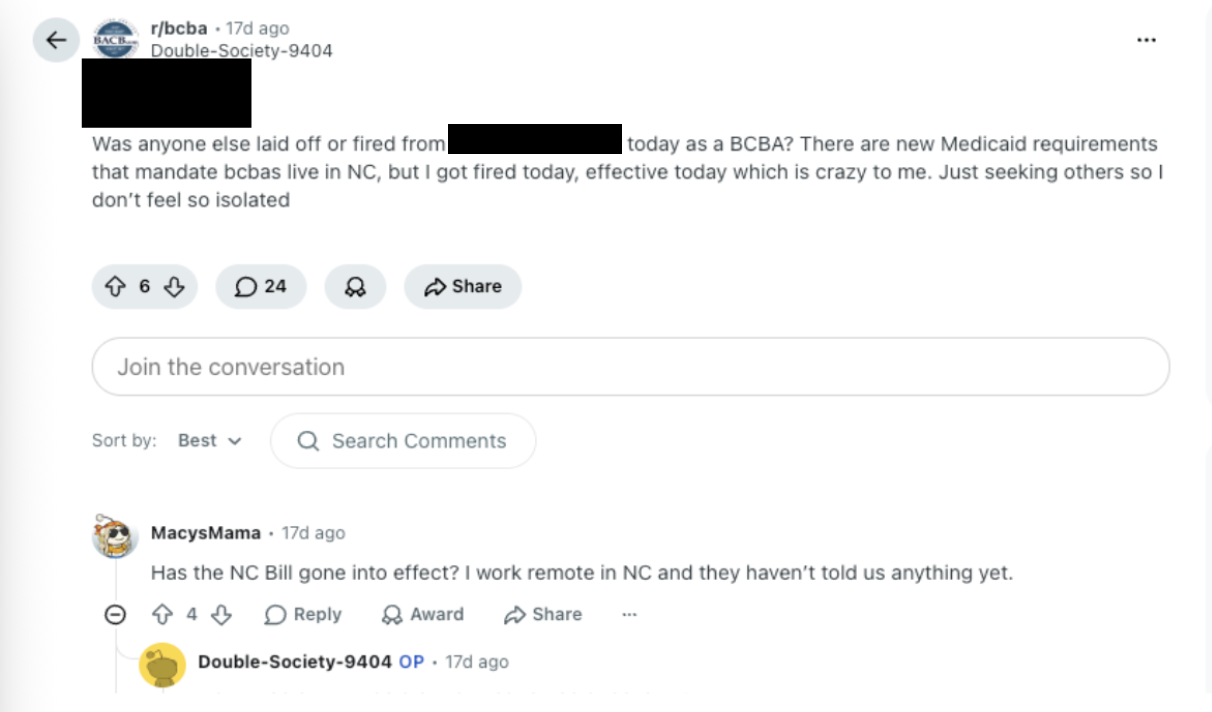
NEW YORK — In May 2026, a thread on the Reddit forum r/ABA surfaced reports of multiple Board Certified Behavior Analysts terminated at a small ABA provider operating in New Jersey, North Carolina, and Virginia, following what posters described as new Medicaid requirements. The reports are unverified and community-sourced. The company did not respond to inquiries. BreakingNewsABA has been unable to independently confirm the specifics of the reported terminations.
But the pattern the reports describe, Medicaid policy changes translating into sudden workforce reductions at ABA providers, is not unverified. It is happening in multiple states simultaneously, driven by a convergence of billing rule changes, rate cuts, documentation requirements, and contract terminations that are reshaping the operating economics of ABA therapy faster than many providers can adapt. The question is no longer whether Medicaid policy changes can trigger BCBA layoffs. The question is how many providers are one policy revision away from the same outcome.
Vermont: The Concurrent Billing Ban
The clearest documented example is Vermont. On November 10, 2025, the Department of Vermont Health Access notified ABA providers that, effective January 1, 2026, it would no longer allow providers to bill Medicaid for concurrent BCBA and behavior technician services. Until that date, Vermont Medicaid had paid for both the behavior technician’s time (delivering direct therapy) and the BCBA’s time (providing clinical supervision and protocol modification) simultaneously. The department characterized the change as a correction to “incorrect coding.” Grace Johnson, a Medicaid policy analyst for the Vermont Agency of Human Services, identified ABA as the “primary area” where the state was acting to avoid potential federal investigations into Medicaid fraud, waste, and abuse.
The impact on Vermont’s approximately 20 ABA providers was immediate. VTDigger reported in March 2026 that the shift caused “a drastic drop in revenue for many ABA providers, one that some say threatens their ability to continue providing services altogether.” Cortney Keene of the Association of Applied Behavior Analysis told VTDigger that eliminating concurrent billing “opens the door for ineffective or possibly harmful services to be provided,” because BCBAs could no longer be present during technician-delivered sessions without absorbing the cost of that supervision time. Brian Marrier of Autism Advocacy Intervention said that “all of these proposed changes happen behind closed doors without engaging with any of us who they’ve engaged with for years.” The Department of Vermont Health Access acknowledged provider concerns and announced it was conducting an ABA rate study to determine whether current payment rates are adequate, but maintained that the billing changes were necessary to protect Vermont from “significant retrospective financial penalties” if the federal government audited the state’s ABA claims.
Alex McCracken, communications director for the Department of Vermont Health Access, framed the change as essential to the long-term sustainability of the ABA benefit itself. “Ultimately, it is DVHA’s goal to preserve the ABA benefit for Medicaid members, and these changes are intended to do that,” McCracken said. The department’s own presentation to the Vermont legislature in February 2026 stated that “Medicaid fraud, waste, and abuse are top enforcement priorities for the current federal administration, putting every state Medicaid program under heightened scrutiny.” Vermont was, in effect, preemptively tightening its own billing rules before the federal government tightened them for the state. The providers caught in the middle were left with less revenue, the same clinical obligations, and no timeline for the rate study results that might restore their margins.

The Vermont example illustrates the mechanism through which a Medicaid billing rule change becomes a workforce event. When concurrent billing was permitted, a center-based ABA program could bill for both the technician and the supervising BCBA during the same session block. Revenue per session was higher, and the cost of BCBA supervision was covered by the billing code. When concurrent billing was eliminated, the revenue per session dropped, but the clinical need for supervision did not. Providers faced a choice: absorb the cost of BCBA supervision from a reduced revenue stream, reduce supervision to the minimum required by licensing standards, or eliminate BCBA positions that the billing structure no longer supported. Each option carries consequences for clinical quality, compliance, and workforce stability.
When concurrent billing was permitted, the cost of BCBA supervision was covered by the billing code. When it was eliminated, the revenue dropped, but the clinical need for supervision did not. Providers faced a choice: absorb the cost, reduce supervision, or eliminate BCBA positions.
Indiana, Arizona, Michigan, Nebraska
Vermont is not an outlier. Indiana implemented the most sweeping ABA Medicaid reform in the country on April 1, 2026. The changes, enacted through the Indiana Health Coverage Programs (IHCP), include restricting ABA coverage to individuals under 21 through Early and Periodic Screening, Diagnostic and Treatment (EPSDT) services, imposing a 4,000-hour lifetime cap on comprehensive ABA (after which members transition to up to 15 hours per week of targeted ABA), introducing new RBT supervision requirements, and restricting telehealth for certain ABA service codes. A six-month transition window allows adults over 21 who were already receiving ABA to continue through September 30, 2026. For providers who had built their caseloads around adult clients or intensive comprehensive ABA programs, the reforms require immediate operational restructuring.
In Arizona, Medicaid managed care organizations terminated contracts with major ABA providers. Mercy Care terminated contracts with Centria Autism Center and Action Behavior Centers. Arizona Complete Health and UnitedHealthcare Community Plan each terminated contracts with Action Behavior Centers. Plaintiffs estimated that up to 1,000 children could lose access to services as a result, though the state’s Medicaid agency AHCCCS disputed the figure. The contract terminations are functionally different from rate cuts or billing rule changes, but the workforce impact is similar: when a provider loses its Medicaid contract in a given market, the clinicians who served those clients face reassignment or termination.
Michigan’s Blue Cross Blue Shield updated its ABA supplemental policy effective January 1, 2026, capping progress notes for technician-delivered ABA (CPT 97153) at two hours and 30 minutes per note and intensifying documentation scrutiny. Vague or incomplete session notes are now among the top reasons for denials and recoupments. The change does not directly reduce rates, but it increases the compliance burden on BCBAs and clinic managers, who must now ensure that every session note meets a higher standard or face claim rejections that translate directly to lost revenue.
Nebraska’s 48% rate cut for technician-level ABA therapy, from approximately $144 per hour to $74.80 per hour, is the most direct version of the pattern: a reimbursement reduction so steep that providers must either accept dramatically lower margins or reduce staff to match the revenue. Nebraska had the highest ABA reimbursement rate in the nation, and the correction was not unexpected. But for the BCBAs and RBTs employed by Nebraska ABA providers, the correction was experienced as a sudden contraction of the labor market in their state.
The pattern is the same in every state, only the mechanism varies. Vermont eliminated concurrent billing. Indiana capped hours and restricted coverage. Arizona terminated contracts. Nebraska cut rates by 48%. Michigan tightened documentation. The result is the same: providers restructure, and clinicians lose positions.
The Federal Overhang
The state-level changes are unfolding against a federal backdrop that amplifies the pressure. The One Big Beautiful Bill Act includes an estimated $911 billion in projected federal Medicaid spending reductions between 2025 and 2034, with roughly 10 million people expected to lose coverage. Semi-annual eligibility redeterminations will begin in 2027, replacing the current annual cycle and creating additional churn in the Medicaid-enrolled population that ABA providers serve. Medicaid work requirements, effective January 1, 2027, will add further complexity. SAMHSA, the federal agency that funds behavioral health grants, training programs, and the national crisis hotline, has experienced significant staff reductions under the current administration’s HHS reorganization.
For ABA providers, each federal action compounds the state-level changes. A provider in Vermont dealing with the concurrent billing ban is simultaneously preparing for OBBBA-driven Medicaid enrollment losses. A provider in Indiana restructuring around the 4,000-hour cap must also navigate tighter OIG scrutiny. A provider in Nebraska absorbing the 48% rate cut faces the additional administrative cost of semi-annual redeterminations that may move clients in and out of Medicaid coverage every six months. The compliance burden is multiplicative, not additive, and the providers least equipped to absorb it are the independent operators with thin margins and limited administrative infrastructure.
What This Means for the Workforce
The ABA workforce is already operating under strain. The BACB reports roughly 83,586 BCBA-level clinicians nationally as of April 2026, while analysts estimate the country would need several times that number to meet demand across the autism population alone. Employers posted 132,307 open BCBA positions in 2025, a 28% increase over the prior year, leaving a gap of roughly 50,000 positions against the certified workforce. Annual RBT turnover ranges from about 77% at smaller providers to over 100% at large multi-state operators, with replacement costs estimated at $15,000 to $25,000 per therapist. Into this environment, states are introducing policy changes that reduce provider revenue, increase documentation burden, restrict billable service configurations, and terminate contracts, all of which translate to fewer paid hours, fewer positions, and fewer reasons for BCBAs and RBTs to stay in the field. A BCBA who loses a position because Vermont eliminated the billing code that funded her supervision time does not necessarily find another BCBA position in the same market. She may leave the field entirely, worsening the shortage that already leaves half of U.S. counties without a single behavior analyst.
The retention crisis is compounded by the nature of the policy changes. Rate cuts reduce compensation. Documentation requirements increase administrative burden without increasing pay. Hour caps limit caseload size and therefore income. Contract terminations uproot client relationships that took months to build. Each of these changes makes ABA practice less attractive relative to other career paths available to BCBAs, many of whom hold master’s degrees and could work in education, consulting, organizational behavior, or corporate training. The field’s ability to retain its existing workforce depends on the conditions of practice, and every policy change that degrades those conditions pushes the workforce toward attrition rather than stability.
The unverified reports stemming from the Reddit post, if they reflect a real event, would represent one small example of a dynamic that is playing out at scale. Easterseals Port Health in Wilmington, North Carolina, announced in early 2026 that it would discontinue its ABA program entirely, affecting more than a dozen families. Vermont providers have warned that they may not survive the concurrent billing ban. Arizona families are suing over lost access after contract terminations. The pattern is consistent: when Medicaid rules change, the adjustment costs are borne first by the providers, then by the clinicians who work for them, and ultimately by the families whose children depend on continuity of care. The policy changes may be justified. The coding corrections may be necessary. The impact is real, it is immediate, and it is accelerating.
AT A GLANCE
| Vermont: | Concurrent billing ban effective Jan 1, 2026; drastic revenue drop for ~20 ABA providers; some warn of inability to continue |
| Indiana: | EPSDT-only (under 21), 4,000-hour lifetime cap on comprehensive ABA (then up to 15 hrs/wk targeted), new RBT supervision rules, telehealth restricted for key codes; effective April 1, 2026 |
| Arizona: | Mercy Care terminated Centria + Action Behavior Centers; UHC + AZ Complete Health terminated Action Behavior Centers; up to 1,000 children at risk |
| Michigan: | BCBS updated ABA policy Jan 1, 2026; progress notes capped at 2.5 hrs (10 units); documentation now top denial reason |
| Nebraska: | 48% rate cut for technician ABA ($144/hr to $74.80/hr); 37% cut for BCBA-level services |
| Federal (OBBBA): | $911B in projected Medicaid cuts 2025-2034; ~10M projected to lose coverage; semi-annual redeterminations and work requirements begin 2027 |
| OIG audits: | ~$200M improper payments across 4 states (IN, WI, ME, CO); 7 states targeted |
| SAMHSA: | Significant staff reductions under HHS reorganization; behavioral health grant and training funding disrupted |
| Workforce strain: | ~83,586 certified BCBAs (April 2026) against a gap of roughly 50,000 unfilled positions; 132,307 open BCBA postings in 2025 (+28%); RBT turnover ~77% to over 100% |
| Closures: | Easterseals Port Health (NC) discontinued ABA; Vermont providers warn of closure; AZ families suing over access |
| Pattern: | Billing changes, rate cuts, contract terminations, and documentation rules all translate to workforce restructuring |
Breaking News ABA Editorial Team