


On November 6, the ABA Coding Coalition posted an updated version of its guide to the 14 billing codes that will cover ABA services starting January 1, 2027, and 3 of its instructions bear on everyday billing work. The guide tells billers to report the assessment code, 97151, on each day assessment work is done. It has them report 97180, the new code for specified indirect work a BCBA or other qualified clinician does on a case without the client present, once a week, with the week’s time totaled on one claim line. It also limits 97155, the code that has covered both directing a technician and a BCBA’s own treatment sessions, to direction with the client present.
The Coalition, which developed the code-change application behind the 2027 set, includes representatives from the Association for Behavior Analysis International, the Association of Professional Behavior Analysts, the Behavior Analyst Certification Board, and the Council of Autism Service Providers, plus two consultants. It calls the document supplemental guidance to the CPT code book (Current Procedural Terminology, the AMA’s billing code system) and says the guide’s examples and answers “are not intended to establish medical necessity criteria, staffing practices, or treatment or documentation standards.” The guide runs 36 pages. The Coalition first published it October 5, about a month after the AMA released the 2027 code set, and the November revision came with no note on what changed.
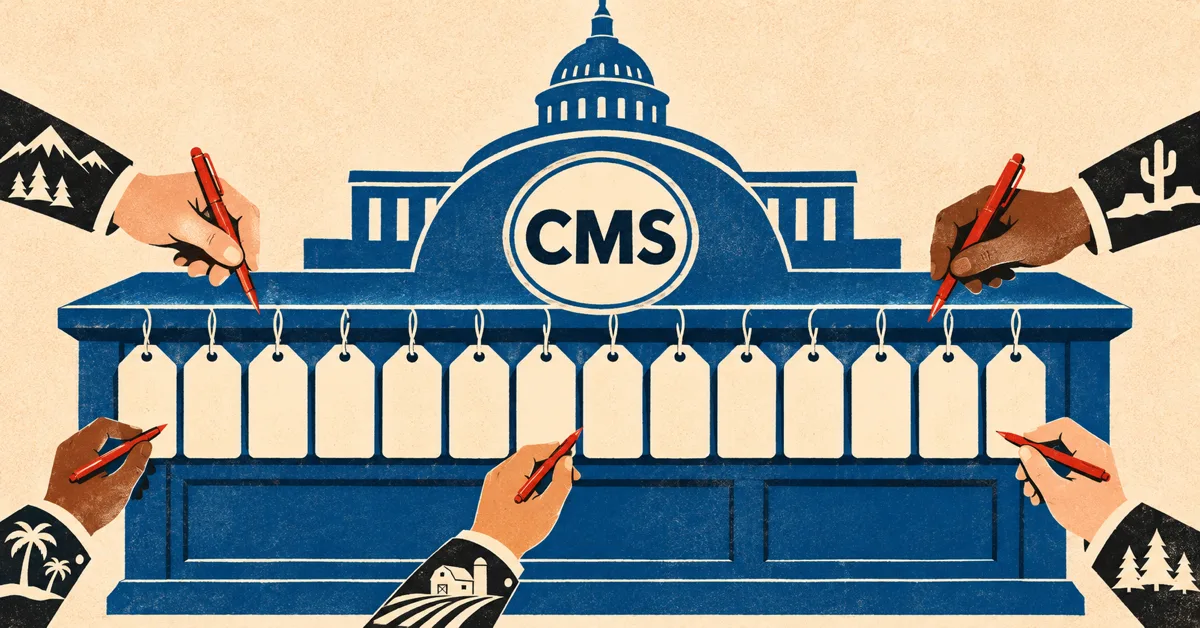
Two days before the Coalition’s update, CMS settled how Medicare will treat the codes. Its final 2027 fee schedule, released November 4 and published in the Federal Register on November 9, keeps all 14 codes contractor-priced, meaning each Medicare contractor sets its own rate and CMS publishes none. It adds 5 of the 6 new codes to the Medicare Telehealth Services List, the services Medicare can pay for when they are delivered by telehealth and its other coverage and billing rules are met. The sixth, 97180, stays off because, CMS said, it is a non-face-to-face service.
How 97151 and 97180 Get Reported
The 97151 instruction departs from how the Coalition reads the AMA’s own published advice. A November 2018 article in CPT Assistant, the AMA’s coding newsletter, said the code “should be reported by aggregating the total time” needed to complete an assessment, “even if the time is not continuous and occurs over multiple days.” The guide reads that as a direction to report the code once, after all the work concludes. It recommends instead reporting 97151 on each day assessment activity occurs, whether that day is spent face-to-face with the client or caregivers or on scoring results and writing the plan.
The Coalition’s stated reason is Medicare’s medically unlikely edit, or MUE, for the code: an automated check on the units one provider reports for one person on one date of service. In CMS’s file effective October 1, 2026, the edit for 97151 is 8 units, or 2 hours, which the guide says is fewer than are typically authorized, so reporting a whole assessment at the end “is currently not possible.” The edit is not an absolute ceiling, though. CMS classes it as a clinical edit, and its claims manual says Medicare contractors may pay correctly coded, medically necessary units above it on appeal. The guide also tells billers never to report 97151 and 97180 on the same day for the same client.
The new code 97180 covers specified work a BCBA does on a case outside the session, work the guide says was “not previously separately reportable.” The code book’s term for that clinician is a physician or other qualified health care professional, or QHP, which the AMA defines as someone qualified by education, training, and licensure or regulation to perform a service within their scope of practice and report it independently. In ABA, that is usually a BCBA, but the credential alone does not settle it: whether a clinician can report a given code depends on state licensure, scope of practice, and each payer’s rules. The covered work is reviewing data and session notes; deciding whether to change treatment targets or protocols (the written procedures technicians follow) and making those changes; deciding whether more assessment is needed; planning a discharge or transition; and training technicians on a specific client’s protocols when the client is not present.
The guide has billers report that work once a week. Citing CPT guidance, it says the time “may be aggregated and reported for a 7-day reporting period” (Sunday through Saturday, for example) as long as each day’s work is documented individually. Billers round each day’s time to 15-minute units, add up the week, and put the total on a single line of the claim. A footnote under two of the guide’s example tables is more direct: “For billing purposes, only report once per week by summing the total time spent” on that work for each client “during the preceding 7 days.” In one of the guide’s examples, 5 hours of such work across 4 days becomes 20 units on a single claim.
Some indirect work stays off that claim. Writing session notes does not count, the guide says. Neither does training technicians in general behavior-analytic principles, CPR, or agency policy; reviewing records for an audit or compliance check; or handling the administrative side of a discharge, such as preparing payer notices, transferring records, or emailing a client’s parents.
Families may owe money on the code. Because 97180 is reported separately from every other code in the set, the guide says, a deductible, copay, or coinsurance may apply, depending on the health plan, even though the client is not present. When the week goes on one claim line, the guide adds, the cost-share applies to one date of service, not to each day the work was done.
The 97155 Split and Other Rules
Under the current set, 97155 does double duty: a BCBA directing a technician during a session and a BCBA treating a client one-on-one while adjusting the protocol both go on the same code. In 2027, the second use moves to a new code, 97173, and 97155 “is no longer a dual-use code,” the guide says. A BCBA reports 97155 when face-to-face with the client and a technician, either directing the technician’s work, which includes correcting errors in how a procedure is carried out, or observing the session to analyze whether the protocol needs adjusting. Direction “is always paired with another code,” the guide says, usually a technician’s, such as 97153, the code for a technician’s one-on-one treatment. The guide describes one exception and calls it uncommon: a BCBA directing another BCBA, on a specific client’s protocols, while that BCBA leads a group billed under 97158. One BCBA cannot bill 97153 and 97155 for the same minutes.
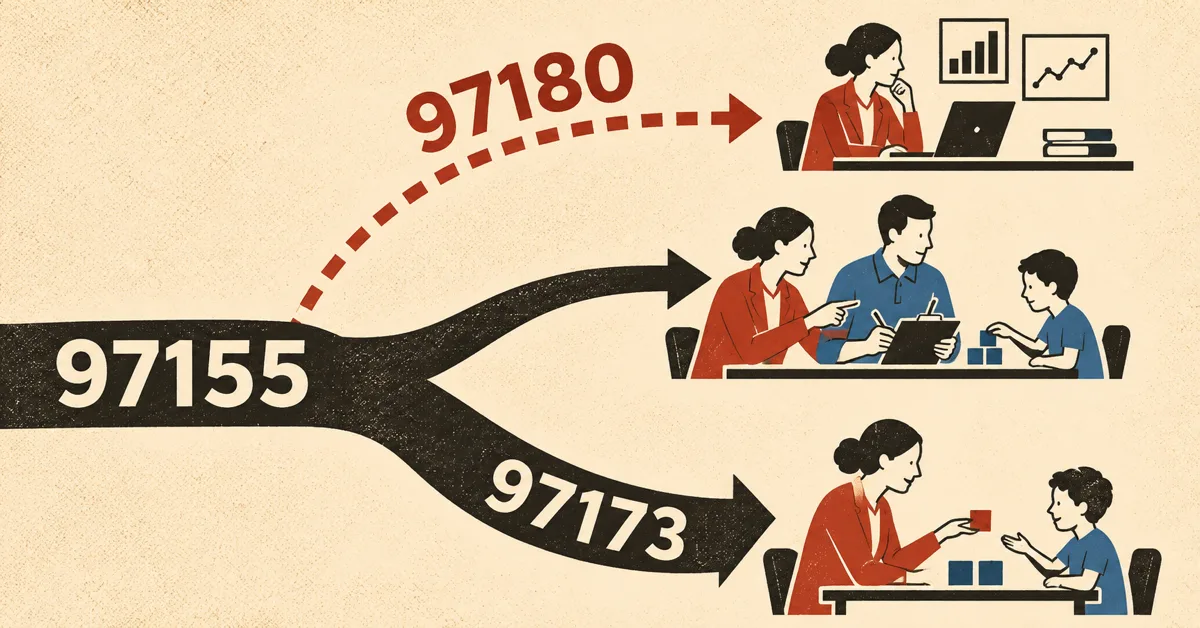
The new code 97173 covers a BCBA’s own treatment of one client and includes the BCBA’s analysis of whether the treatment needs adjusting, so 97155 cannot be billed on top of it. In the Coalition’s sample 26-week authorization, 312 units of 97155 in 2026 become 208 units of 97155 and 104 units of 97173 in 2027, plus 52 units of 97180, half an hour a week, for work the table marks “Currently not reportable.” When a technician cancels and a BCBA fills in, simply running the session as the technician would have, the BCBA reports 97153, the technician code, “even though the session was conducted by a QHP.”
The cap of 8 clients on the group codes (97154 for technician-run groups, 97157 for multiple-family caregiver groups, and 97158 for BCBA-run groups) is gone from the 2027 set, and billers report each code once for every client, or family, attending. The 2027 code book, the guide notes, also broaden who counts as a caregiver under the family guidance code, 97156, to “a patient’s parents or other family members, legal guardians, babysitters, nannies, teachers, or day care providers,” though payers may use their own definition.
The two-technician codes, 97148 for assessment and 97159 for treatment, require two technicians, a client who exhibits what the 2027 set calls harmful behavior, and a setting customized to that behavior. The temporary codes they replace said destructive behavior. The guide defines the new term as any behavior “that jeopardizes the patient’s health or safety or poses a risk of harm or medical consequences for the patient or others.” Its examples run from self-injury, aggression, and property destruction to feeding difficulties, sleep difficulties, and resistance to dental and medical care. A BCBA or other QHP must be on site and immediately available to join the session, a requirement the guide says telehealth can meet where clinically appropriate (and, for the treatment code, medically necessary), subject to each payer’s policy and each state’s rules.
How CMS Explained Its Decisions
CMS priced none of the codes. An AMA committee that advises Medicare on code values reviewed all 14 in January 2026 and recommended contractor pricing, and when a commenter asked for national rates on 97173 and 97180, CMS declined, writing that “the existing payment models and practice patterns are varied.” The telehealth additions came after commenters pointed out that the Medicare telehealth list still carried codes being deleted for 2027. CMS acknowledged it had “inadvertently maintained” the deleted ABA codes and treated the new codes as their replacements.
CMS said nearly all commenters supported adopting the codes and many asked for the telehealth additions. It also recorded one commenter’s warning that the new codes, 97180 in particular, “created heightened risks of insufficient documentation, upcoding, and duplicative or concurrent billing, potentially increasing spending without clear evidence of additional clinical value.” CMS answered that the new coding “better defines these services and provides a more comprehensive framework than the prior, more patchwork methods of reporting.”
What the Guide Leaves to Payers
Every payer that accepts electronic claims has to adopt the new codes, the guide says, because all 14 are now permanent Category I codes and HIPAA requires such payers to use them. But to the question of whether every payer must implement them as of January 1, the guide answers no. “Payers have their own procedures and timelines for implementing new codes,” it says, “so providers must obtain that information from each payer with whom they work.”
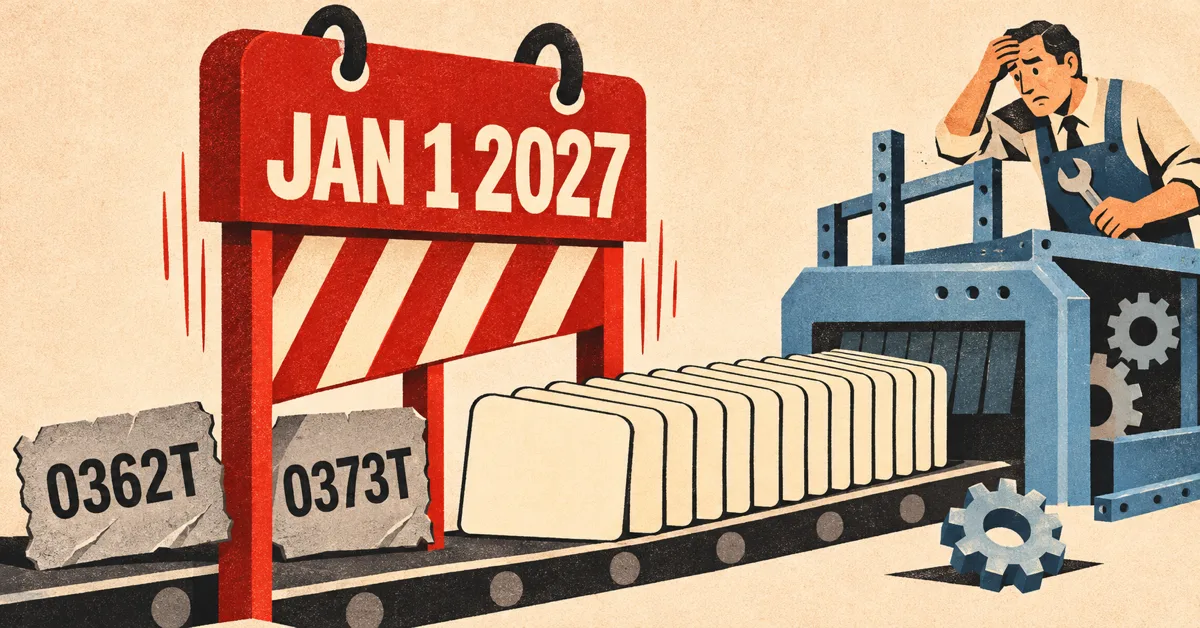
The federal rule behind the first answer applies to health plans covered by HIPAA. It requires them to accept and “promptly process any standard transaction that contains codes that are valid,” and it ties a medical code’s validity to the date the care is furnished and to the dates set by the organization that maintains the code set, here the AMA. The rule does not address coverage, payment rates, or authorizations, a point the guide makes too. For the retiring codes, the guide says there is no grace period: 0362T and 0373T, the temporary codes for assessing and treating destructive behavior, “are invalid for dates of service on or after January 1, 2027.”
Before providers can use the new codes, the guide says, commercial payers must add them to their claims systems and publish billing guidance; update fee schedules, amend contracts, or both; and issue new authorizations, guidance on whether they will honor current authorizations that include deleted codes, or both. For state Medicaid agencies, the guide's steps begin with developing rates and include deciding whether the change requires a state plan amendment, which CMS must approve.
“Don’t assume payers will contact you. Send each of them a letter to alert them about the new codes.” – ABA Coding Coalition, Preparing for Implementation of the 2027 CPT Codes for Adaptive Behavior Services (October 2026)
The Coalition’s advice is to get each payer’s plans in writing before January 1: its implementation date, its crosswalk (the mapping of each old code to the code that replaces it), its rate for each new code, and its handling of authorizations and of claims that straddle the changeover. The Coalition’s October 8 payer-letter package includes a template that requests those confirmations, and it tells providers to send one to every payer they bill rather than wait to be contacted.
The October document also says the Coalition is developing a model coverage policy, updated website FAQs, and updates to the 2027 claim edits on daily units and code pairs “for dissemination over the next few months.”
AT A GLANCE
| Document: | Supplemental Guidance on Interpreting and Applying the Revised 2027 CPT Codes for Adaptive Behavior Services, 36 pages (ABA Coding Coalition; posted October 5, 2026; updated November 6, 2026) |
| Effective date: | January 1, 2027; 0362T and 0373T invalid for dates of service on or after that date, with no grace period (Coalition guidance) |
| 97151 (assessment): | Coalition recommends reporting on each date of service; Medicare MUE is 8 units per day in CMS’s October 1, 2026 file, a clinical edit that can be exceeded on appeal; never on the same day as 97180 for the same client (Coalition guidance; CMS) |
| 97180 (non-face-to-face): | Report once per week: document and round each date of service, then total the 7-day period on a single claim line; excludes session notes, general technician training, audit or compliance review, and administrative discharge tasks (Coalition guidance, citing CPT guidance) |
| 97155 and 97173: | 97155 for directing a technician with the client present (in one uncommon case, another BCBA leading a 97158 group), always paired with another code; 97173 for a BCBA’s or other QHP’s own one-on-one treatment with analysis (Coalition guidance) |
| Unit rule: | 15-minute units; 8 to 22 minutes is 1 unit; under 8 minutes not reportable (Coalition guidance) |
| Payer timing: | HIPAA rules require covered health plans to accept and promptly process standard transactions with codes valid on the date of service (45 CFR 162.925); the guide says payers have their own implementation procedures and timelines; coverage, rates, and authorizations are set payer by payer |
| CMS final rule: | All 14 codes contractor priced; 97148, 97149, 97159, 97160, and 97173 added to the Medicare telehealth list; 97180 not added (91 FR 71023 and 71079–71080, November 9, 2026) |
SOURCES & REFERENCES
| 1. | ABA Coding Coalition. Supplemental Guidance on Interpreting and Applying the Revised 2027 CPT Codes for Adaptive Behavior Services. Updated November 2026 (posted November 6, 2026; accessed November 12, 2026). https://abacodes.org/wp-content/uploads/2026/11/2027-CPT-Supplemental-Guidance.pdf |
| 2. | ABA Coding Coalition. “2027 Supplemental Guidance Article.” Resource page, updated November 6, 2026. https://abacodes.org/resource/aba-coding-coalition-releases-2027-supplemental-guidance-article/ |
| 3. | ABA Coding Coalition. “ABA Coding Coalition Releases 2027 Supplemental Guidance Article.” News post. October 5, 2026. https://abacodes.org/aba-coding-coalition-releases-2027-supplemental-guidance-article/ |
| 4. | ABA Coding Coalition. Preparing for Implementation of the 2027 CPT Codes for Adaptive Behavior Services: Suggestions for Applied Behavior Analysis Providers. October 2026 (posted October 8, 2026). https://abacodes.org/wp-content/uploads/2026/10/ABA-Codes-Suggestions-for-Providers-w-template-ltr-10.8.26.pdf |
| 5. | Centers for Medicare & Medicaid Services. Medicare and Medicaid Programs; CY 2027 Payment Policies Under the Physician Fee Schedule and Other Changes to Part B Payment and Coverage Policies; Medicare Shared Savings Program Requirements; and Medicare Prescription Drug Inflation Rebate Program. Final rule (CMS-1848-F). 91 FR 70992, November 9, 2026; Medicare telehealth discussion at 71023 and Adaptive Behavior Services item at 71079–71080. https://www.govinfo.gov/content/pkg/FR-2026-11-09/html/2026-22743.htm |
| 6. | Centers for Medicare & Medicaid Services. “CMS-1848-F.” Federal regulation notice page; display date November 4, 2026, publication date November 9, 2026. https://www.cms.gov/medicare/payment/fee-schedules/physician/federal-regulation-notices/cms-1848-f |
| 7. | ABA Coding Coalition. About Us. Page modified August 7, 2026; accessed November 9, 2026. https://abacodes.org/about/ |
| 8. | ABA Coding Coalition. Frequently Asked Questions. Page last modified December 10, 2024; accessed November 12, 2026. https://abacodes.org/frequently-asked-questions/ |
| 9. | American Medical Association. “AMA releases CPT 2027 code set.” Press release. September 9, 2026. https://www.ama-assn.org/press-center/ama-press-releases/ama-releases-cpt-2027-code-set |
| 10. | American Medical Association. “Coding Update: Reporting Adaptive Behavior Assessment and Treatment Services in 2019.” CPT Assistant. November 2018;28(11):3–6. https://ababcc.abainternational.org/wp-content/uploads/2019/10/CPT-Assistant.pdf |
| 11. | Centers for Medicare & Medicaid Services. Medicare NCCI Practitioner Services MUE Table, effective October 1, 2026 (posted September 1, 2026). https://www.cms.gov/medicare/coding-billing/national-correct-coding-initiative-ncci-edits/medicare-ncci-medically-unlikely-edits |
| 12. | Centers for Medicare & Medicaid Services. Medicare Claims Processing Manual, Chapter 23, section 20.9.3.2 (Rev. 14428, issued June 16, 2026). https://www.cms.gov/Regulations-and-Guidance/Guidance/Manuals/downloads/clm104c23.pdf |
| 13. | 45 CFR 162.925(c), 162.1000(a), 162.1002, and 162.1011 (HIPAA transaction and code set standards). Electronic Code of Federal Regulations, current as of October 2026. https://www.ecfr.gov/current/title-45/subtitle-A/subchapter-C/part-162 |