


BALTIMORE, MARYLAND – Maryland Medicaid providers can now bill for up to 150 days of supervised applied behavior analysis (ABA) delivered by a new behavior technician working toward certification. A law that took effect Oct. 1 extended the previous 90-day window. The 150 days begin when the technician first provides ABA to Medicaid recipients.
The Maryland Department of Health (MDH) told legislative analysts it preferred to enroll only registered behavior technicians (RBTs). In an analysis cited by the Department of Legislative Services, MDH found that just 28% of technicians earned that credential by the end of the former 90-day period.
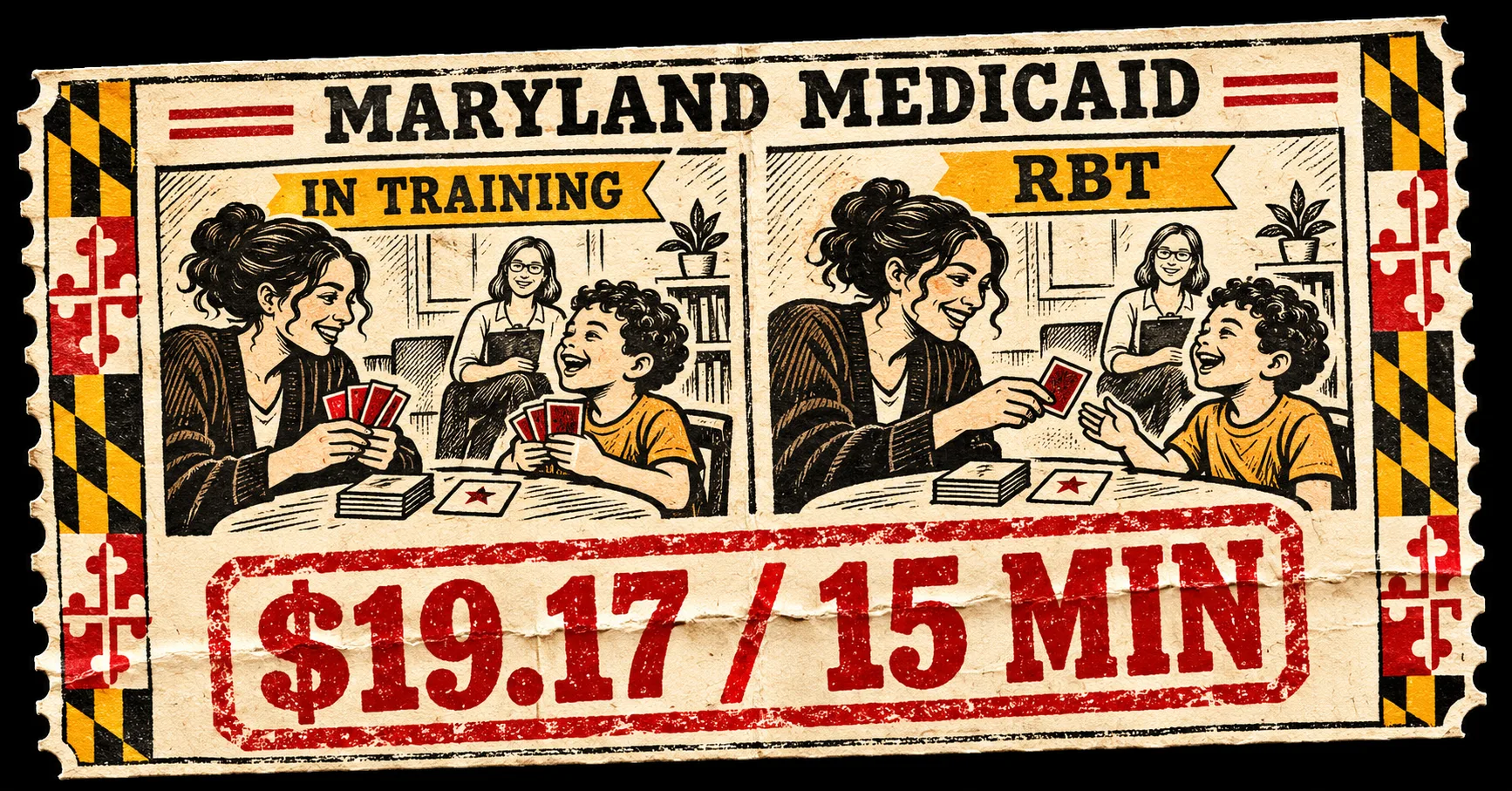
For eligible Medicaid members under 21 with autism, the state covers medically necessary, authorized ABA. Its fee schedule lists $19.17 per 15 minutes of one-on-one treatment by protocol (CPT 97153) when either an RBT or an enrolled, uncertified technician delivers it. Medicaid pays the enrolled ABA program, licensed psychologist, or licensed behavior analyst.
Legislative analysts warned in their fiscal note that many technicians deliver therapy before completing their training and that a longer window “is likely to exacerbate this challenge.” The Behavioral Intervention Certification Council told lawmakers that allowing supervised work during training could help families avoid interruptions in care. For both certified and uncertified technicians, Medicaid requires direction by a licensed psychologist or licensed, board-certified behavior analyst for at least 10% of direct ABA hours with a participant or group.
Sen. Cory McCray sponsored SB 898. The final version passed the House 136–0 and the Senate 45–0 on April 13. No witness registered in opposition at either hearing. On May 22, Gov. Wes Moore told Senate President Bill Ferguson he would let the bill become law without his signature. His letter gave no reason specific to SB 898.
Backdated Enrollment and a 150-Day Clock
During the switch to MPRIME, Maryland’s new enrollment system, MDH paused new technician applications on Aug. 1. Its Oct. 6 notice allows a technician who submits a complete application by Dec. 31, 2026, and receives approval to backdate enrollment as far as Aug. 1. Providers must wait for approval before billing for that period.
The August backdate comes from MDH’s transition notice. The law itself excludes anyone who provided ABA services before Oct. 1, even though the notice gives some earlier starters access to the 150-day enrollment window.
Technicians “are only eligible to be enrolled for a 150-day period,” the notice says. That period runs from the enrollment effective date. Providers can enter a later start in the application’s “Issuance Date” field. MDH gives the example of a technician who first served Medicaid participants on Sept. 1, 2026. Using that date would extend enrollment through Jan. 29, 2027, according to the notice.
Changing employers does not restart the 150 days. The provider manual requires technicians to submit proof of RBT certification in a new MPRIME application within the window to keep their Medicaid enrollment active. Carelon Behavioral Health administers the ABA program. MDH handles enrollment.
A technician whose temporary enrollment expires can still submit a new application to enroll as an RBT. For new technician applications filed after Dec. 31, providers must use the submission date as the effective date.
“MDH advises that its preference is to exclusively enroll fully certified RBTs to ensure an appropriate standard of care and streamline the oversight and administrative processes.” – Fiscal and Policy Note on SB 898, Maryland Department of Legislative Services (2026)
How the House Changed the Bill
McCray’s original bill already included the 150 days. On April 10, the House adopted amendments from its Health Committee. One added a condition under which the law could end. Another changed how the state recognizes credentials.
The law ends automatically if the U.S. Department of Health and Human Services tells MDH by June 30, 2027, through written policy, an audit finding, or other guidance, that the reimbursement provision conflicts with Section 1902(a)(27) of the Social Security Act. MDH would have five days to notify state legislative analysts.
That federal provision requires Medicaid provider agreements to cover two obligations. Providers must keep records showing the extent of services they deliver and supply information about claimed payments when the state Medicaid agency or the federal health secretary requests it. The law and its fiscal note do not identify a specific conflict.
The House also removed the bill’s explicit reference to the Behavior Analyst Certification Board (BACB), which issues the RBT credential. The law allows MDH to require certification from “a credentialing entity recognized by the Department.” The department’s October notice still calls for RBT certification.
The law directs MDH to adopt implementing regulations. As of Nov. 10, the published ABA regulation still defined an uncertified technician as “a paraprofessional in the process of obtaining BACB certification” and specified 90 days from Medicaid enrollment. The department’s October manual and enrollment notice both give technicians 150 days.
AT A GLANCE
| The law: | SB 898 (Chapter 867), sponsored by Sen. Cory McCray, became law without the governor’s signature May 31, 2026. It took effect Oct. 1. |
| Certification window: | 150 days from first ABA services to Medicaid recipients for technicians covered by the law. It excludes anyone who provided ABA before Oct. 1. |
| MDH analysis: | MDH found that 28% of technicians earned RBT certification by the end of the former 90-day window. |
| Provider rate: | $19.17 per 15 minutes of one-on-one treatment under CPT 97153 for either technician category. |
| Backdate: | Approved new MPRIME applications submitted by Dec. 31, 2026, may take effect as early as Aug. 1. The effective date starts the enrollment window. |
| Employer changes: | Changing employers does not restart the 150 days. |
| Federal clause: | Law ends if HHS advises MDH by June 30, 2027, of a conflict with the federal Medicaid provider-agreement requirement. |
SOURCES & REFERENCES
| 1. | Maryland General Assembly. Chapter 867 of 2026 (SB 898), Maryland Medical Assistance Program – Behavior Technicians – Reimbursement. May 31, 2026. https://mgaleg.maryland.gov/2026RS/Chapters_noln/CH_867_sb0898e.pdf |
| 2. | Maryland Department of Health. Maryland Medicaid ABA Provider Manual. Effective Oct. 1, 2026, pp. 3, 5, 7, 10, and 15. https://health.maryland.gov/mmcp/epsdt/ABA/Documents/ABA-Provider-Manual-10_1_26v2.pdf |
| 3. | Jennifer B. Chasse, Maryland Department of Legislative Services. Fiscal and Policy Note, SB 898 (Enrolled – Revised). April 14, 2026, pp. 2–3. https://mgaleg.maryland.gov/2026RS/fnotes/bil_0008/sb0898.pdf |
| 4. | Code of Maryland Regulations. COMAR 10.09.28, Applied Behavior Analysis Services. See .01B(5), .02J, and .06B–C. Accessed Nov. 10, 2026. https://regs.maryland.gov/us/md/exec/comar/10.09.28/index.full.html |
| 5. | Sarah Bannat, Behavioral Intervention Certification Council. “SB 898 – Support as Amended.” Letter to Sen. McCray filed with the Senate Finance Committee. Feb. 26, 2026. https://mgaleg.maryland.gov/cmte_testimony/2026/fin/1wZqQ5QcafdzPnj4JeXfSRiryvc0EilAF.pdf |
| 6. | Maryland General Assembly. SB 898, 2026 Regular Session. Legislative history, roll calls, and enactment. Updated June 30, 2026. https://mgaleg.maryland.gov/mgawebsite/Legislation/Details/SB0898?ys=2026RS |
| 7. | Maryland General Assembly. SB 898 witness signups, Senate Finance Committee (March 10, 2026) and House Health Committee (March 31, 2026). https://mgaleg.maryland.gov/mgawebsite/Legislation/WitnessSignup/SB0898?ys=2026RS |
| 8. | Gov. Wes Moore. Letter to Senate President Bill Ferguson listing bills becoming law without his signature. May 22, 2026. https://governor.maryland.gov/media/894/download |
| 9. | Charles Crisp, Maryland Department of Health. “Newly Enrolling Behavioral Technician Enrollment Backdates.” PT 39-27 (ABA Transmittal No. 12). Oct. 6, 2026. https://health.maryland.gov/mmcp/provider/Documents/transmittals/PT39-27_Newly_Enrolling_Behavioral_Technician_Enrollment_Backdates.pdf |
| 10. | Charles Crisp, Maryland Department of Health. “MPRIME Launch: Day One Provider Actions and Enrollment Policy Updates.” PT 36-27. Oct. 8, 2026, pp. 1–2. https://health.maryland.gov/mmcp/provider/Documents/transmittals/PT36-27_MPRIME_Launch_Day_One_Provider_Actions_and_Enrollment_Policy_Updates.pdf |
| 11. | Maryland General Assembly. SB 898, First Reader. Feb. 6, 2026, p. 3. https://mgaleg.maryland.gov/2026RS/bills/sb/sb0898F.pdf |
| 12. | Maryland General Assembly, House Health Committee. Amendment 673828/1 to SB 898. Adopted April 10, 2026. https://mgaleg.maryland.gov/2026RS/amds/bil_0008/SB0898_67382801.pdf |
| 13. | U.S. Social Security Administration. Social Security Act §1902(a)(27), 42 U.S.C. §1396a(a)(27). https://www.ssa.gov/OP_Home/ssact/title19/1902.htm |
| 14. | Behavior Analyst Certification Board. “Registered Behavior Technician (RBT).” Accessed Nov. 10, 2026. https://www.bacb.com/rbt/ |