

What the Toolkit Does
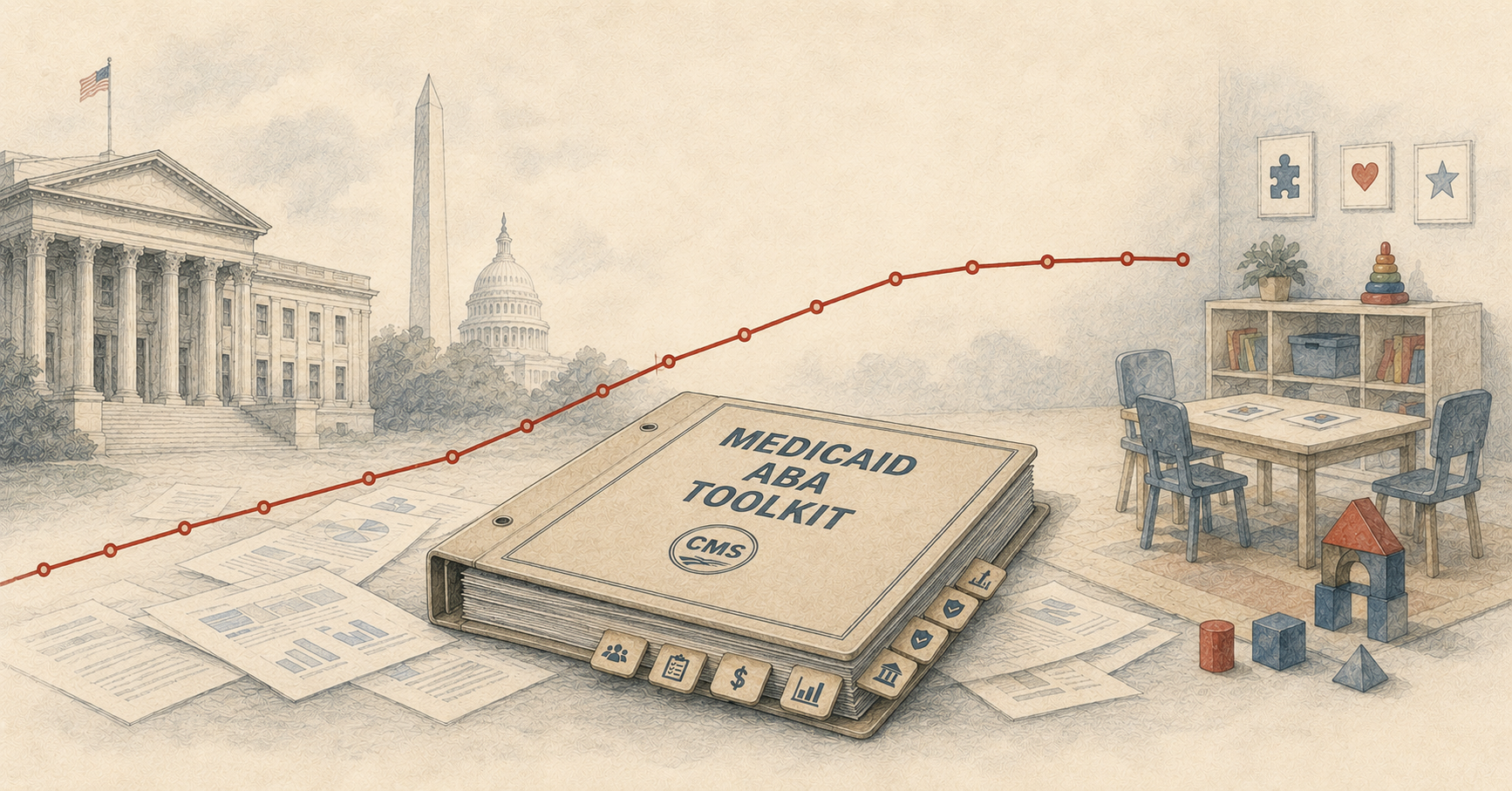
CENTERS FOR MEDICARE & MEDICAID SERVICES — CMS has released a 173-page framework for states that covers clinical standards, benefit design, payment, provider enrollment, utilization management, and program integrity.
The document is guidance, not a new regulation. CMS says it does not create new federal requirements, reduce EPSDT obligations, endorse a single approach to ABA, or direct states to limit medically necessary care.
Instead, CMS asks states to review whether their ABA programs deliver individualized, evidence-based services through qualified providers. The agency also tells states to tailor any changes to their own program structures, populations, and priorities.
The recommendations arrive as ABA use and spending continue to grow. CMS data show a 189% increase in the number of children with an autism diagnosis who received ABA between 2021 and 2025, while spending rose 421%.
That growth explains the federal attention; however, the toolkit reaches far beyond billing enforcement. Its core questions are how care is authorized, who delivers it, how progress is measured, and whether children and families can still reach medically necessary services.
The Guidelines States Are Being Asked to Review
The first focus is clinical need. CMS encourages diagnostic evaluations by qualified, licensed providers using direct observation, caregiver input, standardized tools, and multidisciplinary evaluation when a child’s needs call for it.
The toolkit also urges states to require an individualized treatment plan, or ITP, that covers baseline functioning, measurable goals, treatment intensity, setting, supervision, caregiver training, and transition or discharge criteria.
Authorization decisions should follow that plan, according to CMS, rather than a standard package of hours. Reauthorization should consider progress data, treatment response, hours delivered, and current functional needs.
For utilization management, CMS recommends prior authorization before treatment, concurrent review during care, and reauthorization near the end of an approved period. Reviewers should have expertise in ABA or developmental-behavioral health.
The guidance allows states to use weekly hour limits, but it says those limits should be “soft,” individualized, and open to exceptions when medically necessary under EPSDT. Higher-intensity care may require more frequent outcome reviews.
CMS also asks states and providers to build in time for daily living. Treatment schedules should account for eating, toileting, napping, and other basic needs, with written policies that keep those routines from being pushed aside.
Provider rules receive the same attention. CMS recommends completed licensure and certification before payment, clear supervision standards for technicians, accurate ownership records, and 1 to 2 hours of supervision for every 10 hours of direct treatment.
Telehealth should support care, not become the only form of ABA. The toolkit describes caregiver coaching, treatment supervision, team meetings, and progress reviews as its strongest uses, while encouraging states to keep in-person assessment and observation in the process.
What This Means for Providers and Families
For providers, the message is practical. Treatment plans, session notes, supervision records, caregiver training, and progress data will need to line up with the services billed and the child’s current needs.
The toolkit also asks states to review whether payment rates support access and quality. If states consider bundled, per diem, or value-based payment, CMS tells them to watch for incentives that could lead to underservice, early discharge, or avoidance of children with higher support needs.
Families are not excluded from the framework. CMS says states should explain alternatives to ABA, give parents a clear ability to decline it, build caregiver involvement into the treatment plan, and allow flexibility when families face schedule or caregiving constraints.
What States Do Next
CMS included six state checklists and a consolidated list of suggested practices. States can use them to compare existing policies with the federal framework. Still, the next steps will depend on each state’s Medicaid design and whether officials choose to revise manuals, contracts, authorization rules, payment methods, or provider requirements.
AT A GLANCE
| Toolkit status: | Advisory guidance; it does not create new federal requirements (CMS) |
| Core policy areas: | Clinical standards, coverage, payment, providers, utilization management, and program integrity |
| Treatment plans: | Individualized goals, intensity, supervision, caregiver training, and transition criteria |
| Authorization approach: | Prior authorization, concurrent review, and reauthorization tied to clinical need |
| Service limits: | “Soft” limits with individualized EPSDT exceptions when medically necessary |
| Supervision benchmark: | 1–2 hours of supervision for every 10 hours of direct treatment (CMS suggested practice) |
| Telehealth: | Supportive tool for coaching, supervision, meetings, and reviews; not the only modality |
| Access protection: | Medically necessary services for EPSDT-eligible children under 21 remain required |
SOURCES & REFERENCES
| 1. | Centers for Medicare & Medicaid Services. State Medicaid and Children’s Health Insurance Program Applied Behavior Analysis Toolkit. August 2026. https://www.medicaid.gov/medicaid/downloads/autism-services-aba-toolkit.pdf |
| 2. | Centers for Medicare & Medicaid Services. “CMS Launches New State Toolkit to Protect Children with Autism, Strengthen Oversight of Applied Behavior Analysis Services.” Press release. Aug. 4, 2026. cms.gov/newsroom/press-releases/cms-launches-new-state-toolkit-protect-children-autism-strengthen-oversight-applied-behavior |
| 3. | Centers for Medicare & Medicaid Services. “Autism Services.” Medicaid.gov. https://www.medicaid.gov/medicaid/benefits/autism-services |
| 4. | Fierce Healthcare. “Amid spending growth scrutiny, CMS unveils toolkit for states to safeguard autism care.” Aug. 4, 2026. fiercehealthcare.com/regulatory/cms-unveils-toolkit-states-safeguard-autism-care-amid-aba-spending-growth |
| 5. | HHS Office of Inspector General. “Audits of Medicaid Applied Behavior Analysis for Children Diagnosed With Autism.” Work Plan project SRS-A-25-029. oig.hhs.gov/reports/work-plan/browse-work-plan-projects/srs-a-25-029/ |
| 6. | STAT. “Federal Medicaid audit finds massive overpayment for autism therapy in Colorado.” March 2, 2026. statnews.com/2026/03/02/hhs-medicaid-audit-finds-autism-therapy-overpayment-colorado/ |
| 7. | U.S. Attorney’s Office, District of Minnesota. “First defendant charged in autism fraud scheme.” Sept. 24, 2025. justice.gov/usao-mn/pr/first-defendant-charged-autism-fraud-scheme-0 |
| 8. | CBS News Minnesota. “Provider who pleaded guilty to defrauding Minnesota autism program billed for millions more than state approved.” Dec. 18, 2025. cbsnews.com/minnesota/news/autism-center-billing-minnesota-medicaid-fraud |
| 9. | The New York Times, via GV Wire. “2 Minnesota Autism Therapy Providers Charged in $46 Million Medicaid Fraud Case.” May 21, 2026. gvwire.com/2026/05/21/2-minnesota-autism-therapy-providers-charged-in-46-million-medicaid-fraud-case/ |
| 10. | Indiana Capital Chronicle. “State coming down on autism therapy providers that potentially abused system.” March 24, 2026. indianacapitalchronicle.com/2026/03/24/state-coming-down-on-aba-providers-that-potentially-abused-system/ |
| 11. | Council of Autism Service Providers. “CASP Responds to Wall Street Journal Articles.” March 12, 2026. casproviders.org/news/casp-responds-to-wall-street-journal-articles |
| 12. | Autism Society of America. “Autism Society of America Statement on Integrity of Autism Services.” June 24, 2026. autismsociety.org/autism-society-of-america-statement-on-integrity-of-autism-services/ |
| 13. | Breaking News ABA. “The ABA Billing Fraud Playbook: 7 Schemes That Keep Appearing in Federal Indictments.” March 24, 2026. breakingnewsaba.com/business/the-aba-billing-fraud-playbook-7-schemes-keep-appearing-in-federal-indictments |
| 14. | Bradley LLP. “Emerging Target – Federal Enforcement Comes to the Autism Therapy Industry.” July 13, 2026. bradley.com/insights/publications/2026/07/emerging-target-federal-enforcement-comes-to-the-autism-therapy-industry |
| 15. | Benesch Law. “Heightened Scrutiny of Medicaid-Funded ABA Services: Key Takeaways for Providers.” March 12, 2026. beneschlaw.com/insight/heightened-scrutiny-of-medicaid-funded-aba-services-key-takeaways-for-providers/ |










Join the discussion ▾