

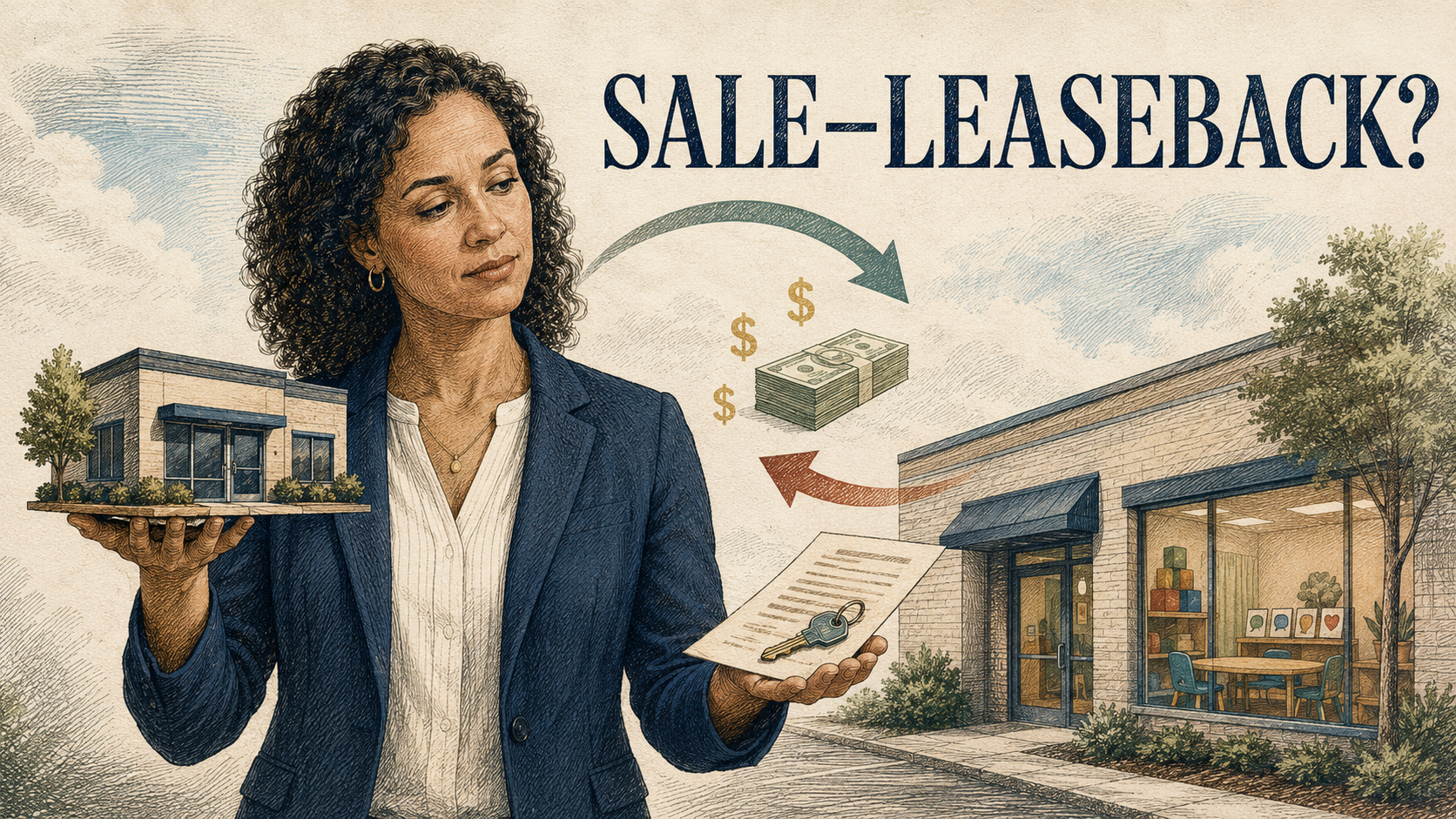
What SAB Capital Does
SAB Capital is a real estate firm that arranges a specific kind of deal for center-based businesses, including ABA providers: the sale-leaseback. An ABA provider sells its building to an investor and, on the same day, signs a long lease to stay right where it is. The clinic continues to operate in the same space. The deed and a rent obligation change hands, and the provider leaves the closing with cash.
The deal works because a building has two prices. Empty, it is worth one amount. With a healthy therapy company signed on to pay rent for 15 years, it is worth far more to an investor, because the investor is really buying the rental payment stream, or in the words of one SAB case study, “the ABA clinic’s occupancy and promised lease income.” The gap between those two prices is money the provider keeps. SAB calls that gap idle lease equity.
One Deal, Start to Finish
SAB’s clearest ABA example is Cross River Therapy in Greenville, North Carolina. The provider, which operates in 6 states, had a waitlist it could not serve in its 6,000-square-foot center, according to SAB’s case study. It needed a bigger building and money to fill it.
SAB negotiated an agreement for Cross River to buy a building near Greenville’s 974-bed hospital for $1.4 million. Then, before that purchase even closed, SAB quietly shopped the building to 30 investors with the lease attached, asking roughly $2.8 million. It got 4 offers in 17 days. An investor paid $2.7 million; $1.4 million went to the building’s original owner, and Cross River kept the remaining $1.3 million. The cash was earmarked for renovations, furniture and toys, and the salaries of BCBAs and RBTs until the center reached its forecast monthly profit.
Cross River never owned the building at all. It only held the signed purchase agreement, and the investor’s funds completed the purchase at closing.
Cross River also gave up a long promise. The lease runs for 15 years; the rent starts at nearly $230,000 a year and goes up 3% each year; and the tenant pays for nearly everything: taxes, insurance, repairs, even the roof. In plain terms, the provider traded a building it could have owned for cash now and rent for a very long time.
Who the Model Works For
SAB’s own materials describe its target client narrowly: center-based businesses with 2 to 7 locations that want to reach 10 or more without borrowing money, or selling a piece of the company to outside investors. The firm’s comparison is to a mortgage, which it says lends only 50% to 80% of a property’s value, while a leaseback delivers the full lease price of the building with no loan rules, no personal guarantee, and no loss of ownership in the business.
The ABA provider’s finances have to be solid, because the investor is buying its promise to pay rent. Cross River’s brochure showed buyers that revenue grew from $3.4 million in 2021 to $20.1 million in 2023, with no debt. When the books are not ready, SAB says it has to build them first. In one deal in Alpharetta, Georgia, the firm describes its biggest hurdle as “supporting a clinically oriented entrepreneur without a professional management team,” which it solved by working with the clinic’s accountants to build financial statements investors could accept.
The provider also needs a real claim on a building, either one it owns or one it has signed an agreement to buy. Renting is not enough. When SAB reviewed two rented centers at a different Atlanta clinic, it found nothing there to cash in. The money came instead from 3 new buildings the clinic agreed to buy in the suburbs: $5.6 million worth of real estate that SAB valued at $13.2 million with the leases attached, putting $7.6 million into the clinic’s hands, by the firm’s account.
The uses of the money look similar across SAB’s cases: build out new space, cover operating costs until a new center fills up, hire and train BCBAs and RBTs, and pay off expensive debt. In one deal covering 5 buildings in Michigan and Indiana, the firm says the $6.1 million raised went to paying down high-interest debt and opening new centers in Nebraska.
How a Deal Happens, in 7 Steps
Here is the sequence of SAB’s process overview and case studies, stripped to plain English.
Step 1: Gather the paperwork. Company- and clinic-level financials, leases, and build-out plans come first because investors and their banks will read them all.
Step 2: Price the real estate. SAB ranks a client’s centers by how well they perform and where they sit, then compares each building’s empty cost against what it would be worth with a long lease attached. That comparison shows whether there is money to unlock.
Step 3: Get a claim on the building. The provider either already owns it or signs an agreement to buy it, the way Cross River did with its 75-day purchase agreement, while SAB lines up investors at the same time.
Step 4: Make investors compete. The buyers are real estate funds and wealthy family investment offices. SAB quietly shops the building and has them bid against each other; in the Alpharetta deal, a final bidding round brought the price to 98% of the asking price in 36 days.
Step 5: Check the buyer, too. In Greenville, SAB spent 30 days studying how each bidder actually secures deal approvals, then shared the provider’s financials and pre-ordered property checks (survey, environmental review, title) before picking a winner. That pressure produced a buyer whose six-figure deposit became non-refundable once a short leasing condition passed.
Step 6: Set the lease terms. How long and how fast rent rises, what renewal rights the provider gets, and who pays for repairs are all decided here. In these deals, nearly everything falls to the tenant.
Step 7: Close and spend the money. In the Covington, Georgia deal, the firm’s own table shows where $3 million in proceeds plus $250,000 of the provider’s cash went: $1 million to finish buying the building, $750,000 to renovations, $750,000 to operating costs before break-even, and $750,000 held in reserve.
AT A GLANCE
| What SAB Capital does: | Arranges sale-leasebacks: an investor buys a provider’s building, and the provider stays as a long-term renter (SAB materials) |
| Why it pays: | A building is worth more with a strong tenant’s long lease attached; the provider keeps the difference (SAB process overview) |
| Greenville deal: | Building bought for $1.4 million, sold for $2.7 million with the lease attached; Cross River kept $1.3 million (SAB case study) |
| Greenville lease: | 15 years; rent starts at $229,824 and rises 3% a year; tenant pays taxes, insurance, and repairs, including the roof (SAB offering memorandum) |
| Versus a mortgage: | Mortgages lend 50% to 80% of a building’s value, per SAB; a leaseback pays out the full leased value with no loan rules or personal guarantee (SAB materials) |
| Who fits: | Center-based operators with 2 to 7 locations aiming for 10+ (SAB process overview) |
| What investors check: | The provider’s finances; Cross River showed $20.1 million in 2023 revenue and no debt (SAB offering memorandum) |
| The trade-off: | Rent for 10 to 20 years, with 3% annual increases in the Greenville lease, in a building the provider no longer owns (SAB materials) |
SOURCES & REFERENCES
| 1. | SAB Capital, Sale-Leaseback Group. “Center-Based Growth Consulting (‘CBGC’): ABA Case Studies.” Case-study booklet provided to BreakingNewsABA. Undated; dated transactions 2022 to 2024. |
| 2. | SAB Capital. “Cross River Therapy, 2501 Stantonsburg Rd, Greenville, NC: Long-Term Sale-Leaseback.” Offering memorandum provided to BreakingNewsABA. Undated. |
| 3. | SAB Capital. “Center-Based Growth Consulting.” Process overview provided to BreakingNewsABA. Undated. |



Join the discussion ▾