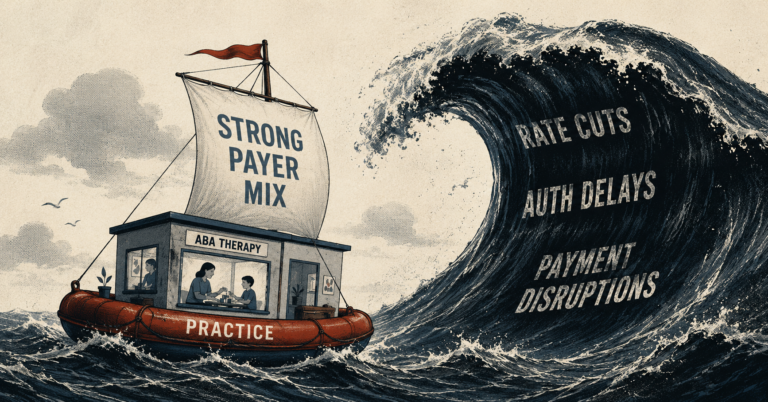

A parent looking for an ABA provider used to get a name from a pediatrician or a friend and call it. Now they ask ChatGPT first. In rater8’s 2026 Patient Choice Report, AI tools edged out both Google and personal referrals as the single biggest influence on how patients chose a provider, and the share using AI to find one nearly doubled in nine months. For ABA, where the person choosing is often a parent deciding who will spend twenty hours a week with their child, the answer the assistant gives about your clinic is the actual referral.
Old trick, new trick, red trick, blue trick
If your inbox looks anything like mine, it’s filled weekly with cold emails mentioning AEO, GEO, SEO, website audits, and other various pitches to bring you clients. At some point along the way you either did the work yourself or hired an agency making the same pitch as the cold emails but you got to meet them, and you liked them.
That agency did a content audit, produced a strategy deck, told you about pillar pages, and added a page or two to your menu, probably “What is ABA Therapy?” and “What is Autism?” or some version of them. Then they installed Yoast or RankMath if you’re on WordPress, and the job became writing until the little light turned green. That light counted how many times you said “ABA therapy,” whether the meta description hit the right length, whether your sentences ran short enough. And if your site got enough traffic, you probably got cited in more undergraduate papers than you could imagine.
The pitch in your inbox now is the same theater with new props: an llms.txt file, some schema, and a promise, standing in for the pillar pages and the green light. Google has been clear about the files it reads. Its published guidance says you can keep an llms.txt for other systems that read it, and that Google Search won’t reward or penalize you either way; it simply ignores it. Worth having. Not worth a monthly fee.
Google has been clear for years about what you should publish, and it hasn’t changed: useful content for the end user, with a unique point of view that adds depth and nuance to the subject, that Google can access and crawl. That’s the instruction. It hasn’t changed in twenty years. Every trick you’ve ever heard was a way to game that system, whether that’s keyword stuffing or internal linking, and every few months you heard that your strategy had to change because of a “core update.”
The head terms belong to the chains
If you followed that agency’s advice and took the obvious path, you now have a page in your menu titled “What is ABA Therapy?” along with every other major player in the field. Pull up the biggest ABA chains: Action Behavior Centers, ACES, Behavioral Innovations, Hopebridge, LEARN Behavioral. The same “What is ABA Therapy?” and “What is Autism?” pages sit in almost every one, an ABA glossary included. Those were the terms every parent used to type, and for fifteen years the whole game was ranking for them. Two problems for a regional clinic. One, you won’t outrank a national chain with two hundred locations and a decade of backlinks for a term that broad; that race was over before you entered it. And two, the parent deciding who will work with their kid is typing it into a different box, the one at the bottom of their AI Chat Assistant, not a fresh Google search.
Why does the box matter?
It’s about context. Not long ago I asked Claude to help me find a Denso relay for the rear climate control on a twenty-six-year-old Land Cruiser, and we worked out that I’d pull the part from a junkyard donor before paying to ship one from the UAE. It generalized that experience to every chat thereafter, placing caveats on suggestions like “For a guy who wrenches on his own Land Cruiser…” Additionally, it knows I care about that rear air conditioning because I’m in Arizona with a toddler. It helped me buy her Christmas presents. It brings her up frequently when I ask it questions about planning camping trips, meal planning, or movie times.
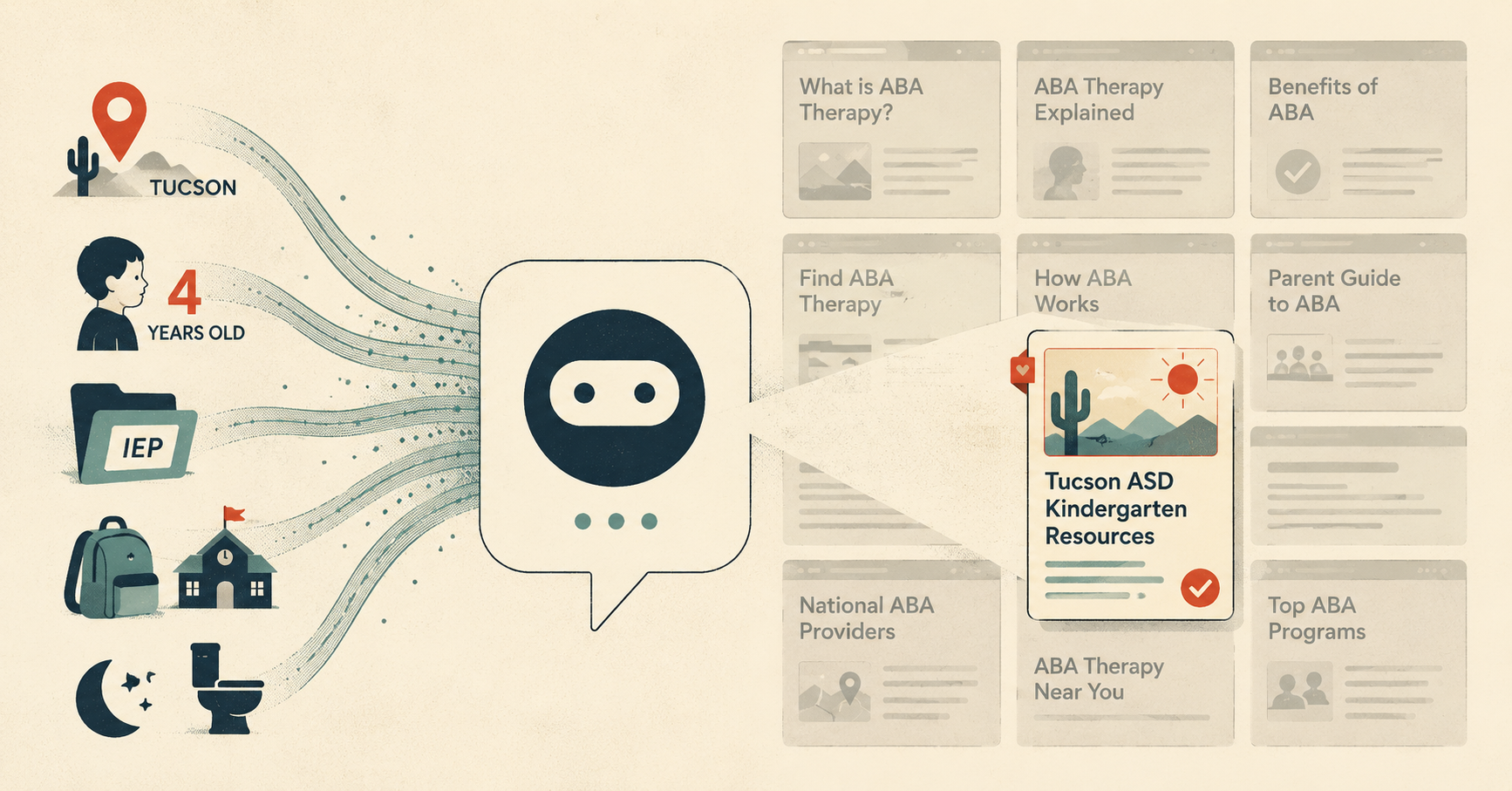
You’ve seen your own version of this. Think about whether your assistant has ever carried something from one conversation into a completely unrelated one. That’s the whole promise of these tools, and it’s what changed search while everyone was arguing about llms.txt files. The words a parent types when they go looking for ABA are no more specific than the ones they’d have typed into Google a decade ago. What’s different is the context riding behind them: where they live, that they have a four-year-old, that there’s an IEP meeting on the calendar, that they’ve spent two weeks reading about potty training at 2 a.m. The assistant appends all of it and answers the specific family. It’s matching that family to whoever’s content actually speaks to them. The question has become more specific and targeted without anyone realizing it while everyone experiences it.
The one contest scale can’t win
So the contest moved to the one place scale can’t follow. The assistant is matching a specific family to whoever’s content fits them, and in that contest, two hundred locations and a decade of backlinks buy you nothing.
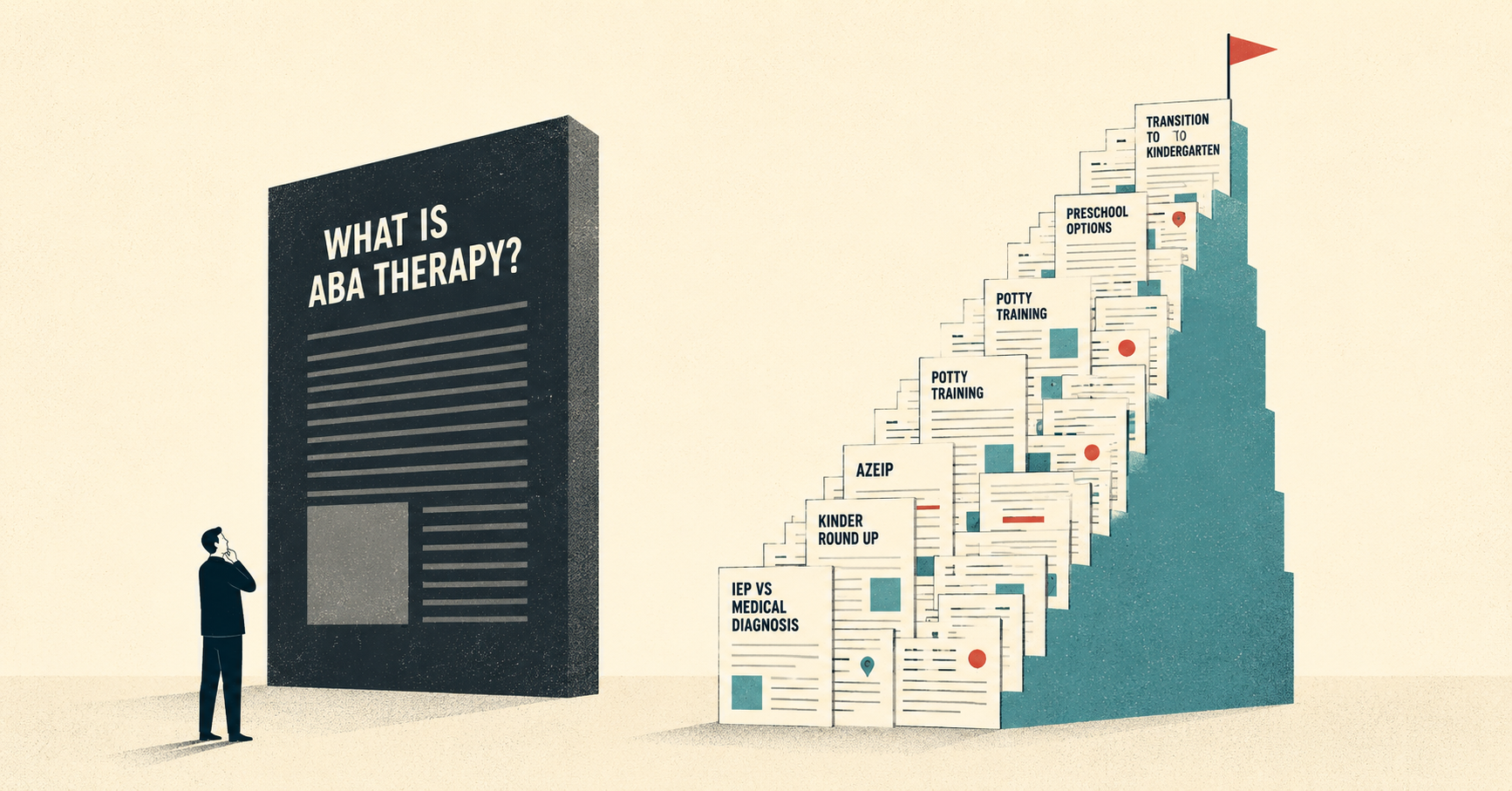
Imagine that family with a newly diagnosed 4-year-old trying to prepare to enter kindergarten next year types “What’s the difference between a medical and educational diagnosis for ASD?” into ChatGPT.
A national explainer written for everyone has a list of recycled, broad-stroke suggestions that are so vague they could apply to every school district in the nation. At the end there’s a bulleted to-do list that says things like “Prepare a list of questions for your pediatrician”, “Join a local ASD Parent Support Group on Facebook”, and “Practice packing your child’s backpack with them each morning this summer”. This isn’t a pot shot at anyone who wrote those blogs; I wrote those blogs before AI Assistants entered the scene.
Which is where the blog you’re going to write comes in, “Resources for Kindergarten Transitions into Tucson Unified School District”, and you get to include the contact number for the Arizona Early Intervention as well as the link to the Department of Economic Security’s page on AZEIP. You can also mention Kinder Round Up, held at each elementary school in the spring to help facilitate transitions. You can point out that Tucson Unified School District has preschool options to begin the transition now and wax poetically about the pros and cons of the Infant and Early Learning Centers versus the Community Education Preschool Programs or Inclusive Preschool Programs. In short, you can be specific, and that family needs you to talk about your experience with the process of obtaining an educational diagnosis and IEP with students in the Tucson Unified School District.
You’ve seen this family before. You’ve connected them with these exact resources and coached them through their anxiety in a family treatment guidance session. You were in the room the first time a child manded for a break instead of melting down. Can I tell you who wasn’t there and who hasn’t done those things? The national chain’s marketing team.
You already know what to write
The agency is not going to tell you to write these highly specific blogs, and the national chain won’t write them either because the chart they pulled from Ahrefs or SEMrush shows there’s no search volume for “Tucson Kindergarten Transitions for Children with ASD”.
The problem underlying specificity is volume. You used to write for a single broad keyword and hope it drove 5000 visits; now you need to write for 50 highly specific keywords, and if they only drive 100 visits apiece, that’s still 5000 visits, but they’re more qualified because you spoke directly to their specific problem. 50 highly specific articles is the hard part – getting your team’s knowledge onto the page for every situation a parent might carry, often enough to matter, without thinning it into slop. That friction bites hardest in the awkward middle where most ABA organizations live: bigger than a solo practice, smaller than a PE-backed multisite, on tighter margins than either. You can’t out-publish the roll-ups by brute force, and you can’t hand-write a hundred specific posts a year while you’re running clinics. That part is solvable, and I put how I do it in writing: here is the content engine built for exactly that.
A separate piece of bad advice that I won’t go into depth on in this article, but I would be remiss to not mention, is depth and length. You’ve heard the advice to keep your articles or blogs short and to the point, 750 to 1500 words, because people have short attention spans. That’s true if you’re writing for people. Have you ever asked your AI assistant a question and seen how many websites it pulls up and rifles through before handing you an answer? It’s not 750 words. It’s going to read ten to fifteen thousand words before it hands that family an answer, and the most thorough and specific answer is going to win. Be that answer.
So, the question is: how do you convince the AI chat to recommend you to the parent? And the answer is specificity, volume, and depth.