

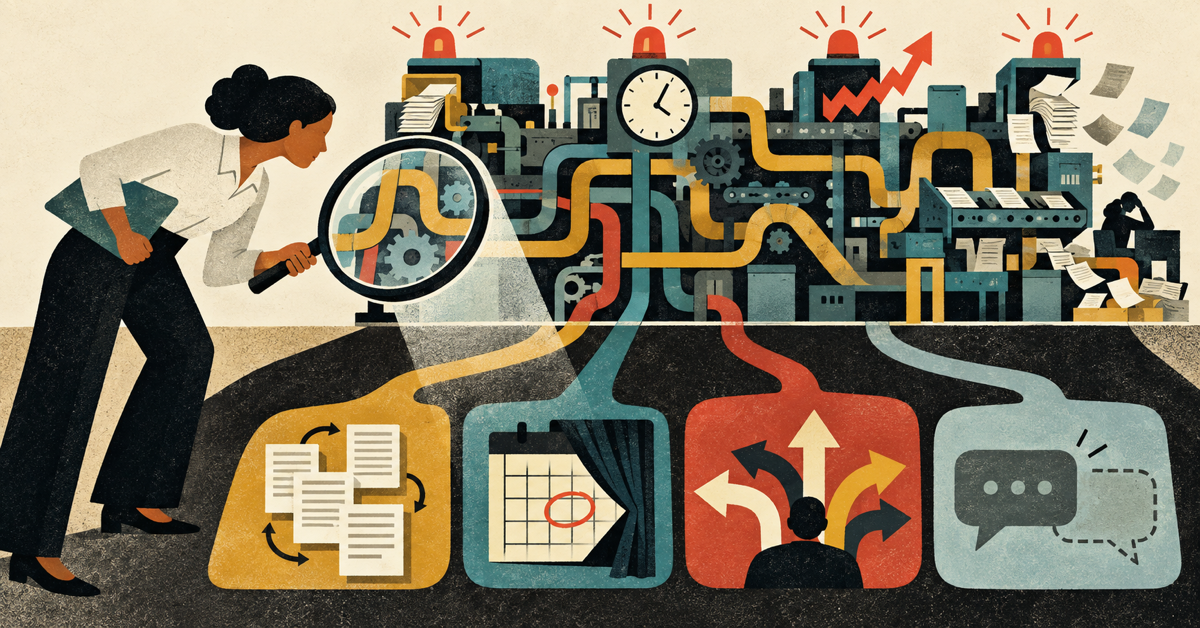
Why OBM Feels Harder to Get Into Than It Is
Organizational behavior management has always felt a little like the mysterious cousin of clinical behavior analysis. Most BCBAs know it exists. A lot of us think it sounds interesting. But get much closer, and suddenly there are acronyms, assessment tools, business terminology, and job titles you’ve never heard of, and it starts to feel like an entirely different field.
It really isn’t.
At its core, organizational behavior management, or OBM, is the application of behavior analysis to improve organizational results. Instead of using behavior analysis to help an individual learner gain a skill or improve their quality of life, we’re looking at behavior within an organization and asking what needs to change for the organization, and the people in it, to function better.
That could mean reducing employee turnover, improving onboarding, increasing caregiver participation, decreasing the time it takes to get a client from referral to services, improving supervision, or figuring out why a new company initiative sounded great in the meeting and then promptly disappeared three weeks later.
Many BCBAs assume they need an MBA, years of executive experience, or a much stronger business background before they can tackle those kinds of problems. Business knowledge certainly helps, and anyone moving into a new context has a responsibility to understand that context. But BCBAs are often much more prepared for organizational work than they realize.
The trick is learning how to apply skills they already have to a different kind of client: the organization.
Start With the Business Problem, Not the Intervention
Imagine an ABA organization has high RBT turnover.
There are plenty of places leadership could immediately go with that problem. Increase pay. Add retention bonuses. Require more supervisor check-ins. Improve employee recognition. Build another training. Redesign onboarding.
Any of those things could help. But choosing one before understanding the problem is the organizational equivalent of selecting a clinical intervention before conducting an assessment.
OBM starts with discovery.
When are people leaving? Is turnover particularly high in the first 30, 60, or 90 days? Does it vary by supervisor, location, schedule, or client assignment? What are employees saying when they leave? What is different about the experience of employees who stay? What does onboarding currently look like?
We are trying to move from a broad business problem “our turnover is too high,” to a much better understanding of what is producing it and where the organization has leverage to change it.
That should feel familiar to a BCBA.
If someone told you a client was “noncompliant,” you wouldn’t immediately build a token economy. You would want to know what they mean by noncompliance, when it happens, what happens before and after it, and what other variables might be contributing.
Organizational problems deserve the same curiosity.
Find Behavior That Is Actually Worth Changing
Organizations also tend to describe problems in wonderfully unobservable terms.
People need more accountability. Managers need to communicate better. Employees aren’t engaged. Staff need to take ownership.
Behavior analysts are useful here because our training makes us uncomfortable leaving things that vague. We want to know what someone would actually be doing differently.
But OBM adds another layer to pinpointing behavior that we don’t always have to think about in the same way clinically:
If we successfully change this behavior, will it actually affect the organizational result?
Suppose an ABA organization wants to improve caregiver participation. We could decide that BCBAs need to send reminder emails before parent-training sessions. That’s observable. It’s measurable. We could design an intervention around it and probably get a beautiful graph showing that reminder emails increased.
But what if attendance doesn’t change?
We successfully changed behavior that didn’t have much leverage.
A stronger discovery process might reveal that caregivers are more likely to participate when they help select meaningful goals, leave each session knowing exactly what to practice, and regularly see evidence that their participation is helping their child.
Now we have behavior that is not only measurable, but connected to the outcome the organization actually cares about.
That is an important shift when moving into OBM. The goal isn’t simply to find behavior we can change. It’s to identify behavior worth changing.
“A successful OBM project doesn’t end with a behavior changing. The behavior should change something that matters to the organization.”
Not Every Performance Problem Needs Training
One of the easiest places for BCBAs to add value inside organizations is by challenging the assumption that every performance problem is a training problem.
Organizations love training.
Something isn’t happening? Train people.
Still not happening? Retrain them.
Still not happening? Send an email reminding everyone about the training.
Sometimes people genuinely lack the skill, and training is exactly the right intervention. But plenty of performance problems have very little to do with whether someone knows what to do.
Consider an ABA organization struggling with treatment plans being submitted late. The obvious response might be more training on documentation expectations or time management.
But imagine we conduct discovery and find that the BCBAs already know exactly how to write the reports. The problem is that information lives in three different systems. Some of it has to be entered twice. Authorization deadlines aren’t visible until they become urgent. Report writing competes with billable expectations. Feedback about documentation usually arrives after something is already late.
That is a very different problem.
Training someone again on a behavior they already know won’t reduce the response effort required to complete it. It won’t redesign the workflow. It won’t make deadlines more visible. And it won’t resolve competing contingencies created by the organization’s productivity expectations.
This is where behavior analysts should feel at home. We’re trained to ask why behavior is or isn’t occurring before deciding how to change it.
In OBM, we simply have more of the organization to examine.
Look at the Performer, Process, and Policy
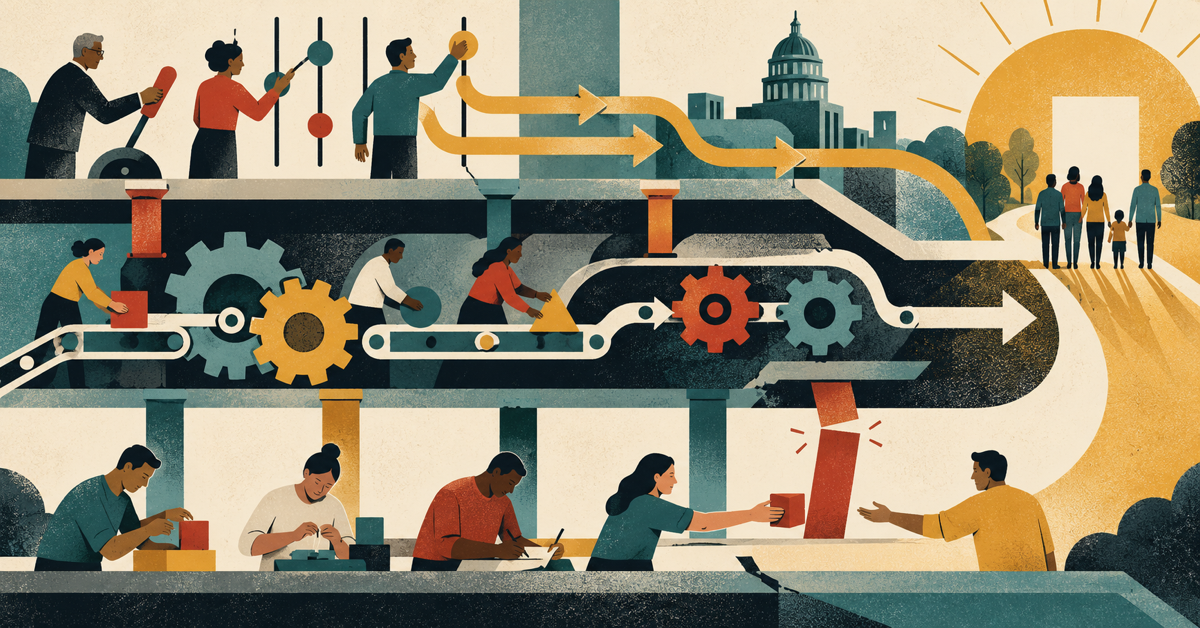
One way I approach organizational problems is by looking for alignment across three levels: performer, process, and policy.
At the performer level, we’re asking many of the questions that already come naturally to BCBAs. Does the person know what’s expected? Do they have the skill? Do they have the resources they need? What feedback are they receiving? What happens when they perform the behavior correctly?
Then we zoom out to the process.
How does the work actually get done? Are there unnecessary steps? Duplicate work? Bottlenecks? Poor handoffs between departments? Is the organization asking an employee to navigate a badly designed process and then treating the resulting performance problem as an issue with the employee?
Finally, we look at policy and the larger organizational system.
Imagine an ABA company says caregiver training is one of its most important clinical priorities, but BCBAs are primarily evaluated and rewarded based on billable productivity. Leadership can talk about caregiver training in every meeting, create a new training about it, and send weekly reminders.
The contingencies may still be saying something else.
Sometimes we need to change employee behavior. Sometimes we need to redesign the process around the employee. And sometimes the organization has created policies or systems that make the behavior it says it wants less likely.
If we only ever intervene with the performer, we miss a huge part of what OBM allows us to do.
BCBAs Are More Prepared Than They Think
This is usually the point where a BCBA interested in OBM starts listing everything they don’t know.
I don’t understand finance. I’ve never run a business. I don’t know enough about operations. I don’t have an MBA.
Those knowledge gaps matter. Being a behavior analyst doesn’t automatically make someone an expert in finance, HR, operations, marketing, or organizational strategy. If you’re working on a problem in a new context, you need to understand enough about that context to ask good questions and recognize what matters.
But consider what BCBAs already know how to do.
We know how to take a vague concern and make it observable. We know how to collect and interpret data. We know how to examine what is happening in the environment instead of relying solely on someone’s explanation of behavior. We know that training isn’t the answer to every performance problem. We know how to form hypotheses, test changes, evaluate outcomes, and adjust when something isn’t working.
Those are incredibly valuable organizational skills.
The gap isn’t necessarily learning an entirely different profession. It’s learning how to connect behavior-analytic skills to organizational results and letting your client be the expert in their industry.
Your Current Organization Is Full of OBM Projects
Getting into OBM also doesn’t necessarily require leaving clinical ABA or finding a job with “OBM” in the title.
If you work in an ABA organization, you’re already surrounded by potential OBM projects.
Recruiting. Onboarding. Scheduling. Supervision. Caregiver training. Clinical documentation. Authorization management. Employee development. Retention. Performance management. Implementing new technology. Rolling out organizational changes.
Every one of those systems contains behavior.
Imagine you’re a clinical director and notice new BCBAs consistently struggle during their first 90 days.
You could add another onboarding presentation.
Or you could approach onboarding as an organizational problem.
What should a successfully onboarded BCBA be doing at 30, 60, and 90 days? Which of those behaviors have the greatest impact on successful performance? Where are people getting stuck? What does the current onboarding process look like? What feedback and reinforcement do new BCBAs receive? Are expectations clear? Which parts of the process create unnecessary friction?
Then you make targeted changes and evaluate whether they actually affect ramp time, performance, satisfaction, retention, or whatever result prompted the project in the first place.
Now you’re not simply managing employees.
You’re applying behavior analysis to improve an organizational system.
And our field could use much more of that.
ABA organizations struggle with turnover, inefficient processes, poor implementation, competing priorities, communication breakdowns, and changes that don’t stick. At the same time, these organizations employ people who are literally trained in the science of behavior.
There is an enormous opportunity to use that expertise not only to improve outcomes for individual clients, but also to improve the organizations responsible for serving them.
What BCBAs Actually Need to Learn
None of this means a BCBA can decide tomorrow to become an OBM consultant and automatically know how to solve complex business problems.
There is a skill gap. I just think it’s a much more manageable one than many BCBAs assume.
Clinical behavior analysis gives us a roadmap. We learn how to assess, identify, and define targets, analyze variables affecting behavior, develop interventions, measure outcomes, and make data-informed adjustments.
What many BCBAs interested in OBM are missing is the organizational version of that roadmap.
You need to learn how to identify a worthwhile business opportunity, conduct discovery, pinpoint behavior with enough leverage to influence that opportunity, diagnose why the behavior isn’t occurring, design an intervention across the appropriate systems levels, and support the organization through actually adopting the change.
And then you have to close the loop: Did changing the behavior improve the organizational result that made the project worth doing?
Once you understand that process, OBM starts to feel considerably less mysterious.
It’s also why I created the OBM Practitioner Program. The program walks BCBAs through that strategic process step by step, from identifying and investigating an organizational opportunity through pinpointing, root-cause analysis, intervention, and change management.
Because most BCBAs interested in OBM don’t need to throw away what they know and start over.
They need to learn how to apply it to a much bigger system. Then do it over and over.
AT A GLANCE
| OBM: | The application of behavior analysis to improve organizational results. |
| Start with: | A meaningful business opportunity or organizational result, not a predetermined intervention. |
| Discovery asks: | What is actually happening, where is it happening, and what variables may be contributing? |
| Pinpointing asks: | Which observable behaviors have enough leverage to meaningfully affect the result? |
| Diagnosis asks: | Why isn’t the desired performance happening now? |
| Three systems levels: | Performer, process, and policy. |
| Common mistake: | Assuming a performance problem is a training problem before diagnosing its cause. |
| Where BCBAs can practice: | Onboarding, retention, supervision, caregiver training, scheduling, documentation, authorizations, employee performance, process improvement, and organizational change. |
SOURCES & REFERENCES
| 1. | The ABA Collective. OBM Practitioner Program. theabacollective.com/obm-practitioner. Accessed September 2026. |
| 2. | Mellanie Page, BCBA, MBA. Professional profile, The ABA Collective. LinkedIn. linkedin.com/in/mellaniepage. Accessed September 2026. |
| 3. | Behavior Analyst Certification Board. Board Certified Behavior Analyst (BCBA). bacb.com/bcba. Accessed September 2026. |








Join the discussion ▾