
The Landscape: A Dozen Competitors, No Winner
FORT LAUDERDALE, FLORIDA – CentralReach is the largest and most established ABA-specific software platform in the United States. Founded in 2010, it has grown from 20,000 users in 2018 to more than 200,000 professionals by 2025, driven by a combination of organic growth and 14 strategic acquisitions. Its platform encompasses practice management, clinical data collection, scheduling, billing and revenue cycle management, payroll, AI-powered session notes, staff training, and analytics. In March 2025, Roper Technologies acquired CentralReach from Insight Partners for approximately $1.65 billion — a price tag that valued the company at roughly 9.4 times its projected revenue of $175 million. The acquisition signaled that the ABA software market had matured enough to attract enterprise-grade investors. It did not signal that the market had been won.
CentralReach’s dominance is concentrated among large, multi-site ABA organizations that need enterprise-grade reporting, custom workflows, and integrated billing. For these providers, CentralReach functions as a mission-critical operating system. But for the thousands of small and mid-size practices that constitute the majority of the ABA market, CentralReach is often too expensive, too complex, and too difficult to implement. The platform’s quote-based pricing, steep learning curve, and reported implementation challenges have created space for a field of competitors that each target a different segment or solve a different problem.
Ensora ABA — formerly Catalyst, now part of Ensora Health (the rebranded Therapy Brands) — has built its reputation on fast, therapist-friendly mobile data collection with offline support. Rethink Behavioral Health offers a content-rich platform with more than 1,500 pre-built treatment goals and video-based RBT training. AlohaABA targets small-to-mid-size practices with an affordable, intuitive interface that combines scheduling, billing, and authorization tracking. Theralytics competes on billing and payroll integration. Raven Health has entered as an AI-powered newcomer emphasizing real-time clinical insights and automated session notes. CR Essentials — CentralReach’s own offering for practices under 50 employees — has grown 240 percent year-over-year since its 2021 acquisition of Behaviorsoft. And platforms like Noteable, Hi Rasmus, Motivity, ClinicSource, and TherapyPM each carve out niches based on specific feature strengths.
The result is a market where no single platform commands majority share, where practices routinely use two or three systems simultaneously to cover their needs, and where switching costs are high enough that dissatisfied customers often stay rather than migrate. It is, by any reasonable definition, a fragmented market — and the fragmentation is not accidental.
Why ABA Is So Hard to Digitize: The Seven Workflow Problems
To understand why no EHR has cracked the ABA market, it is necessary to understand what ABA clinical workflows actually require. The demands are fundamentally different from those of a physician’s office, a hospital, or even a mental health practice. Seven characteristics make ABA uniquely challenging to digitize.
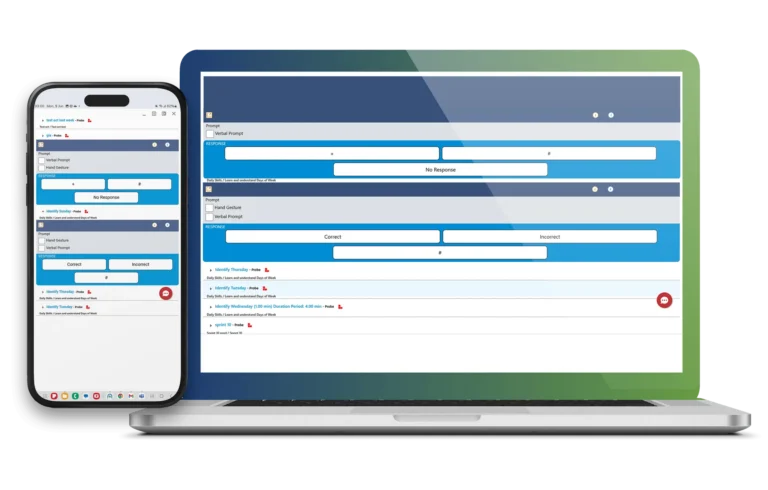
1. Real-time, trial-by-trial data collection. ABA therapy is built on continuous measurement. During a session, a behavior technician may need to record discrete trial data (correct/incorrect responses across dozens of targets), frequency counts of specific behaviors, duration measurements, interval recording, and latency data — all in real time, while simultaneously engaging a child who may be non-verbal, physically active, or exhibiting challenging behavior. The data collection interface must be fast enough that the therapist can record without looking away from the child for more than a second. No standard medical EHR was designed for this. Most ABA platforms were not designed for it well enough either.
2. Multi-setting, mobile-first delivery. ABA therapy is delivered in clinics, homes, schools, and community settings. The software must work on tablets and phones, must function offline in homes and schools with unreliable internet, and must sync data reliably when connectivity is restored. A session note entered in a home with no Wi-Fi at 4 PM must appear in the BCBA’s dashboard by 5 PM and in the billing system by end of day. The offline-to-online sync problem has been a persistent source of data loss complaints across platforms.
3. Program books and treatment plan complexity. A single ABA client may have a treatment plan with 30 to 50 active targets across multiple skill domains — communication, social skills, daily living, academic readiness, behavior reduction — each with its own measurement method, mastery criteria, and graphing requirements. The digital program book must allow BCBAs to create, modify, and sequence these targets, assign them to specific sessions, and ensure that the RBT’s data collection interface reflects the current plan. When a target is mastered and a new one is introduced, the system must update seamlessly. This level of clinical programming complexity has no parallel in other EHR specialties.
4. Supervision and oversight workflows. BCBAs supervise RBTs, and the supervision itself is a billable, documented service. The EHR must track supervision hours, support real-time observation during sessions, allow supervisors to review and co-sign session notes, generate supervision reports for BACB compliance, and maintain the chain of clinical accountability that payers and licensing boards require. Remote supervision via telehealth adds another layer: the platform must support screen sharing, video observation, and remote data review within a HIPAA-compliant framework.
5. Authorization-driven scheduling. Unlike most medical specialties, every ABA session must be delivered within the boundaries of a prior authorization that specifies the number of approved hours, the authorized CPT codes, the authorization period, and sometimes the specific provider credentials required. The scheduling system must know how many hours remain on each client’s authorization, prevent scheduling beyond authorized limits, alert when authorizations are approaching expiration, and track utilization against approved units in real time. A scheduling error that results in services delivered outside an authorization window produces an unbillable session and a revenue loss.
6. Session-to-claim conversion. ABA billing is time-based and code-specific. A session note must capture the start and end time, the CPT code, the rendering provider’s credentials, the supervising BCBA, the place of service, and the clinical documentation required by the payer. The EHR must convert this session data into a billable claim with the correct units, modifiers, and authorization reference — and it must do this for hundreds of sessions per day across multiple payers, each with different rules. The session-to-claim pipeline is where most ABA billing errors originate, and it is where the gap between clinical and administrative software is most painful.
7. Graphing and visual analysis. Behavior analysts make clinical decisions based on visual analysis of graphed data — trend lines, level changes, variability, and response to intervention. The EHR must generate publication-quality graphs from session data, support multiple graph types (line graphs, bar graphs, cumulative records), allow customization of axes and phase lines, and make these graphs available to supervisors, families, and payers for treatment reports and authorization requests. Automated graphing is expected; manual graphing in Excel is the reality for many practices whose EHR’s graphing capabilities are inadequate.

The $1.65 Billion Question: What the CentralReach Acquisition Means
Roper Technologies’ acquisition of CentralReach for $1.65 billion was the most significant transaction in the history of ABA technology. Roper — a diversified technology company with $7 billion in annual revenue that specializes in acquiring niche-market software businesses — described CentralReach as having “clear niche market leadership, mission critical and high ROI solutions, a high recurring revenue mix, and outstanding customer retention.” The company projected that CentralReach would contribute approximately $175 million in revenue and $75 million in EBITDA for the 12 months ending June 2026, with sustainable 20 percent-plus organic revenue growth.
The acquisition validates the ABA software market as a durable, high-growth niche. It also consolidates CentralReach’s position at the top of the enterprise segment. With Roper’s capital behind it, CentralReach can invest in product development, AI capabilities, and potential further acquisitions at a pace that smaller competitors cannot match. The company has already made 14 acquisitions under Insight Partners, absorbing Behaviorsoft (now CR Essentials), data analytics tools, and complementary platforms.
But the acquisition also raises questions for the broader market. CentralReach’s pricing and complexity already put it beyond the reach of many small practices. Under Roper’s ownership — a company that optimizes for cash flow and margin — there is no reason to expect prices to decline. The gap between what enterprise ABA providers use and what small practices can afford may widen, further fragmenting a market that is already split along lines of practice size, clinical sophistication, and willingness to pay.
The Integration Problem: Why Practices Use Three Systems at Once
The practical consequence of the ABA EHR market’s fragmentation is that many practices operate with multiple overlapping systems. A common configuration: one platform for clinical data collection (Catalyst/Ensora), a different platform for billing and practice management (AlohaABA or CentralReach), and a third tool for scheduling or payroll. Some practices add standalone graphing tools, telehealth platforms, or assessment instruments that do not integrate with their primary EHR. The result is duplicate data entry, synchronization failures, reconciliation headaches, and administrative hours spent bridging systems that were not designed to talk to each other.
AlohaABA, recognizing this pattern, has partnered with Hi Rasmus, Motivity, and Ensora Health to sync clinical data into its practice management platform. CentralReach has pursued integration through acquisition, absorbing data collection and analytics tools into its platform. Rethink offers a unified clinical and administrative system but with less billing depth than CentralReach. Each approach involves trade-offs: all-in-one platforms sacrifice best-in-class functionality in specific areas; best-of-breed approaches sacrifice integration.
The integration problem is not unique to ABA, but it is more acute because the clinical data collection requirements are so specialized. A general-purpose EHR like Epic or Athenahealth can handle the billing and scheduling needs of an ABA practice but cannot handle the trial-by-trial data collection, program book management, or supervision workflows. ABA-specific platforms handle the clinical side but often lag behind general healthcare EHRs in billing sophistication, reporting, and interoperability. The dream of a single platform that does everything — clinical data collection, program management, scheduling, billing, supervision, graphing, training, and analytics — remains unrealized, and the CentralReach acquisition’s $1.65 billion valuation suggests that whoever comes closest will build a very valuable company.
What Comes Next: AI, Interoperability, and the Race to Integrate
The ABA EHR market in 2026 is shaped by three forces that will determine its evolution. The first is artificial intelligence. CentralReach has invested heavily in AI-powered session notes, scheduling optimization, and analytics. Raven Health has entered the market with an AI-first approach to clinical documentation. The promise of AI in ABA software is to reduce the administrative burden that consumes BCBA and RBT time — auto-generating session narratives from data, flagging treatment plan adjustments based on graphed trends, and predicting authorization denials before they happen. The risk is that AI-generated clinical documentation may not survive payer scrutiny or meet the evidentiary standards required for authorization appeals and audits.
The second force is interoperability. As ABA moves further into the broader healthcare ecosystem — integrated with pediatric practices, school systems, and managed care organizations — the demand for data exchange between ABA-specific platforms and general healthcare systems will intensify. FHIR-based APIs, standardized data formats, and integration with health information exchanges are table stakes in the broader EHR market but remain nascent in ABA. The platform that solves interoperability — allowing a BCBA’s treatment data to flow seamlessly into a pediatrician’s chart or a school’s IEP system — will have a significant competitive advantage.
The third force is consolidation. The CentralReach-Roper deal may be the first of several. Ensora Health (Therapy Brands) has already aggregated multiple behavioral health software products under one umbrella. Private equity firms that have invested in ABA provider companies are increasingly looking at the technology stack as well. The ABA EHR market in five years may look very different from today’s fragmented landscape — fewer players, larger platforms, and higher switching costs. Whether that consolidation serves the clinicians and families who depend on these systems, or merely the investors who own them, will depend on whether the surviving platforms are built for clinical excellence or for margin extraction.
“CentralReach is a fantastic business with clear niche market leadership, mission critical and high ROI solutions, a high recurring revenue mix, and outstanding customer retention.” — Neil Hunn, President and CEO, Roper Technologies
AT A GLANCE
Market Structure: 12+ ABA-specific EHR/practice management platforms; no single platform holds majority share; fragmented by practice size, feature focus, and price point
CentralReach: Market leader for enterprise ABA; 200,000+ users; acquired by Roper Technologies (March 2025) for $1.65B; ~$175M revenue; 14 acquisitions since 2018; founded 2010, HQ Fort Lauderdale
Ensora ABA (Catalyst): Leading mobile data collection; offline support; rebranded from Catalyst under Ensora Health (formerly Therapy Brands); therapist-friendly interface; fewer billing features
Rethink BH: 1,500+ pre-built treatment goals; video RBT training library; EVV compliance; strong in multi-disciplinary settings (ABA + OT + speech)
AlohaABA: Small-to-mid-size focus; affordable pricing; scheduling + billing + auth tracking; integrates with Hi Rasmus, Motivity, Ensora for clinical data
CR Essentials: CentralReach’s small practice tier (<50 employees); acquired as Behaviorsoft (2021); 240% YoY growth; simplified, standardized interface
Raven Health: AI-first newcomer; automated session notes, denial management, real-time clinical insights; targets practices seeking modern UX and billing automation
Other Competitors: Theralytics (billing/payroll), ClinicSource (multi-therapy), Noteable (cloud documentation), TherapyPM (simplicity), AccuPoint, Hi Rasmus, Motivity
7 Workflow Challenges: (1) Real-time trial-by-trial data collection; (2) multi-setting mobile/offline delivery; (3) program book complexity; (4) supervision workflows; (5) authorization-driven scheduling; (6) session-to-claim conversion; (7) visual analysis graphing
Common Practice Setup: Many practices use 2–3 overlapping systems (e.g., Catalyst for data + AlohaABA for billing + separate telehealth/graphing tools); duplicate entry and sync issues common
AI Trends: AI-powered session notes (CentralReach, Raven); scheduling optimization; trend-based treatment recommendations; denial prediction; risk: payer scrutiny of AI-generated documentation
Interoperability Gap: ABA platforms lag behind general healthcare EHRs in FHIR, HL7, and HIE integration; no seamless data exchange with pediatric EHRs or school IEP systems
Consolidation Trend: CentralReach–Roper ($1.65B); Ensora Health aggregating multiple behavioral health products; PE interest in ABA technology stack growing
HIPAA/Compliance: All platforms must maintain HIPAA compliance, BAAs, SOC 2; EVV requirements vary by state for Medicaid-funded services
Switching Costs: High data migration complexity; treatment plan/program book transfer; staff retraining; typical migration takes 2–4 months for mid-size practice
SOURCES & REFERENCES
CentralReach Acquisition: Roper Technologies press release, March 24, 2025; Behavioral Health Business analysis, March 24, 2025; CB Insights company profile
CentralReach Data: CentralReach.com; PitchBook company profile; Software Advice reviews and ratings; Capterra comparison data
Ensora/Catalyst: Capterra product listing (Ensora Data Collection); Raven Health data collection comparison (January 2026); formerly Therapy Brands, rebranded to Ensora Health
Platform Reviews: Software Advice ABA Software comparison (February 2025); GetApp EMR/EHR listings (2026); The Medical Practice top 20 review (October 2025); Theralytics competitive analysis (January 2025)
Raven Health: Raven Health ABA practice management and data collection software reviews (December 2025, January 2026)
Passage Health: Top 5 ABA Practice Management Software in 2026 (tested and ranked); AlohaABA integration analysis
Clinical Workflows: BACB practice standards; CASP practice guidelines; ABA Coding Coalition CPT code resources; clinical workflow requirements derived from industry analysis
Industry Context: BACB certificant and demand data (2025); CentralReach 2025 Autism and IDD Care Market Report; ABA market valued at $4B (2023) with 4.8% CAGR to 2032
Published: BreakingNewsABA.com — March 2026