NEW YORK – The numbers tell the story of a retreat. Behavioral health accounted for 67% of all telehealth visits in 2024, according to Trilliant Health. But between 2023 and 2024, the total number of behavioral health telehealth visits dropped by 10 million — the largest single-year decline since the pandemic began. In May 2024, Optum announced it was closing its virtual care business, launched just three years earlier. Walmart shuttered Walmart Health Virtual Care the same month. Amwell and Teladoc, the two largest telehealth platform companies, disclosed multiple rounds of mass layoffs, strategy pivots, and executive departures. The stock performances of both companies had been in sustained decline.
In the ABA industry specifically, CentralReach’s 2025 market report identified a notable shift toward in-clinic care and clinic-based services. The data did not show telehealth disappearing — but it showed an industry that had experimented with remote delivery during a crisis and was now recalibrating, not around what was technologically possible but around what produced the best clinical outcomes for children with autism.
The recalibration matters because it contradicts two narratives that have dominated the conversation since 2020. The first: that telehealth would permanently transform ABA delivery, making clinic-based models obsolete. The second: that telehealth was a pandemic expedient with no lasting clinical value. Neither is accurate. The five-year evidence base shows something more useful and more complicated — a set of specific use cases where telehealth produces outcomes comparable to in-person delivery, and a larger set of use cases where it does not.
What the Research Actually Shows: Three Categories
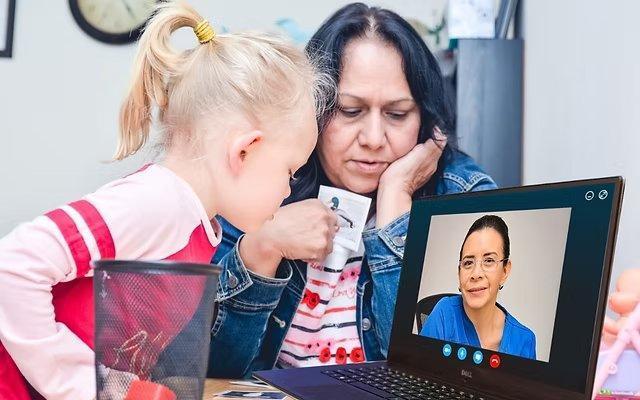
Category 1: Parent training and caregiver coaching — strong evidence. This is where the telehealth evidence is most robust and most consistent. Multiple studies, including the foundational work by Heitzman-Powell et al. (2014) and Vismara et al., have demonstrated that parent-implemented interventions delivered via telehealth are as effective as in-person training in improving skill outcomes for children with ASD. The mechanism is straightforward: the BCBA coaches the parent through a video connection while the parent works directly with the child in the home environment. The child receives the hands-on intervention. The clinician provides the clinical expertise. The technology bridges the geographic gap without removing the physical contact that ABA therapy requires.
Caregiver coaching via telehealth has an additional advantage that in-person models do not: the clinician observes the child in the natural environment, not in a clinic setting. Behavior patterns, environmental triggers, and reinforcement dynamics that might not be visible in a clinic are directly observable when the session takes place in the family’s living room, kitchen, or backyard. This ecological validity makes telehealth-delivered parent training not just equivalent to in-person delivery but, for some assessment purposes, superior.
![Parent training and caregiver coaching represent the strongest use case for telehealth in ABA: the BCBA coaches the parent in real-time while observing the child in the natural home environment — ecological validity that clinic-based sessions cannot replicate. | Photo courtesy: [attribution]](https://breakingnewsaba.com/wp-content/uploads/2026/03/telehealth-aba-article-image-2.jpg)
Category 2: BCBA supervision and clinical oversight — moderate evidence with caveats. Telehealth-delivered supervision of RBTs by BCBAs has been practiced since before the pandemic and is supported by a growing evidence base. The CASP 2020 practice parameters for telehealth implementation explicitly framed telehealth as a delivery method, not a separate service, establishing the clinical foundation for remote supervision. However, a 2024 survey by Sipila-Thomas and Brodhead of 69 behavior analysts who had supervised via telehealth identified significant barriers: internet connectivity was the most frequently cited supervisee barrier (67%), followed by distractions during sessions (36%). For supervisors, the most common barriers were difficulty modeling or demonstrating strategies over video (42%) and inability to properly observe therapist-patient interactions due to camera limitations (41%).
The supervision evidence suggests that telehealth works when the technology is reliable, the supervisee is experienced enough to implement feedback independently, and the supervision involves clinical consultation rather than hands-on demonstration. For new RBTs who need in-vivo modeling of techniques — how to physically prompt a child, how to position yourself during discrete trial training, how to manage a safety situation — remote supervision is a poor substitute for being in the same room.
Category 3: Direct therapy with children (CPT 97153) — limited and conditional evidence. This is where the gap between telehealth aspiration and clinical reality is widest. Direct ABA therapy — the 25 to 40 hours per week of one-on-one intervention that constitutes the core of intensive ABA — is inherently physical. The RBT delivers discriminative stimuli, provides physical prompts, manages materials, redirects behavior, and builds rapport through sustained in-person contact. Delivering these functions through a screen requires a caregiver to serve as a physical proxy, creating a three-party interaction that is clinically and logistically complex.
A 2021 study published in the Journal of Applied Behavior Analysis evaluated telehealth direct therapy for seven individuals with varying ASD severity levels, using natural environment teaching and discrete trial training via videoconferencing. Skills were taught with varying levels of caregiver support. The results showed that targeted skills could be acquired through telehealth direct therapy — but the study noted that success depended heavily on the child’s existing skill level, the caregiver’s availability and competence as a physical proxy, and the type of skill being targeted. Language and adaptive skills were more amenable to remote delivery than skills requiring hands-on guidance or physical management of challenging behaviors.
![CentralReach’s 2025 market data shows a notable shift back toward in-clinic care and clinic-based services — not because telehealth failed, but because the clinical core of ABA therapy requires physical presence for the most intensive interventions. | Photo courtesy: [attribution]](https://breakingnewsaba.com/wp-content/uploads/2026/03/telehealth-aba-article-image-3.jpg)
What Telehealth Is Good For — and Where It’s Settling
The post-COVID equilibrium for telehealth in ABA is not zero. It is a hybrid model in which telehealth serves specific, well-defined functions within a predominantly in-person treatment framework. The functions where telehealth has demonstrated durable value include parent training and caregiver coaching (the strongest evidence base), BCBA supervision of experienced RBTs (particularly in rural or underserved areas where in-person supervision frequency is constrained by geography), initial and ongoing assessments where caregiver interview and record review are the primary modalities, care coordination across multidisciplinary teams, and transition planning sessions that do not require direct contact with the child.
For providers in rural and underserved areas — and more than half of all U.S. counties have no behavior analysts at all — telehealth remains a critical access tool. A family in rural Montana whose nearest BCBA is three hours away benefits enormously from telehealth supervision and parent coaching, even if the direct therapy hours are delivered in person by a locally based RBT. The access argument for telehealth is strongest precisely where the in-person workforce is thinnest.
The hybrid model that is emerging as the industry standard looks like this: direct therapy (97153) delivered in person, in clinic or home settings. BCBA supervision (97155) delivered in a mix of in-person and telehealth, calibrated to the RBT’s experience level and the clinical complexity of the case. Parent training (97156) delivered via telehealth when geography, scheduling, or parent preference supports it. Assessment and treatment planning conducted through a combination of in-person observation and telehealth interview. This is not the telehealth revolution that was predicted in 2020. It is something more modest and more sustainable: telehealth as a complement to in-person care, not a replacement for it.
![For the more than half of U.S. counties that have no behavior analysts, telehealth remains the difference between some access to clinical expertise and none at all. The access argument is strongest precisely where the in-person workforce is thinnest. | Photo courtesy: [attribution]](https://breakingnewsaba.com/wp-content/uploads/2026/03/telehealth-aba-article-image-4.jpg)
What Providers and Families Should Know
Telehealth is not disappearing from ABA — it’s narrowing. The services most amenable to telehealth delivery (parent training, supervision, assessment) will continue to be available virtually in most states and from most payers. Direct therapy delivered via telehealth will become increasingly rare except in access-constrained geographies where no in-person alternative exists.
Payer policies are tightening. Check with your specific payer about telehealth billing requirements for ABA codes. Many payers now require modifiers for telehealth claims, prior authorization for virtual sessions, and documentation that telehealth delivery was clinically indicated. Claims submitted without the correct telehealth modifier risk denial or retroactive recoupment.
The hybrid model requires infrastructure. Providers offering both in-person and telehealth services need scheduling systems that can manage both modalities, EHR platforms that support telehealth-specific documentation, and clinical protocols that define which services are delivered in which format based on clinical criteria rather than operational convenience.
For rural families, advocate for telehealth access. If your family lives in an area without adequate in-person ABA providers, document the access gap. Request single-case agreements for telehealth delivery when no in-network provider is available within access standards. The clinical evidence supports telehealth for parent training and supervision even in jurisdictions that are restricting telehealth for direct therapy.
The Five-Year Verdict
The pandemic forced an experiment that the ABA industry would not have run voluntarily. The results of that experiment are now clear enough to act on. Telehealth works for parent training. It works for supervision when the technology is reliable and the supervisee is experienced. It works for assessments that rely on interview and record review. It does not work — or works only under narrow, resource-intensive conditions — for the direct, intensive, one-on-one therapy that constitutes the clinical core of ABA.
The industry’s quiet retreat from telehealth-heavy models is not a failure of innovation. It is a recognition that the therapeutic relationship between an RBT and a child cannot be fully mediated by a screen. The future of telehealth in ABA is not as a primary delivery modality but as an infrastructure layer that extends the reach of in-person care, connects clinicians across distances, and puts clinical expertise in homes where it would otherwise not arrive at all. That is a smaller ambition than the 2020 predictions suggested. It is also a more honest one.
AT A GLANCE
BH Telehealth: 67% of all telehealth visits in 2024; dropped by 10 million visits between 2023–2024 (Trilliant Health)
Industry Shift: CentralReach 2025 data shows notable shift to in-clinic and clinic-based ABA services
Strong Evidence: Parent training/caregiver coaching via telehealth — comparable outcomes to in-person in multiple studies
Moderate Evidence: BCBA supervision via telehealth — effective with caveats (internet 67% barrier; modeling difficulties 42%)
Limited Evidence: Direct therapy (97153) via telehealth — conditional on child skill level, caregiver proxy, and skill type
Key Barriers: Internet connectivity (67%); distractions (36%); can’t model strategies (42%); camera limitations (41%)
Policy Status: Pandemic-era flexibilities extended through 2024; reverting in 2025; CBO: permanent extension = $2B cost
Provider Access: 50%+ of U.S. counties have no behavior analysts; telehealth critical for rural/underserved access
Hybrid Model: Direct therapy in-person; supervision mixed; parent training via telehealth; assessment hybrid
Market Context: Optum closed virtual care (May 2024); Walmart Health Virtual Care closed; Amwell/Teladoc in decline
Sources & References
1. Behavioral Health Business. “Telehealth Claims Are Declining. What’s Next for Virtual Mental Health Care?” January 26, 2026
2. Trilliant Health. “Telehealth Demand: An Update After the COVID-19 Pandemic.” July 2025
3. CentralReach. 2025 Autism and IDD Care Market Report (March and November editions)
4. Sipila-Thomas & Brodhead. Survey of telehealth supervision barriers in ABA (2024). 69 behavior analysts
5. Ferguson, Craig & Dounavi. Telehealth ABA for young children with ASD: improvements in adaptive behaviors (2019)
6. Heitzman-Powell et al. Parent-implemented ABA via telehealth: effectiveness study (2014)
7. Lindgren et al. Telehealth early intensive behavioral intervention: feasibility and outcomes (2016)
8. Journal of Applied Behavior Analysis. Effectiveness of telehealth direct therapy for ASD (2021). PMC8274667
9. CASP. Practice Parameters for Telehealth-Implementation of ABA: Continuity During COVID-19 (2020)
10. New York State Medicaid. Applied Behavior Analysis Evidence Review. July 2025
11. Updox. “Telehealth After 2025: What Providers Need to Know.” December 2025
12. Congressional Budget Office. Telehealth extension cost estimates ($2B excess Medicare spending)