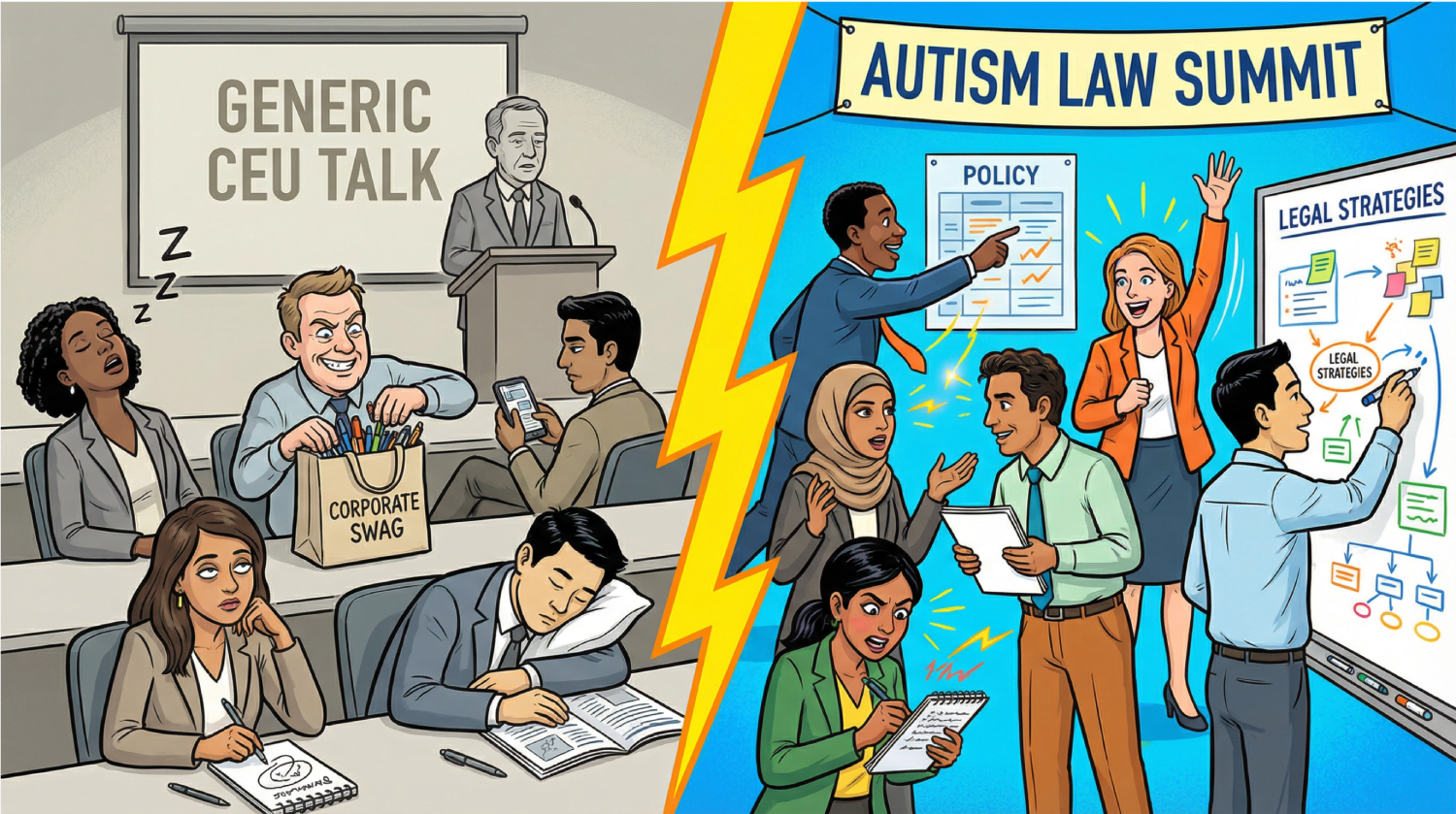
There are conferences where you collect CEUs, grab a few vendor pens, and fly home. And then there is the Autism Law Summit — the one event each year where the future of our industry is actually being shaped in real time.
If you’re an ABA provider, clinic owner, BCBA, or anyone who depends on the legal and policy landscape to do your work, the Autism Law Summit isn’t optional. It’s essential.
The Autism Law Summit is a two-day annual gathering co-organized by the Council of Autism Service Providers (CASP) and the Autism Legal Resource Center (ALRC). The driving forces behind it are Lorri and Dan Unumb — two of the most consequential figures in autism law in the country. Lorri, now CEO of CASP, spent years at Autism Speaks spearheading the national movement for autism insurance reform. Dan, founder of the ALRC, has argued autism legal issues before courts across the country and co-authored a law school casebook literally called Autism and the Law. These are not conference organizers who stumbled into the space. They built the legal infrastructure that allows many of our practices to exist.
The Summit has been running for nearly two decades. That kind of staying power is a signal.
More than 350 attendees come through the doors each year, and the mix is unlike anything else in our field. You’ll find ABA providers sitting next to insurance company representatives, parent advocates next to state legislators, lobbyists next to self-advocates. There are lawyers, researchers, politicians, and clinicians — people who rarely occupy the same room, let alone the same conversation.
That diversity is the point. The issues that define our field — insurance coverage, Medicaid policy, workforce shortages, billing compliance, access to care — don’t exist in clinical isolation. They live in courtrooms, state legislatures, and insurance boardrooms. If we only talk to ourselves, we lose.
The Summit goes deep on the topics that keep clinic owners up at night and that families fight through every single day. Sessions tackle insurance law and compliance, state and federal policy updates, emerging legal precedents in ABA coverage, the complexities of military family access through TRICARE, and the broader legislative landscape affecting autism services nationwide.
This isn’t theoretical policy discussion. Attendees routinely walk away with concrete, actionable intelligence — new developments in insurance denials, shifts in how states are interpreting mandates, legal strategies that other providers have used successfully. When a new ruling or regulation is quietly changing the reimbursement environment, the people at this Summit often know first.
Our Industry Needs to Be in the Room.
Here’s the uncomfortable truth: policy gets made with or without us. Legislators craft autism-related bills. Insurance companies write coverage policies. Regulators issue guidance. And if the people actually delivering services — the BCBAs, the clinic directors, the RBTs showing up every day — aren’t present in those conversations, the outcomes reflect that absence.
The Autism Law Summit is one of the few spaces where practitioners and policymakers are genuinely in dialogue. Providers who attend don’t just learn what’s happening; they get to shape what happens next. They testify. They network. They bring stories from the clinic floor to people who write laws and negotiate contracts.
One attendee put it plainly: if they could only attend one event per year, it would be the Autism Law Summit — because it attracts the people who are actually moving the needle.
The ABA field is under pressure from every direction. Funding is complicated. Workforce challenges are real. Insurance battles are relentless. And the political environment around healthcare is anything but stable. In that context, staying in the clinical lane and hoping policy works itself out is not a strategy. It’s a gamble.
The Autism Law Summit is where our industry goes to stop gambling and start leading. Block the time. Make the trip. Be in the room.
The families we serve are counting on us to be there.