The Argument
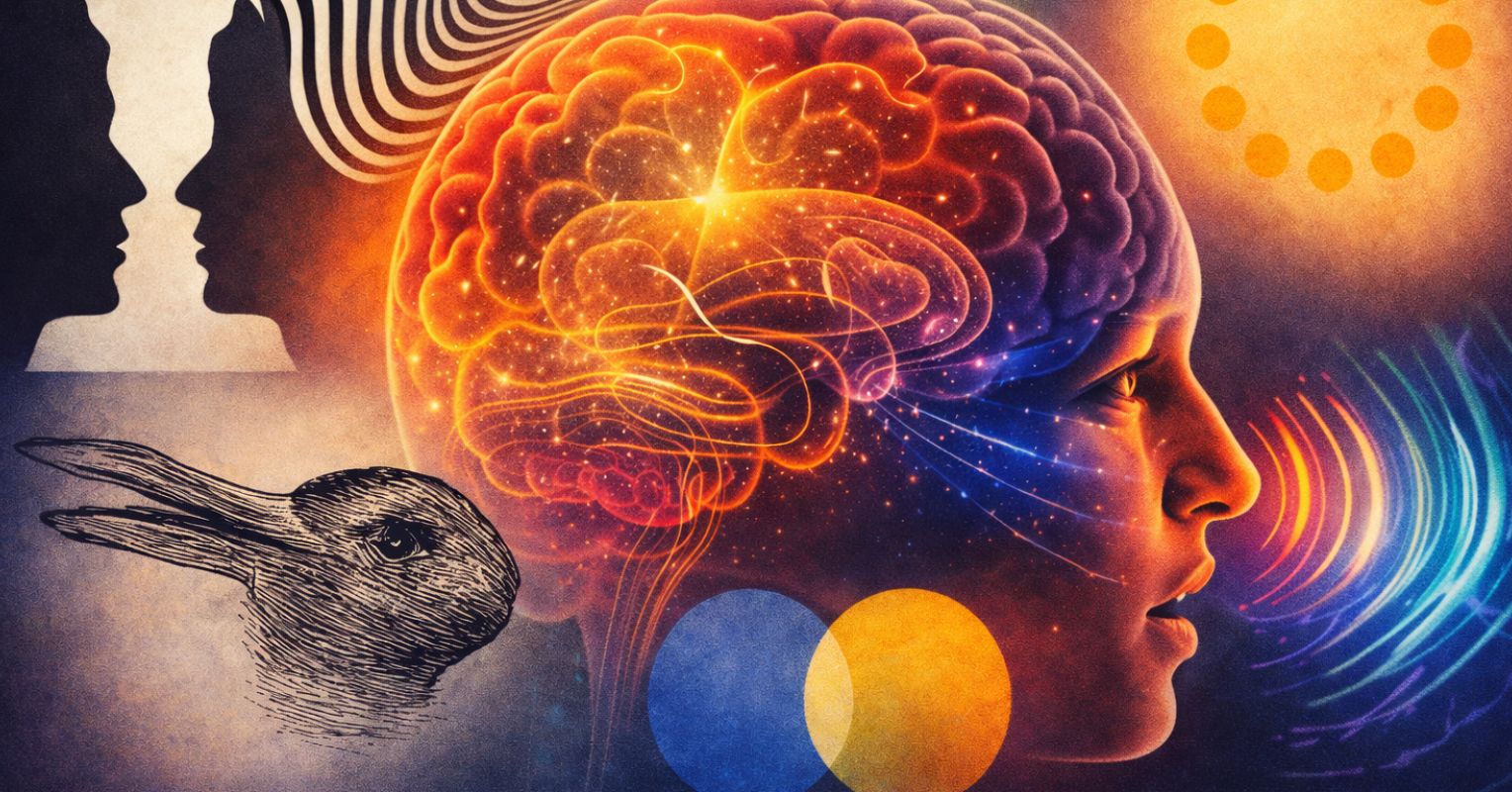
The author contends that perception is not a passive recording of the world but an active, strategic process where the brain constantly interprets and constructs reality from limited information. This core thesis is illustrated through various sensory illusions, which are presented not as ‘tricks’ but as revealing instances where the brain’s interpretive work becomes visible. The McGurk effect, for example, demonstrates how visual input (lips saying ‘ga’) combined with auditory input (‘ba’) often results in a fused, third perception (‘da’ or ‘ka’), highlighting the brain’s drive for coherence. The author’s personal experience, where attention dictated whether they heard ‘ba’ or saw ‘ga’ separately, serves as an early clue to the diverse strategies individuals employ in sensory integration.
Further examples reinforce this idea. The stream-bounce illusion shows how an ambiguous visual event (two dots meeting) is resolved into a ‘bounce’ when a simple click sound is added, demonstrating sound’s ability to add certainty to visual information. Similarly, the double-flash illusion reveals how two quick beeps accompanying a single flash of light can lead to the perception of two flashes, underscoring the brain’s ‘temporal binding window’—a brief period where sensory events are treated as belonging together, even if it means shaping the experience to maintain coherence. The parchment skin illusion, where altering the sound of rubbing hands changes the perceived tactile quality of the skin, powerfully illustrates that sensory discomfort can emerge from the interaction between senses, not solely from the intensity of a single stimulus.
The author argues that these illusions reveal the brain’s prioritization of coherence over absolute accuracy, often employing ‘shortcuts’ to create a stable, unified story of the world. For many autistic and ADHD individuals, including the author, these shortcuts may be applied more cautiously, or the ‘stitching’ of multisensory integration remains visible. This leads to a perception that is more deliberate and precise but also more effortful, especially in complex environments. What is often labeled as ‘sensory difficulty’ in neurodivergent individuals is reframed as ‘sustained problem-solving’—a nervous system actively resolving more ambiguity, more often, with less reliance on automatic assumptions.
The Counter-View
The article implicitly challenges the common assumption that sensory experiences, particularly discomfort, originate solely from the intensity or nature of a single sensory input (e.g., a sound being too loud, a texture being too rough). The parchment skin illusion directly undermines this by showing how auditory input can alter tactile perception without any physical change to the skin. This suggests that the ‘problem’ is not always the stimulus itself, but rather the brain’s interpretation and integration of multiple sensory signals. From a traditional perspective, sensory processing differences might be viewed as deficits or hypersensitivities that need to be ‘tolerated’ or ‘extinguished.’ However, the author’s perspective shifts this, suggesting that the brain’s active interpretive process, when it deviates from typical integration strategies, is a different, albeit more effortful, way of engaging with the world.
Impact on the Field
This perspective holds significant implications for Applied Behavior Analysis (ABA) and the broader behavioral health industry. If sensory ‘difficulty’ is understood as sustained cognitive effort in resolving sensory ambiguity, rather than merely an aversion to intense stimuli, it necessitates a shift in intervention strategies. For BCBAs and RBTs, this means moving beyond simply reducing stimulus intensity or attempting to ‘toughen up’ individuals to tolerate discomfort. Instead, interventions should focus on creating environments and experiences that reduce unnecessary sensory conflict, improve the alignment and timing of multisensory input, and minimize the cognitive load associated with sensory processing.
Understanding that perception is actively constructed means that behavior intervention plans (BIPs) related to sensory sensitivities should consider the interplay of senses and the individual’s unique integration strategies. This could involve more nuanced environmental modifications, antecedent strategies that pre-empt multisensory mismatches, and teaching self-advocacy skills for managing complex sensory environments. It also encourages a deeper appreciation for neurodiversity, reframing sensory differences not as errors to be corrected, but as distinct, often effortful, modes of engaging with the world, requiring support that aligns with individual perceptual styles.
Career Takeaway
For BCBAs and clinic owners, embracing this understanding of perception means prioritizing individualized sensory assessments that go beyond simple preference questionnaires. Focus on identifying specific multisensory integration challenges and the cognitive effort they demand. Design interventions that proactively reduce sensory ambiguity and improve the temporal and spatial alignment of sensory inputs within therapy settings. This might involve careful consideration of lighting, soundscapes, tactile materials, and the timing of verbal instructions relative to visual cues. Recognize that what appears as a behavioral challenge related to sensory input might, in fact, be a manifestation of the brain’s intensive work to make sense of its environment. By creating more coherent and less demanding sensory landscapes, professionals can reduce cognitive load, potentially leading to increased engagement and more effective skill acquisition for individuals receiving ABA services.
Fast Facts
| Key Point | Why It Matters for ABA |
|---|---|
| Perception is active construction, not passive sensing | Shifts focus from stimulus intensity to brain’s interpretive process in sensory interventions. |
| Sensory illusions reveal brain’s drive for coherence over accuracy | Highlights why some individuals might struggle with ‘blending’ sensory inputs, leading to effortful processing. |
| Autistic/ADHD perception often involves ‘sustained problem-solving’ | Reframes sensory ‘difficulty’ as cognitive effort, guiding more supportive and less confrontational intervention strategies. |
Expert Perspective
Sensory illusions are not mere tricks; they are profound clues revealing how the brain actively constructs our reality, offering critical insights into neurodivergent experiences.
Source: psychologytoday.com