The Practice
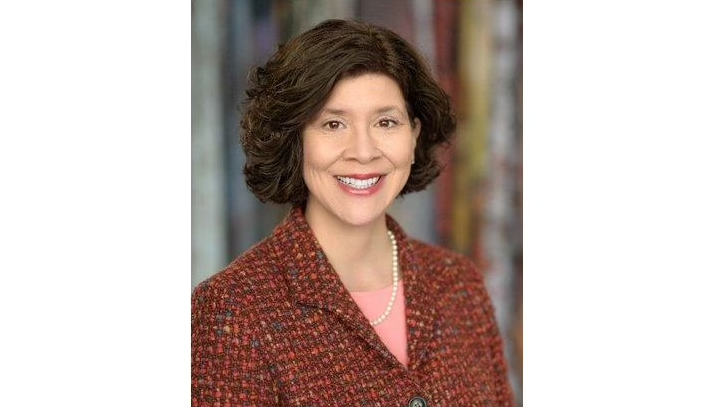
Jenni Davis-Blevins, owner of Alabama Behavioral Therapy, recently addressed the Scottsboro Rotary Club, offering a comprehensive overview of her career in applied behavior analysis (ABA) and the significant evolution within the field. Graduating in 2004, Davis-Blevins initially sought a role while pursuing her master’s degree, which led her to an ABA clinic specializing in working with children on the autism spectrum. This experience quickly transformed into a profound passion, shaping her professional trajectory.
Davis-Blevins defined ABA as an evidence-based, natural science approach designed to treat individuals with Autism Spectrum Disorder (ASD) and other developmental disabilities. The core objective of ABA is to enhance crucial life skills, including cognition, language, social interaction, and self-help abilities in young children. For adult patients, the focus shifts towards improving behaviors that facilitate better daily functioning, alongside a universal goal across all age groups to decrease problem behaviors that impede daily life and overall well-being.
She elaborated on the practical application of ABA principles, explaining a systematic approach: first, observing a child’s behavior; second, identifying the underlying function or ‘why’ behind that behavior; and third, developing a strategy to modify it into a more socially acceptable response. This process involves breaking down complex behaviors into smaller, manageable steps, culminating in a detailed, step-by-step treatment plan. Davis-Blevins drew a distinction between ABA and speech therapy, noting that while a speech therapist might concentrate on articulation, ABA prioritizes teaching more effective communication methods. She provided an illustrative example of a child throwing a tantrum for milk, explaining that if the tantrum yields the desired result, it reinforces the problem behavior. Instead, ABA might teach the child to use a picture card, a sign for milk, or even a simple ‘m’ sound to request the item, thereby replacing the tantrum with a functional communication skill.
Key Benefits
Davis-Blevins underscored the dramatic shift in autism diagnosis rates throughout her career. When she began practicing, the prevalence was approximately 1 in 182 children. She attributed the perceived
Source: jcsentinel.com