
The Practice/Tool
Artificial intelligence (AI) is rapidly becoming an indispensable component of Applied Behavior Analysis (ABA) therapy, shifting from a future concept to a present reality. ABA therapy providers across the U.S. are increasingly adopting AI-powered platforms to automate data collection, enhance billing accuracy, reduce administrative burdens, and personalize treatment plans. This technological integration allows clinicians to dedicate more time to direct therapy and supervision, rather than manual documentation and analysis, which historically consumed significant hours.
For decades, ABA therapists grappled with clinical inefficiencies, relying on paper-based or static spreadsheet data collection. This often led to hours spent on manual data entry, tracking responses, and generating graphs, leaving less time for client care. Analysts frequently received delayed or partial insights, hindering timely identification of trends and adaptive treatment plan adjustments. Even today, many ABA clinicians spend an estimated 25-35% of their time on documentation and data entry. Operationally, practices faced challenges with fragmented systems for scheduling, payroll, medical billing, and reporting. Manual processes were prone to errors in prior authorization and medical coding, resulting in denied claims, clinician underutilization, and last-minute cancellations. A lack of real-time visibility meant leadership often reacted to issues rather than proactively addressing them.
AI and digital tools are emerging as potent solutions to these pressures. While AI’s role in healthcare is broad, its application in ABA is uniquely human-centric. It empowers Board Certified Behavior Analysts (BCBAs) and Registered Behavior Technicians (RBTs) with data-informed decision-making, rather than replacing clinical judgment. By 2026, AI is expected to bridge clinical precision and operational efficiency, ushering in an era where every decision, clinical or operational, is backed by data-driven intelligence. This expanded personalization extends beyond tailoring therapy to individual learners, encompassing the entire ecosystem of clients, families, clinicians, and administrative teams. As Loren Larsen, CEO and co-founder of Videra Health, notes, AI helps analyze patient records, demographic information, and treatment history to predict outcomes and recommend care pathways for better clinical results.
Key Benefits
AI tools connect clinical and operational systems, allowing a learner’s progress data to influence treatment frequency, which in turn affects scheduling, authorizations, and billing volume. For instance, if a learner’s progress plateaus, an AI system can alert the BCBA to adjust the plan, automatically triggering an updated authorization workflow and informing the billing system of projected revenue and staffing needs. This seamless integration ensures clinical decisions instantly inform business operations, a level of personalization unattainable with manual systems.
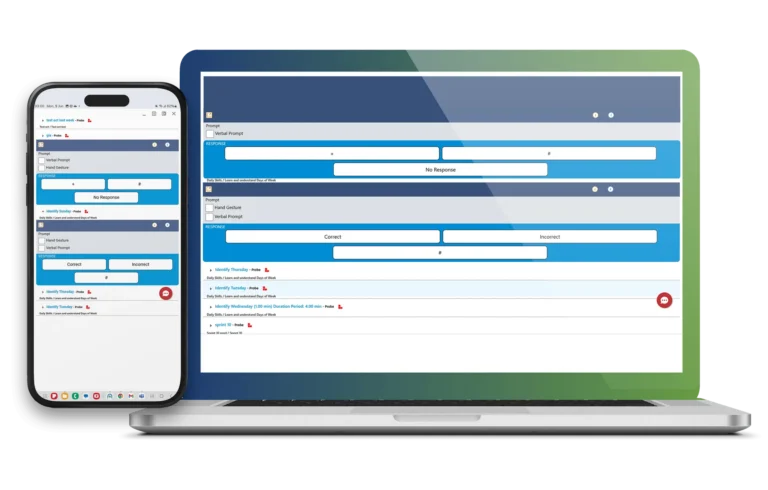
Modern platforms like Motivity and CentralReach have transformed behavior tracking, moving beyond static data entry to real-time response recording, therapist prompts, and automated progress graphs. AI analyzes this data to identify patterns in maladaptive behavior frequency, optimal reinforcement schedules, and predictive suggestions for goal adjustments. This allows clinicians to focus on therapy while supervisors gain immediate visibility into learner progress across locations. Machine learning models can detect subtle behavior trends, predicting skill plateaus or regressions, enabling BCBAs to intervene early. A 2022 exploratory study found that machine learning algorithms predicted ABA treatment recommendations with an accuracy of ~81-84% compared to clinician-prepared recommendations.
AI dashboards consolidate active cases, progress scores, and clinician notes into a unified, real-time view, improving quality oversight and data-driven supervision. In documentation, AI-powered tools summarize session notes, transcribe dictations, and auto-populate data fields, cutting documentation time by as much as 40-60%. This efficiency frees up valuable clinician hours and supports accurate billing and compliance audits.
Operationally, comprehensive platforms integrate scheduling, HR, payroll, and billing. AI personalization predicts staffing gaps, forecasts cancellations, and optimizes clinician utilization. AI-driven Revenue Cycle Management (RCM) systems detect missing CPT modifiers, identify claim risks, and learn payer patterns, leading to 30-40% fewer denials, faster claim turnaround, and improved net collection rates. AI scheduling algorithms consider therapist credentials, travel distance, and learner availability to build optimized calendars, with some platforms reporting 25-30% fewer no-shows after implementation. AI billing engines verify claims against payer rules, cross-check documentation, and validate codes automatically, accelerating processing and improving accuracy. AI bots automate insurance eligibility verification and prior authorizations in seconds, eliminating hours of manual work and preventing costly service delays. Predictive denial management uses machine learning to forecast risky claims and recommend corrections before submission, potentially reducing claim denials by up to 50%.
Two studies highlight AI’s potential: one involving 29 children with ASD demonstrated ML models achieving ~82.9% commonality for domain codes and ~84.1% for target codes with clinician-prepared plans, showing high mastery rates for ML-recommended targets. Another study in a rheumatology clinic compared AI rule engines to traditional insurer processes for prior authorizations. The AI engine found ~95% of investigation requests appropriate within a minute, compared to 82.9% approved by insurers, with 29.2% of insurer requests requiring further queries. For medication authorizations, the AI matched every diagnosis and treatment plan, while insurers approved 81.3%, with 18.6% pending and an average delay of ~5 days for queries. Both studies underscore AI’s ability to enhance personalization and operational efficiency.
Practical Applications
When evaluating AI tools for 2026, ABA practices should prioritize seamless integration. Tools must connect with existing Electronic Medical Record (EMR) or ABA data systems, scheduling, billing, and ideally, payer/eligibility platforms, utilizing APIs and open architecture to prevent data silos. Practices should look for real-time alerts for clinician utilization, eligibility lapses, or claim issues, and automated workflow actions, such as suggesting interventions when progress plateaus or alerting staff when eligibility expires.
It is crucial that the platform is designed specifically for ABA therapy, supporting unique workflows like prompt fading, mastery criteria, token systems, and caregiver participation, while aligning progress tracking, billing codes, and documentation with ABA-specific payer requirements. The solution should connect clinical progress with financial outcomes, demonstrating measurable ROI through reduced denials, faster reimbursements, or improved clinician utilization. Finally, practices must ensure the chosen solution is HIPAA compliant, scalable, and supported by robust vendor training and support.
Fast Facts
| Key Point | Why It Matters for ABA |
|---|---|
| AI cuts documentation time by 40-60% | Frees up clinician time for direct client care and supervision, reducing burnout. |
| AI-driven RCM reduces denials by 30-40% | Improves revenue predictability and cash flow, allowing reinvestment in clinical quality. |
| AI scheduling reduces no-shows by 25-30% | Increases revenue consistency and optimizes clinician utilization, enhancing practice stability. |
Expert Perspective
Personalization in ABA is expanding to mean personalizing the experience for your entire ecosystem: clients, families, clinicians, and administrative teams.
Source: behavioralproz.com